


French Garniture De Cheminee
These french garniture de cheminee sets are matching mantelpieces of clocks and flanking candelabras or urns, chosen to anchor a room with classical symmetry.
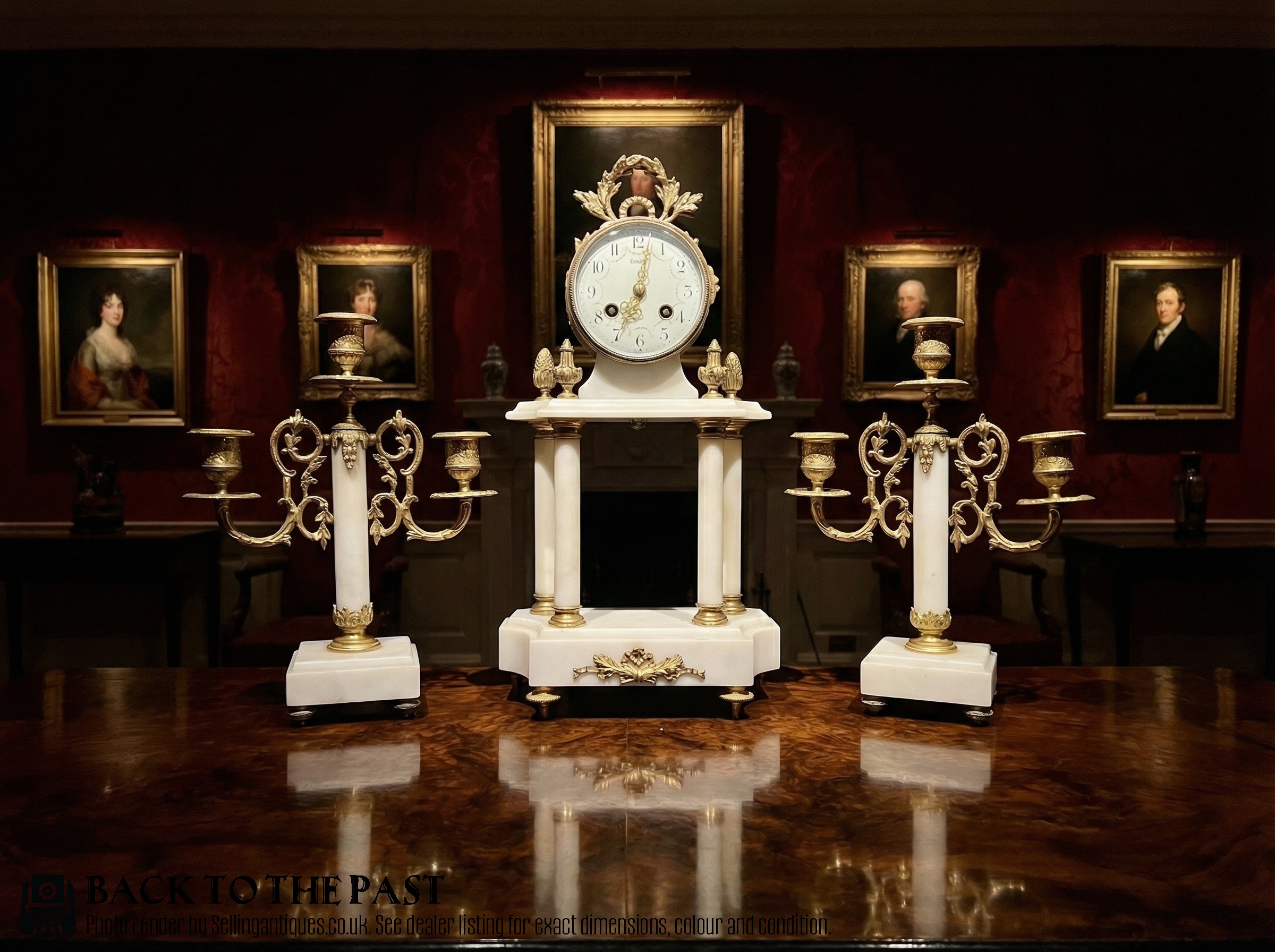
French Garniture De Cheminee
A french garniture de cheminee comprises a central mantel clock accompanied by two matching side pieces, such as candelabras or urns, designed to sit together on a fireplace mantel. Most examples on this page date from the nineteenth century, drawing heavily on Louis XVI and Louis XV revival styles.
The configurations vary from porcelain and enamel designs to substantial architectural compositions in marble and ormolu. Buyers encounter complete three-piece sets that maintain strict stylistic harmony across the clock and its companion pieces.
Originating primarily from French workshops, these sets reflect the ornate interior decorative schemes of their respective periods, ranging from Victorian interpretations to strict neoclassical revivals.

How they were made
Makers utilised cast bronze, often finished with fire-gilded ormolu, combined with white or coloured marble to build heavy, durable structures. Enamel and porcelain plaques frequently decorate the clock dials and body panels.
Intricate metalwork involves detailed chasing and casting of decorative motifs such as cherubs, floral garlands, and classical scrolling. Stonemasons cut and polished the marble bases to support the considerable weight of the metal mounts.
French Garniture De Cheminee Retail Price Guide 2026
Typical asking prices for french garniture de cheminee among the pieces listed under this phrase on Sellingantiques today, from the lower quarter to the upper quarter. They describe what is for sale here now, not the wider market.
Listings feature materials including enamel, gilt bronze, ormolu, brass, marble, white marble, bronze, and glass.
What varies in quality
The refinement of the bronze chasing and the crispness of the ormolu gilding separate standard production from exceptional pieces. Superior sets display deeply etched detail and substantial metal weight rather than shallow stamping.
The selection and preparation of the marble also dictate value, with flawless, finely veined stone indicating superior craftsmanship. Furthermore, the inclusion of named maker signatures on the movements elevates the standing of the entire garniture.
H Luppens Paris·Raingo Fres Paris·Ferdinand Berthoud
The French Garniture De Cheminee Glossary
- Garniture de cheminee
- A matching decorative set designed for the mantelpiece, typically consisting of a central clock and two side ornaments. This French term translates literally to fireplace furniture.
- Ormolu
- Gilt bronze produced by applying a finely ground high-carat gold-mercury amalgam to a bronze object and heating it. This technique creates a rich, durable golden surface.
- Candelabra
- Branched candlesticks designed to hold multiple candles, frequently supplied as the matching side pieces in a clock garniture. They mirror the decorative style and materials of the central clock.
- Louis XVI Style
- A neoclassical design movement characterised by straight lines, symmetry, and classical Roman or Greek motifs. It stands in contrast to the earlier, more fluid curves of the Rococo style.
French Garniture De Cheminee: Frequently Asked Questions
What pieces make up a garniture?
A standard garniture consists of a central mantel clock accompanied by a pair of matching side pieces. These companions are usually candelabras, urns, or vases.
All three items share identical materials, styles, and decorative motifs to create a unified display across a mantelpiece.
How do I date these clock sets?
Dating relies heavily on the stylistic clues present in the mounts, the shape of the marble case, and the materials used. Nineteenth-century examples often revive earlier Louis XVI or Rococo aesthetics.
Examining the clock movement and any maker signatures stamped on the backplate also provides a reliable production window.
Where should I display a garniture?
These sets are traditionally proportioned to sit on a fireplace mantel, where the central clock is flanked symmetrically by the two matching objects. They also function effectively on large sideboards or console tables.
Due to their substantial weight and use of marble and bronze, they require a sturdy, level surface.
Are the side pieces always functional?
The side pieces often function as candelabras designed to hold real candles, though many serve a purely decorative purpose as ornamental urns. The paired items complete the visual symmetry of the arrangement.
Their primary role is to balance the visual weight of the central clock.