
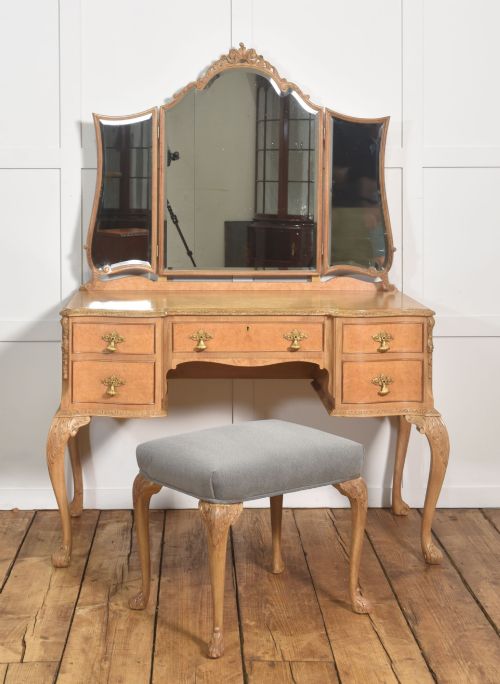


Walnut Vanity Unit
A walnut vanity unit brings warm grain and classic utility to the bedroom, and these pieces span Victorian washstands to Art Deco dressing tables.
Walnut Vanity Unit
A walnut vanity unit covers both antique dressing tables and marble top washstands made from walnut, burr walnut, and painted walnut. Buyers searching this phrase meet everything from Victorian Duchess dressing tables to Art Deco pedestal dressing chests.
The selection on this page ranges across the nineteenth century, the Edwardian period, and the nineteen-thirties. Forms include pieces with triple mirrors, swing mirrors, and tiled washstands with marble tops.
Makers and workshops represented include Maurice Adams, Harry and Lou Epstein, and Maples. Styles stretch from Victorian and Aesthetic Movement to Cotswold School, Queen Anne Revival, and Dutch Marquetry.
How they were made
Makers utilised solid walnut and burr walnut veneers over structural timbers, often selecting figured grains for drawer fronts and mirror frames. Marquetry panels added pictorial detail to continental examples.
Functional surfaces incorporated inset marble tops and glazed tiles on washstands, whilst dressing tables relied on bevelled mirror glass, brass fittings, and occasional fabric elements.
Materials recur in walnut, burr walnut, marble, mirror glass, and ceramic tiles.
What varies in quality
The selection of timber veneer determines much of the visual impact, with burr walnut offering complex patterns superior to plain boards. Cabinetmaking skill shows in the neatness of dovetails and the crispness of applied marquetry.
Design ambition separates standard bedroom furniture from pieces attributed to notable workshops like Maples or the Epstein brothers. Retaining original hardware, glass plates, marble slabs, and tiled splashbacks elevates a piece.
Maurice Adams·Harry and Lou Epstein·Maples
The Walnut Vanity Unit Glossary
- Burr walnut
- A veneer taken from the gnarled growth of a walnut tree, highly prized for its swirling, decorative grain patterns. It turns up frequently on nineteenth-century and Art Deco dressing chests.
- Duchess dressing table
- A grand nineteenth-century dressing table style featuring a large central mirror flanked by smaller mirrors or trinket drawers. These often sit above a serpentine lower section.
- Washstand
- A bedroom cabinet designed to hold a basin, typically topped with marble and fitted with tiled splashbacks before the widespread adoption of plumbed bathrooms.
- Marquetry
- The art of applying small pieces of veneer to form decorative pictures or geometric patterns. Dutch examples showcase floral and botanical motifs.
- Pedestal dressing table
- A form where twin banks of drawers support the main writing or grooming surface, popular during the Art Deco period.
Walnut Vanity Unit: Frequently Asked Questions
What is a walnut vanity unit?
A walnut vanity unit is a term used for antique dressing tables, washstands, and grooming chests made from walnut timber. They combine practical storage with mirrors or marble surfaces for daily use.
These pieces date from the nineteenth century through to the nineteen-thirties, covering styles like Victorian, Edwardian, and Art Deco.
How do I date a walnut dressing table?
Dating relies on stylistic clues, construction methods, and hardware. Victorian pieces often feature heavy proportions and mirror supports, whereas Art Deco examples display geometric lines and burr walnut veneers.
Pinned or dovetailed drawer construction and the style of the mirror frame also help pinpoint the decade of manufacture.
Were these used for washing or grooming?
Some pieces on this page started life as washstands with marble tops and tiled backs for holding basins and ewers. Others were built specifically as dressing tables with mirrors for personal grooming.
Many washstands now find a second life as hallway consoles or bathroom sink surrounds.
How do I care for antique walnut furniture?
Protect walnut surfaces from direct sunlight and excessive moisture to prevent timber movement and veneer lifting. Regular dusting with a soft, dry cloth maintains the polish without chemical buildup.
Wax can be applied sparingly to nourish the wood and preserve the depth of the grain.