
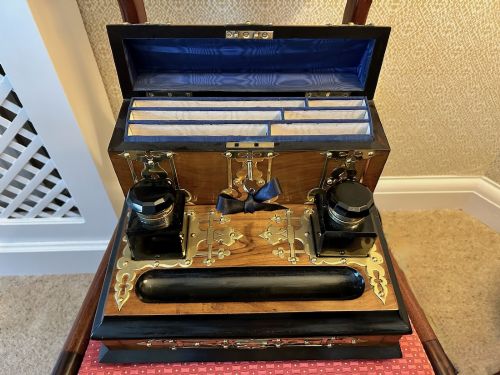
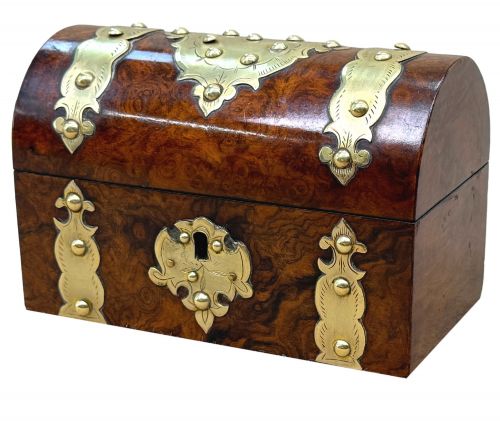


Walnut Stationery Casket
A walnut stationery casket organises the desk with figured timber and brass, offering a tactile piece of Victorian craftsmanship for daily use.
Walnut Stationery Casket
A walnut stationery casket provides a dedicated repository for letters and writing paper upon the Victorian desk. These pieces generally date from the mid to late nineteenth century, spanning decades such as the eighteen-fifties, sixties, and eighties.
The most common formats on this page are domed stationery boxes and desk-top caskets constructed from walnut, burr walnut, and figured walnut. Alongside traditional boxes, variations include sound desk stands and items featuring Tunbridge ware or hand-painted porcelain plaques.
Makers such as Trussell Brighton produced notable examples during this period. These accessories form part of a broader category of nineteenth-century desk accessories designed for the domestic interior.
Materials and construction methods
Makers constructed these caskets using solid walnut, burr walnut, and figured walnut, often applied as veneers over mixed hardwood foundations. Surfaces frequently receive reinforcement and decorative contrast from brass mounts, bands, and bound edges.
Interiors and functional elements incorporate diverse materials including porcelain, silk, and glass to hold inkwells or organise paper compartments. Specialised decorative techniques such as Tunbridge ware appear on select pieces, adding intricate mosaic patterns to the exterior.
Listings feature Victorian pieces predominantly dated to the eighteen-fifties, sixties, and eighties, constructed from walnut, burr walnut, and figured walnut.
Factors that distinguish quality
The choice of timber underpins the visual appeal of a walnut stationery casket, with highly figured burr walnut and carefully matched veneers marking out superior examples. Finer pieces integrate high-grade brass mounts and specialised decorative elements like hand-painted porcelain or mosaic woodwork.
Construction precision dictates the longevity of these desk accessories, particularly in the alignment of domed lids and the stability of fitted internal partitions. Pieces carrying attribution to known makers or specific retailers generally demonstrate higher standards of workmanship.
Trussell Brighton
The Walnut Stationery Casket Glossary
- Burr walnut
- A prized timber harvested from the irregular growths of the walnut tree, showing swirling grain patterns. It is sliced into thin veneers for decorative furniture and boxes.
- Stationery box
- A desk accessory designed to hold writing paper, envelopes, and correspondence. These containers usually feature internal tiered partitions for organisation.
- Tunbridge ware
- A form of decorative woodwork originating from Tunbridge Wells, characterised by mosaic patterns made from many small pieces of natural coloured woods.
- Brass bound
- A construction method where brass strips reinforce the edges and corners of a wooden box. This provides both structural durability and visual contrast against the dark timber.
Walnut Stationery Casket: Frequently Asked Questions
What is a walnut stationery casket?
A walnut stationery casket is a Victorian desk box built to hold writing paper and envelopes. These containers reflect the formal correspondence habits of the nineteenth century.
Craftsmen utilised walnut and burr walnut veneers, often enhancing the exteriors with brass mountings and fitted internal compartments for organisation.
How were these caskets used?
Users placed these boxes on desks and writing tables to keep writing materials neat and protected from dust. The tiered interiors held envelopes, sheets of paper, and sometimes small ledgers.
Many examples included integrated spaces for inkwells and stamps, serving as central hubs for household letter writing.
How do I date a walnut stationery casket?
Dating relies on stylistic clues, construction techniques, and materials recorded across the Victorian era. Pieces from the eighteen-fifties and sixties often feature domed lids and heavy brass mounts.
Later examples from around eighteen-eighty show subtle shifts in proportion and decorative motifs, while specific makers or retailers occasionally stamp their work.
How do I care for burr walnut?
Burr walnut requires stable environmental conditions away from direct sunlight and strong heat sources. Excessive dryness can cause delicate veneers to lift or crack over time.
Occasional dusting with a soft, dry cloth maintains the finish without stripping the natural oils of the timber.