

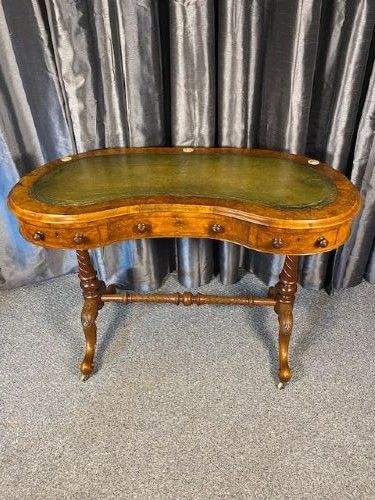
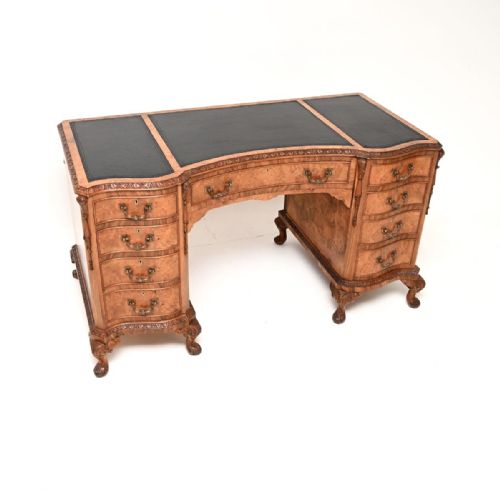
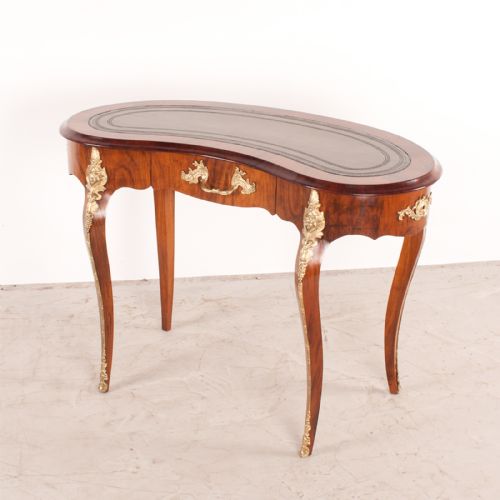


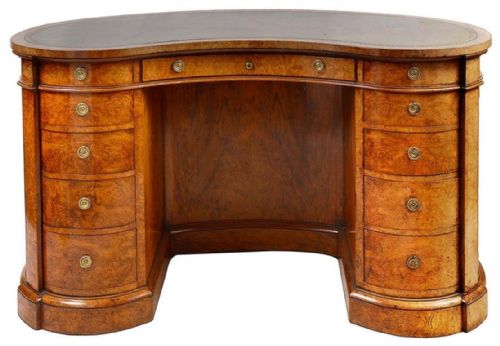


Walnut Kidney Desk
A walnut kidney desk brings a curved silhouette and figured timber to a study, offering a distinct writing surface shaped for the user.
Walnut Kidney Desk
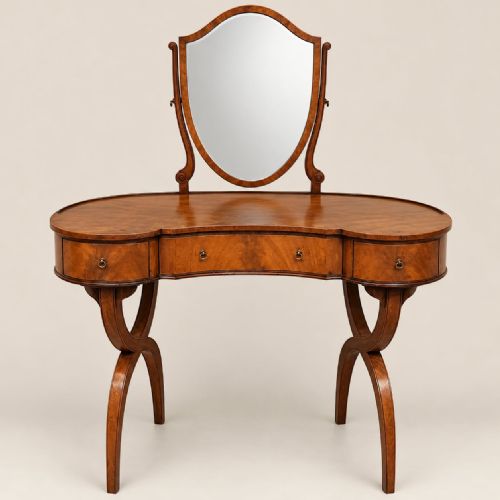
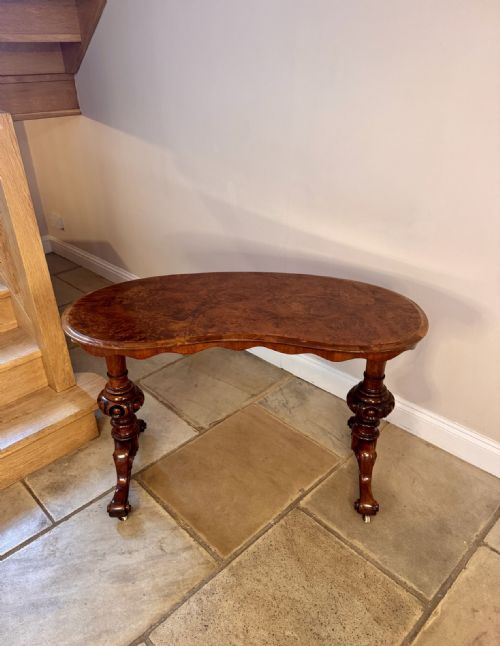
A walnut kidney desk presents a distinctive curved top designed to wrap slightly around the person seated at it. These tables appear most frequently from the Victorian period through to the early twentieth century, constructed as freestanding writing desks or lighter occasional writing tables.
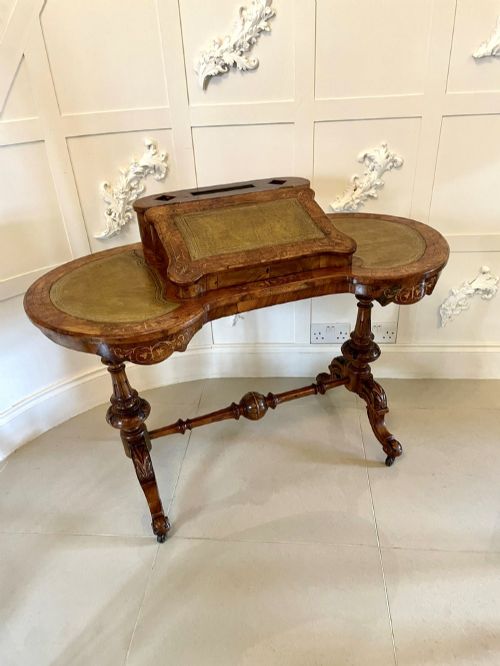
Makers shaped these pieces with a concave front edge, allowing the user to sit closer to the centre. The evidence shows versions incorporating leather writing surfaces, fitted drawers and occasional gallery or davenport tops.
Materials and Construction
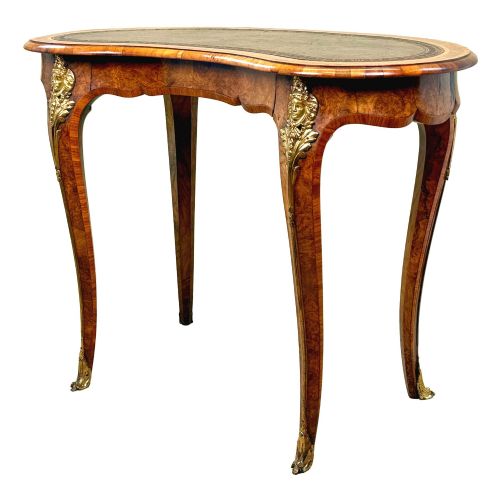
Craftsmen built these desks using walnut and burr walnut veneers, selected for their rich, swirling grain patterns. Many examples incorporate marquetry inlay, brass mounts and ormolu detailing to accentuate the curved outlines.
Writing surfaces are frequently inset with tooled leather, while internal structures utilise solid walnut and secondary timbers. Ormolu mounts and brass handles provide functional accents that follow the sweeping contours of the frame.
Walnut Kidney Desk Retail Price Guide 2026
Typical asking prices for walnut kidney desk among the pieces listed under this phrase on Sellingantiques today, from the lower quarter to the upper quarter. They describe what is for sale here now, not the wider market.
Some desks even incorporate a davenport top, proving that Victorian cabinetmakers loved a compartment within a compartment.
Quality Variations
The distinction between tiers rests on the choice of timber veneer and the precision of the marquetry. Superior examples display carefully matched burr walnut across the curved top and drawer fronts, while simpler versions rely on plain walnut surfaces.
Construction detail also separates standard production from finer work, visible in the execution of the curved drawer sides and the quality of the cast ormolu mounts. The integration of freestanding finished backs indicates a desk intended to sit centrally in a room.
Gillows·Maurice Adams·Laszlo Hoenig·Waring & Gillows
The Walnut Kidney Desk Glossary
- Burr walnut
- Timber taken from a growth or burl on a walnut tree, yielding highly figured and convoluted grain patterns. This material is prized for veneer work on high-end Victorian furniture.
- Bureau-plat
- A flat-topped writing table, often freestanding with drawers, originating in France. These tables frequently feature ormolu mounts and leather writing inserts.
- Marquetry
- Decorative inlay work using various coloured woods to form pictorial or geometric patterns on a surface. It appears on the top panels of many nineteenth-century writing tables.
- Ormolu
- Gilded bronze or brass used for decorative mounts and fittings on furniture. It adds metallic contrast to the dark walnut timber.
Walnut Kidney Desk: Frequently Asked Questions
What is a walnut kidney desk used for?
These pieces serve primarily as writing tables or decorative freestanding desks in a study or drawing room.
The curved front allows the user to sit comfortably in the centre while keeping stationery within reach.
How do I date a walnut kidney desk?
Dating relies on stylistic markers and construction methods, with many examples originating in the Victorian era and the nineteenth century.
Later pieces span the Art Deco period up to the nineteen-twenties, showing shifts in inlay and hardware design.
Are these desks finished on the back?
Many surviving examples are freestanding, meaning the back is polished and finished with veneer or inlay just like the front.
This allows the desk to sit in the middle of a room rather than flat against a wall.
What is the difference between a desk and a writing table?
Writing tables often feature lighter proportions and occasional table framing, while desks may incorporate pedestals or more substantial drawer configurations.
Both types share the characteristic curved kidney silhouette seen across these listings.