




Walnut Demilune Console Table
A walnut demilune console table brings architectural grace to a hallway, and these half-round surfaces range from restrained Georgian forms to elaborate Victorian and revival pieces.
Walnut Demilune Console Table
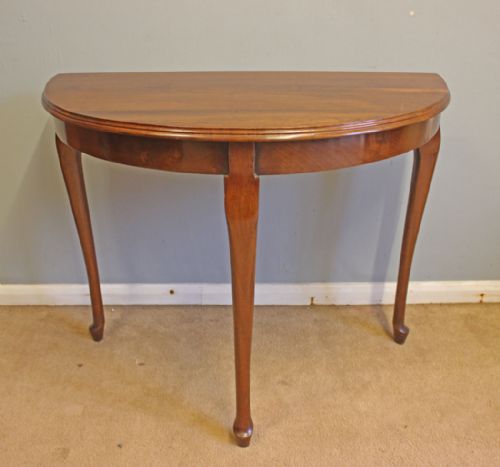
A walnut demilune console table is a half-round piece designed to stand flat against a wall, frequently serving multiple functions as a card, games or side table. Buyers look for this form to maximise surface area in narrow spaces without blocking a room.
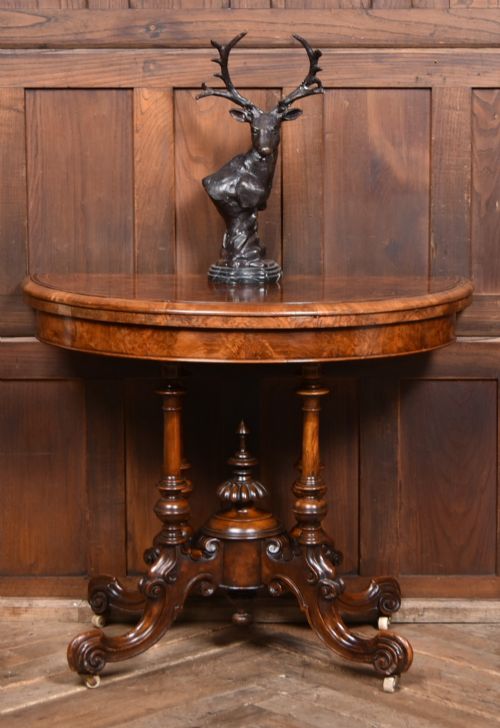
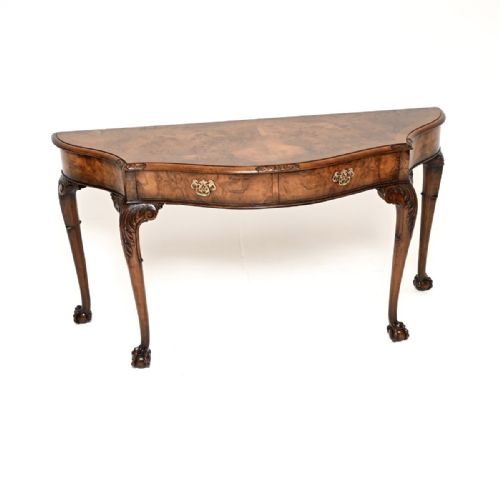
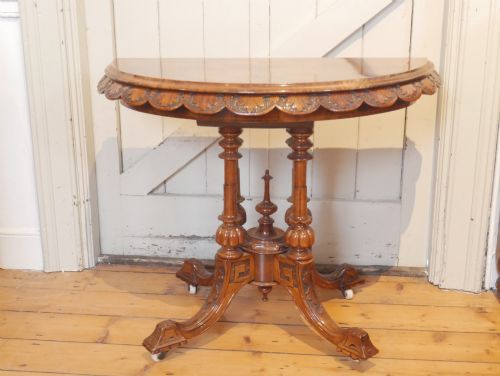
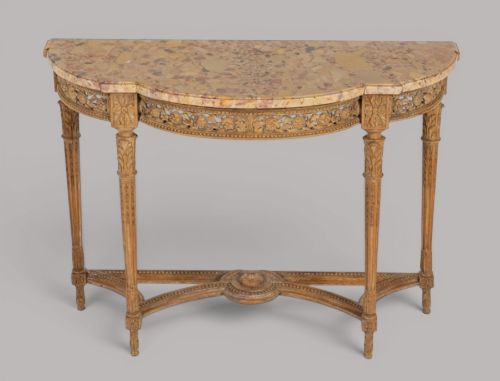
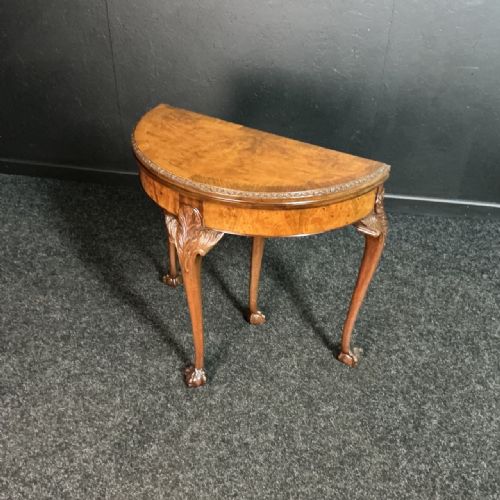
The selections available here span from eighteenth-century Italian Baroque and Louis XVI examples to nineteenth-century Victorian pieces and early twentieth-century Queen Anne Revival furniture. The most common versions encountered are fold-over card tables and console tables finished in burr walnut veneer.
Makers utilised timber, marble tops, brass fittings and floral marquetry inlay across different eras. Pieces appear singly or as pairs, reflecting formal domestic arrangements from the eighteenth century onwards.
How they were made
Cabinet makers constructed these tables using solid timber frames overlaid with burr walnut veneer to create highly figured, decorative grain patterns across the semicircular top. Crossbanding and floral marquetry were frequently applied to enhance the visual depth of the wood.
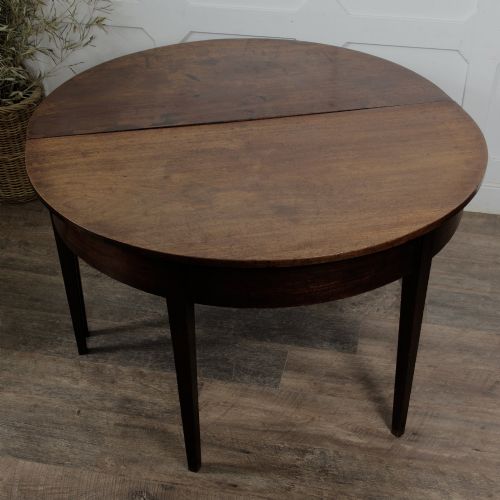
Marble tops appear on select eighteenth-century and nineteenth-century console tables, providing a heavy, durable surface supported by carved wooden frames. Folding mechanisms for games and card tables relied on pivoting or swing-leg supports hidden beneath the fold-over top.
Listings span from the 18th Century through to the 1930s, featuring materials such as marble, brass, and burr walnut veneer.
What varies in quality
The quality of a walnut demilune console table depends heavily on the selection and matching of the burr walnut veneer across the semicircular top. Superior pieces display harmonious, symmetrical grain patterns that flow seamlessly when the table is opened for games.
Carving detail and timber selection dictate the tier of a piece, separating mass-produced revival furniture from finely worked eighteenth-century and Victorian examples. The structural integrity of the folding mechanisms and the crispness of inlaid marquetry further separate standard pieces from the finest output.
The Walnut Demilune Console Table Glossary
- Demilune
- Half-moon shape, describing tables designed with a flat edge for placement against a wall. This profile became popular in the eighteenth century for maximising floor space in formal rooms.
- Burr walnut
- Timber taken from a tree growth or burl, yielding swirling, knotty grain patterns. Cabinet makers prized this wood for decorative veneering on tabletop surfaces.
- Fold-over
- A hinged tabletop construction that opens to double its surface area, frequently concealing a baize-lined interior for card games. This dual-purpose design was standard for eighteenth and nineteenth-century entertaining.
- Marquetry
- The art of applying small pieces of veneer to form decorative patterns and pictorial designs. Floral motifs are commonly inlaid into the walnut surfaces of Victorian tables.
- Console table
- A table supported against a wall by consoles or legs, designed primarily for display rather than heavy utility. Earlier examples often featured marble tops and elaborate carving.
Walnut Demilune Console Table: Frequently Asked Questions
How do I use a demilune table?
These half-round tables sit flat against a hallway or reception room wall, holding decorative objects or lamps without obstructing walkways.
Many examples incorporate folding tops that swing open to create a full surface for card games and social gatherings.
Are these tables original or revival pieces?
The selection includes authentic eighteenth and nineteenth-century antiques alongside early twentieth-century Queen Anne Revival furniture.
Checking the construction methods, timber ageing and hardware helps determine the exact period of manufacture.
What is burr walnut veneer?
Burr walnut is a decorative wood slice taken from knotted tree growths, producing intricate, swirling grain patterns across the tabletop.
Cabinet makers applied these thin layers over solid timber frames to achieve high visual impact.
Do these tables come as pairs?
Several listings feature matched pairs of demilune console tables, which were originally manufactured to flank a fireplace or architectural doorway.
Single tables also appear frequently for standalone placement in smaller rooms.