




Burr Walnut Foldover Table
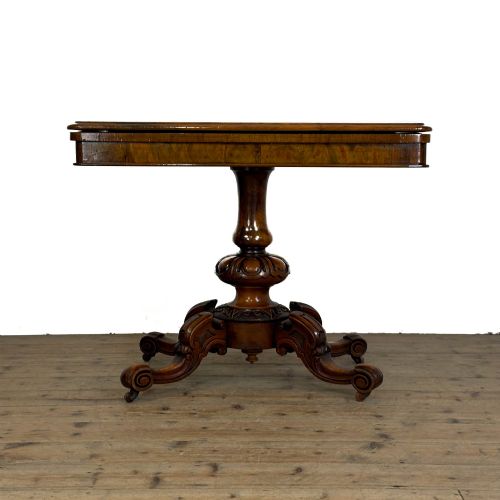
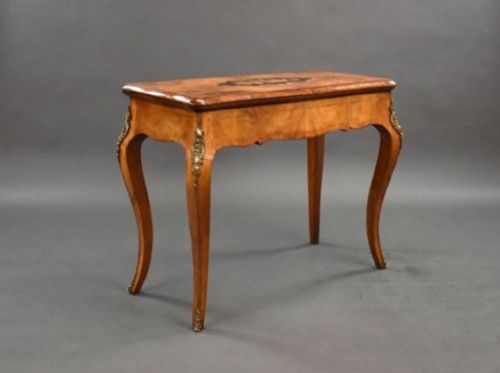
These burr walnut foldover tables combine rich timber figuring with ingenious folding tops designed for cards and games.
Burr Walnut Foldover Table
A burr walnut foldover table is a piece of furniture engineered with a hinged top that opens to reveal a baize-lined surface for cards or board games. These pieces emerge predominantly from the Victorian era, spanning the mid-nineteenth century with occasional later revivals in Queen Anne and George II styles.
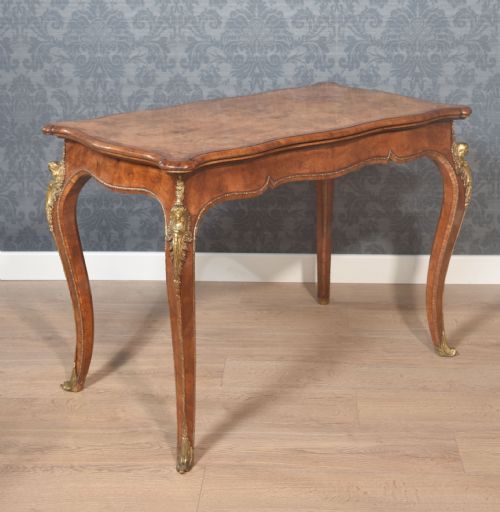
The form exists primarily as card tables and games tables, often featuring serpentine contours or butterfly shapes. Most examples rely on walnut and burr walnut veneers, occasionally complemented by mahogany and ebonised wood.
Makers utilised marquetry and boxwood inlay to decorate the surfaces, whilst structural elements incorporated brass and ormolu mounts. The underlying construction supports the folding leaf, which swings open to double the surface area.
How they were made
Cabinetmakers selected highly figured burr walnut veneers for the primary visual impact, laying them over secondary timbers such as mahogany. They applied boxwood inlay and marquetry directly into the veneer panels to create geometric and floral motifs.
The folding mechanism required precise joinery to ensure the swivel or foldover top aligned flush when closed. Ormolu mounts and brass hinges provided the necessary mechanical support and decorative accentuation.
Materials recorded across these tables include walnut, burr walnut, mahogany, brass, ormolu, and ebonised wood, frequently decorated with boxwood inlay and marquetry.
What varies in quality
Quality rests in the intensity and selection of the burr walnut figuring across the top and frieze. Finer examples display symmetrical veneer matching that flows continuously when the table is closed.
The crispness of the marquetry inlay and the execution of boxwood stringing differentiate standard production from superior pieces. Structural flourishes, such as carved bases or serpentine shaping, demand greater joinery skill.
Edwards & Roberts·S&H Jewell
The Burr Walnut Foldover Table Glossary
- Burr walnut
- Timber taken from the wart or growth on a walnut tree, yielding highly decorative swirling grain patterns. This veneer forms the visual signature of these tables.
- Foldover top
- A hinged surface that pivots or folds back to double in size, revealing a playing surface beneath. It defines the dual-purpose nature of the furniture.
- Marquetry
- Decorative inlay work using various woods to form pictorial or geometric patterns on the table surface. Craftsmen set these thin veneers into the primary timber.
- Ormolu
- Gilded bronze used for decorative mounts and accents on nineteenth-century furniture. It provides a bright metallic contrast to the dark walnut tones.
- Serpentine
- A furniture contour characterised by a curved line that undulates inward and outward. This shaping requires careful cutting of the solid timber and veneer.
Burr Walnut Foldover Table: Frequently Asked Questions
How do burr walnut foldover tables work?
The top surface comprises two matched leaves hinged together or mounted on a pivoting mechanism. Opening the leaf reveals a concealed well or a baize-lined playing area.
When closed, the table functions as a compact console or side table. The clever engineering hides the gaming purpose entirely until the top is lifted and turned.
What games were played on these tables?
Victorian households utilised these tables primarily for card games such as whist, cribbage, and quadrille. Many surfaces accommodated multiple pastimes.
Some variants specifically integrated chess and draughts boards into the playing surface. The baize lining provided a soft, non-slip surface for dealing cards and moving pieces.
How should I place a foldover table in a room?
Position the table against a wall in its closed position to serve as an accent piece beneath a mirror or artwork. This showcases the figured burr walnut top.
Ensure sufficient clearance around the table if you intend to open the leaf regularly. The pivoting action requires empty space to swing the top safely without obstruction.
How do I distinguish Victorian from later revival pieces?
Mid-nineteenth-century examples display authentic period construction methods, timber ageing, and hand-cut veneers. These often feature naturalistic walnut or burr walnut figuring.
Revival pieces from the early twentieth century often adopt Queen Anne or George II styling. Examining the secondary timbers and interior construction helps clarify the true age.