
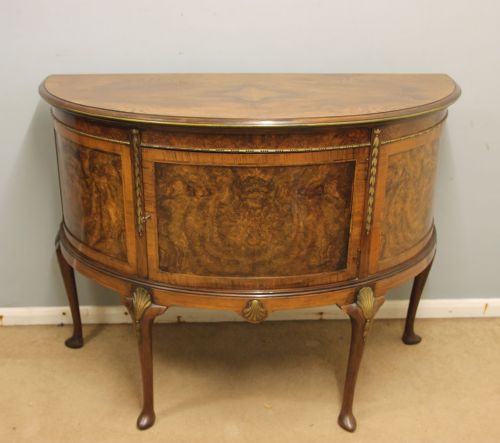
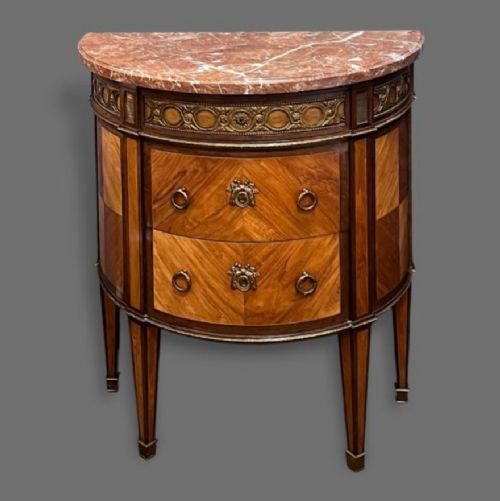
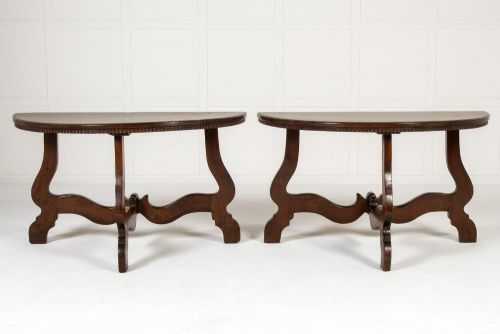


Walnut Demi Lune Table
A walnut demi lune table brings half-circle grace to a hallway or drawing room, offering flat-backed utility against a wall with the option to open for games or tea.
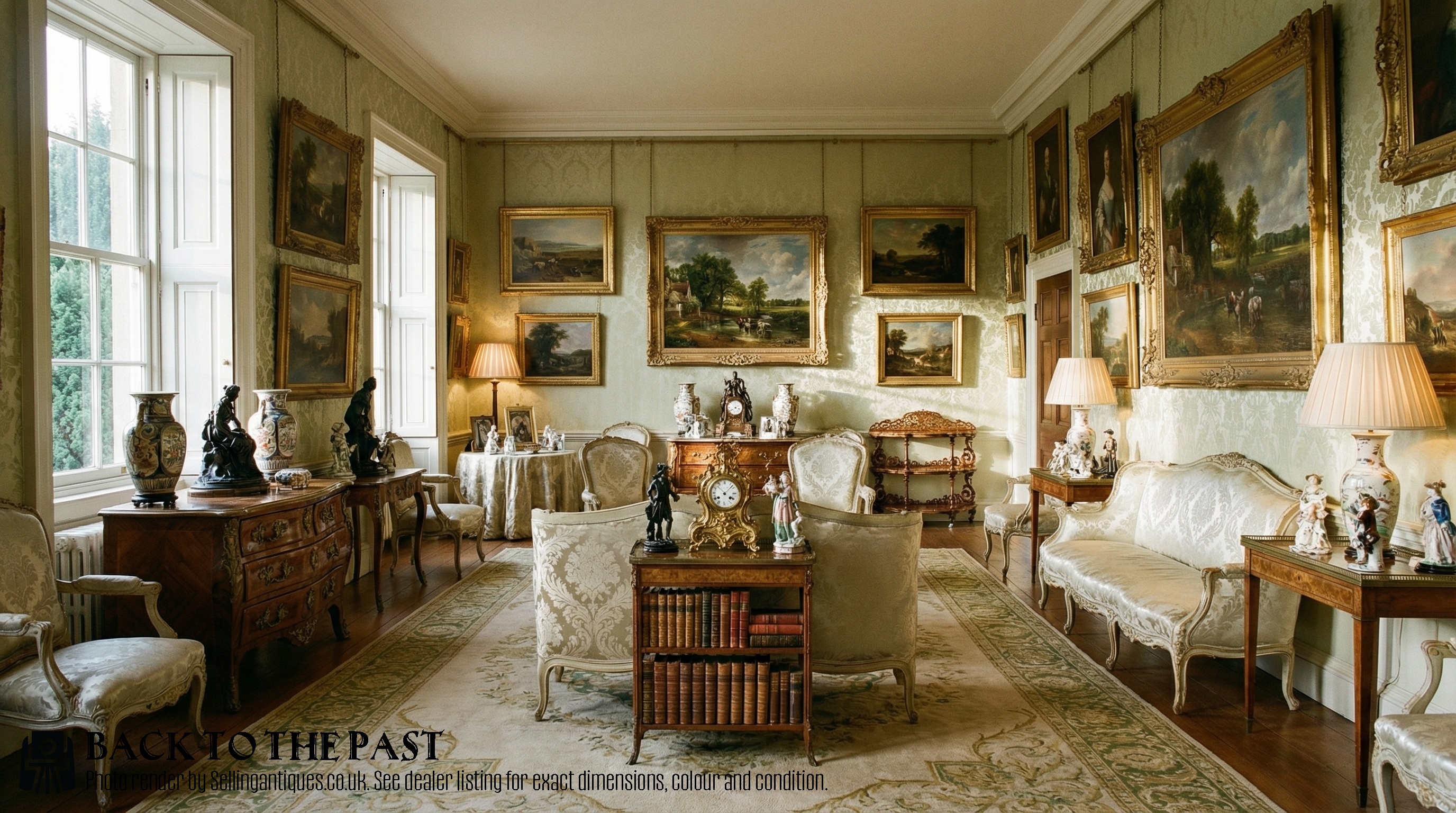
Walnut Demi Lune Table
A walnut demi lune table takes the form of a half-moon, designed to sit flush against a wall while occupying minimal floor space in a reception room or entrance hall. These pieces appear frequently as fold-over card tables, console tables, and side cabinets across Victorian, Edwardian, and early twentieth-century periods.
The archive and current selection show a strong prevalence of card and games tables alongside console tables, often utilising figured burr walnut veneers. Examples range from eighteenth-century Italian and Georgian forms to later Queen Anne revival pieces and French-influenced designs.
How they were made
Cabinet makers constructed these tables using solid timber frames overlaid with walnut and burr walnut veneers, which were selected for their intricate grain patterns and warm brown tones. Marquetry inlay, brass mounts, and marble tops appear on select continental and neoclassical examples.
Folding mechanisms on card and games tables required precise pivot or gate-leg hinges to support the rotating or unfolding top safely when opened for play.
Many card tables conceal a shallow hidden well beneath the folding top, originally designed to store counters and packs of playing cards.
What varies in quality
The distinction between standard production and exceptional craftsmanship rests in the selection of the burr walnut veneer and the symmetry of its grain matching across the semi-circular top. Finer examples display crisp carving on the cabriole legs and solid structural integrity in the folding hinge mechanisms.
Provenance and maker attribution elevate certain pieces, particularly those bearing the marks of established cabinet-making firms, alongside original marble inserts and well-preserved polish.
Maple and Co·Pietro Ferrario·W.F. Greenwood and Sons York
The Walnut Demi Lune Table Glossary
- Demi-lune
- A French term meaning half-moon, describing furniture with a semicircular flat back and a curved front. This shape allows the piece to stand flat against a wall.
- Burr walnut
- Timber taken from a tree growth or burl, yielding swirling, highly figured grain patterns. Cabinet makers prized this wood for decorative veneering.
- Console table
- A table supported against a wall by consoles or legs, often used for display in halls or living spaces. These pieces match the architectural scale of a room.
- Fold-over top
- A hinged table surface that doubles in area when opened, commonly found on card and games tables. It rests on a swing leg or rotating pivot when in use.
Walnut Demi Lune Table: Frequently Asked Questions
How do I use a walnut demi lune table?
These pieces function primarily as console or side tables against a wall, holding lamps, mirrors, or decorative objects in a hallway or drawing room.
Many versions feature a fold-over top that swings open to create a larger surface for card games, tea, or writing when needed.
Where should I place a demi lune table?
The flat straight edge sits flush against a wall, making narrow hallways, landings, and entrance foyers ideal locations for saving floor space.
They also anchor living room walls beneath artwork or mirrors without extending too far into the walking area.
How do I tell Victorian tables from earlier ones?
Victorian examples often employ rich burr walnut veneers with heavier framing, reflecting mid-to-late nineteenth-century tastes and manufacturing methods.
Eighteenth-century and Georgian pieces typically show simpler solid walnut construction or different leg forms such as pad feet without Victorian embellishments.
How do I care for burr walnut surfaces?
Keep the timber away from direct sunlight and heat sources to prevent the burr walnut veneer from drying, fading, or cracking over time.
Dust regularly with a dry cloth and apply occasional traditional wax polish to maintain the sheen of the polished finish.