
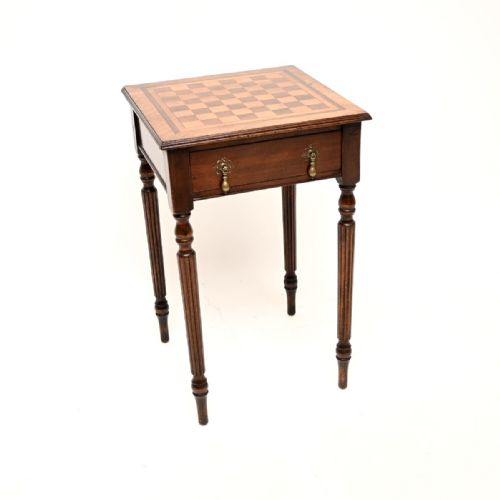
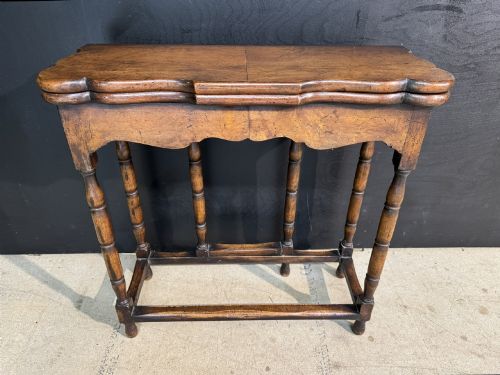


Vintage Walnut Card Table
A vintage walnut card table brings rich timber grain and clever folding surfaces together for both play and display.
Vintage Walnut Card Table
A vintage walnut card table serves as a dual-purpose surface designed for card games, tea, or general display when closed. These pieces trace back through several eras, most notably appearing in early twentieth-century interpretations of older designs.
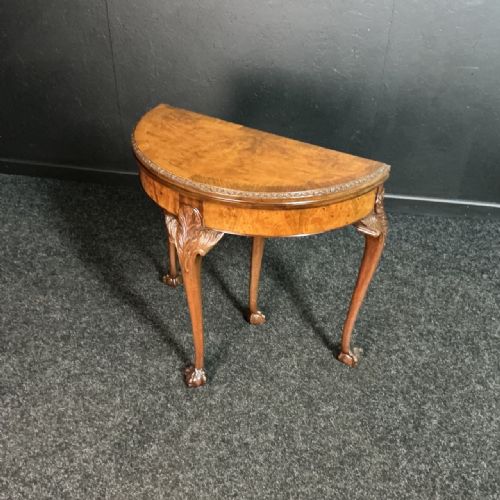
The most common version met on this page is the Queen Anne style folding card table executed in burr walnut. These examples often feature demi-lune or fold-over tops that conceal a baize-lined playing surface beneath.
Makers also produced games tables during the Art Deco period alongside Victorian pedestal centre tables adapted for entertainment. Origins span British workshops and French ateliers utilising classical marquetry inlay.
Evaluating craftsmanship
Quality rests in the selection of the walnut veneer and the precision of the fold-over mechanism. Superior tables maintain flush joints and smooth rotation when the top transforms from a side table to a games surface.
The refinement of the carving on the cabriole legs and the depth of the timber figuring separate standard production from finer workshop output.
Some tables hide secret compartments beneath the folding top, originally designed to store stray playing counters and ivory dice.
Epstein and Co
The Vintage Walnut Card Table Glossary
- Burr walnut
- A specialised timber cut from tree growths that yields intricate swirling grain patterns. This material is highly prized for veneering table tops.
- Baize
- A woolen felt fabric traditionally used to line gaming and card tables. It provides a soft, non-slip surface for cards and counters.
- Demi-lune
- A half-moon shape characteristic of folding card tables that sit flush against a wall when closed. Opening the top reveals a full circular or rectangular playing surface.
- Marquetry
- Decorative inlay work using various coloured woods to create pictorial designs on furniture surfaces. French tables frequently display this technique.
- Cabriole leg
- A furniture leg featuring a double curve modelled on animal limbs, terminating in a pad or claw foot. This form defines Queen Anne style pieces.
Vintage Walnut Card Table: Frequently Asked Questions
How do I open a folding card table?
Most models feature a pivoting top or a rear leg that swings out to support the opened leaf.
Take care to lift gently and check the hinges before applying weight to the unfolded surface.
What are these tables used for?
They function primarily as occasional side tables when folded shut against a wall.
Opening the top reveals a dedicated surface for card games, chess, or writing.
How do I care for walnut veneer?
Keep the timber away from direct sunlight and excessive heat sources to prevent the veneer from drying out.
Apply a quality wax periodically to maintain the lustre of the grain.
How do I distinguish different periods?
Victorian examples often incorporate heavy pedestal bases and elaborate carving.
Twentieth-century interpretations favour Queen Anne revival styling with slender cabriole legs and burr walnut surfaces.