
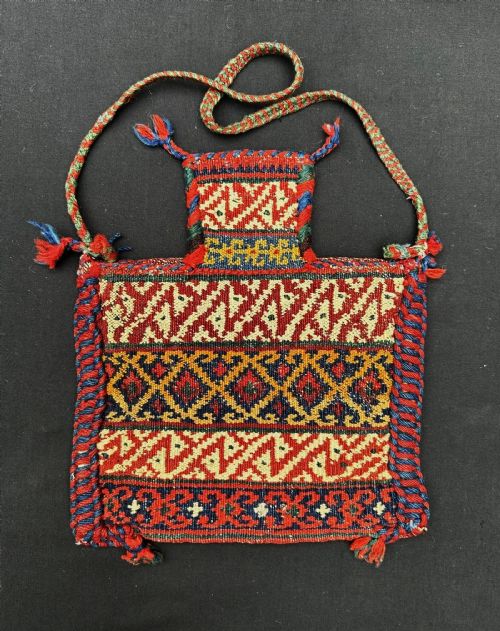
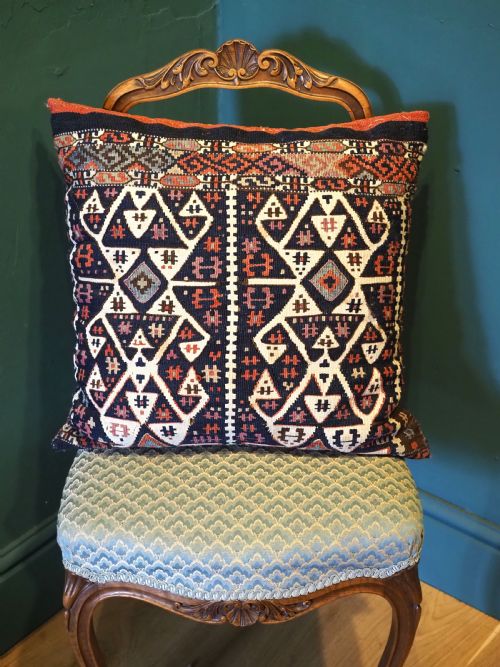
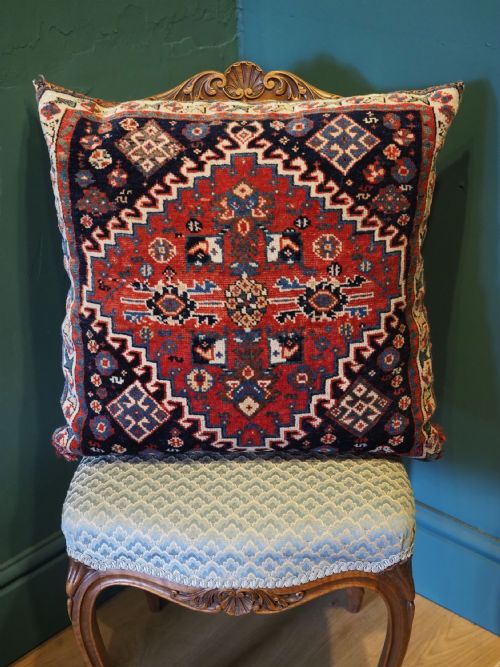


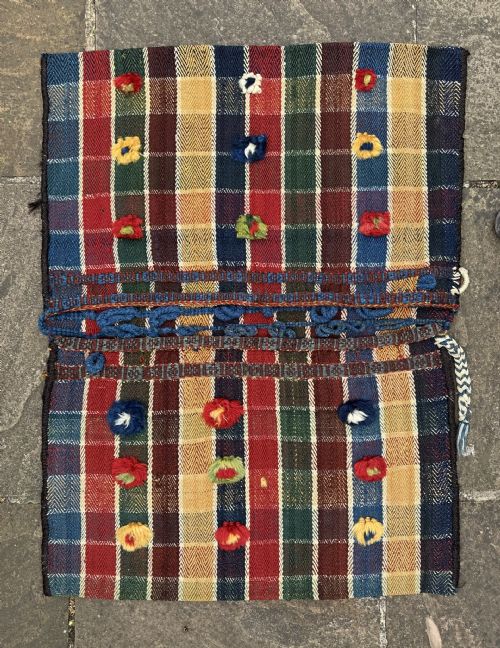
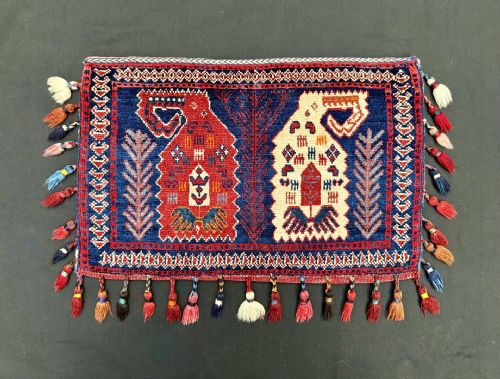


Vintage Tribal Saddle Bag
These vintage tribal saddle bag pieces are nomadic woven trappings offering rich patterns and tactile history for your floor or walls.
Vintage Tribal Saddle Bag
A vintage tribal saddle bag represents the utilitarian weaving of nomadic groups from Persia and Anatolia, made to transport belongings across difficult terrain. When you search for a vintage tribal saddle bag, you encounter full sets with their plain weave backs intact, half bags, and individual faces that have been carefully converted into cushions or rugs.
The pieces on this page span from the mid nineteenth century through to the early twentieth century, reflecting the traditional craft of regions such as Fars, Luristan, and Kerman. You will find specific tribal attributions including Qashqai, Afshar, Shahsavan, Luri, Tekke Turkmen, and Yuruk.
Forms range from tobacco and pipe bags to large khorjin sets and vanity bags. Each object carries the distinct geometric and medallion vocabulary of its maker, serving as a direct link to nomadic daily life.
Assessing quality in nomadic weavings
Quality rests on the density of the weave, the clarity of the tribal motifs, and the richness of the wool. Pieces utilising hand-spun wool with natural dyes display a luminous depth that synthetic colour simply cannot replicate.
Condition and completeness also govern the piece, distinguishing full sets with original backs from solitary bag faces or later cushion adaptations. Intact edges, minimal restoration, and strong structural integrity elevate an example within its type.
The listings span from 1850 to 1920, showcasing wool, cotton, leather, and natural dyes across Persian and Anatolian tribal traditions.
The Vintage Tribal Saddle Bag Glossary
- Khorjin
- A traditional double-sided saddle bag used by nomads for transport. These items feature two main compartments joined by a central slit web.
- Sumac
- A flatweave technique where pattern wefts are wrapped around the warp threads before passing to the next. This method creates a sturdy fabric with a ribbed surface resembling embroidery.
- Chuval
- A large tent bag produced by Turkmen tribes for household storage. They typically display multiple rows of guls on the face.
- Gul
- A medallion motif repeated across Turkmen and other Central Asian tribal carpets and bags. Each design often identifies a specific tribe or clan.
- Heybe
- The Turkish term for a saddle bag or double pouch used by nomadic groups in Anatolia. These pieces frequently combine kilim flatweave with knotted pile sections.
Vintage Tribal Saddle Bag: Frequently Asked Questions
How were tribal saddle bags originally used?
Nomads slung these double pouches over horses, camels, or donkeys to carry personal possessions, provisions, and household goods during seasonal migrations.
Once the group reached a campsite, the bags served as indoor storage containers for grain, bedding, and smaller valuables inside the tent.
How can I display a saddle bag at home?
Complete sets with their connecting webs can be hung securely on a wall as textile art, preserving their original construction.
Individual bag faces are frequently converted into floor cushions, footstools, or small accent rugs that bring rich texture to living spaces.
How do I tell different tribal designs apart?
Afshar and Qashqai weavers from Persia often favour repeated boteh motifs, bold medallions, and rich indigo or madder red fields.
Turkmen groups like the Tekke distinctively utilise orderly rows of guls, whereas Anatolian Yuruk and Kurdish pieces display heavier geometric abstraction.
What is the difference between a full bag and a bag face?
A full bag retains both front pile panels and the original plain weave back or connecting bridge used to drape over an animal.
A bag face is simply the decorative front section that survived after the plain weave back deteriorated or was removed for easier domestic use.