
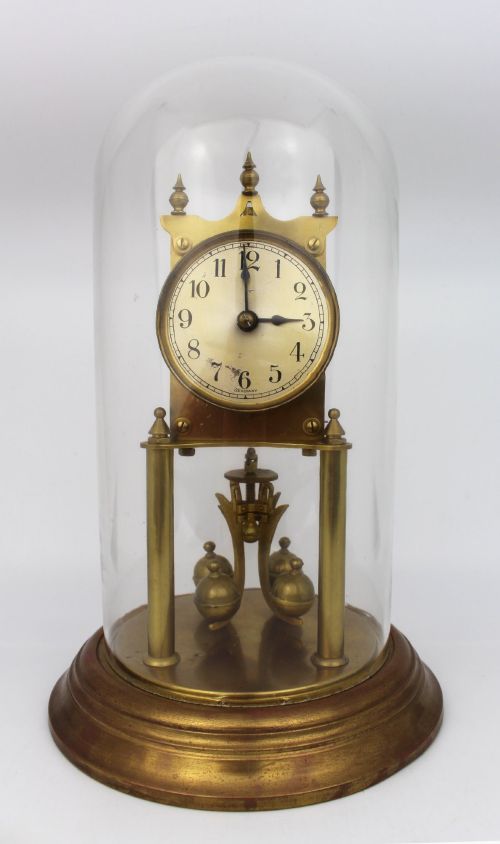


Vintage Torsion Clock
These vintage torsion clock pieces are mechanical marvels of timekeeping, desired for their mesmerizing rotating pendulums and precision engineering.
Vintage Torsion Clock
When you search for a vintage torsion clock, you encounter precision timepieces driven by a slow-rotating torsion pendulum rather than a traditional swinging one. The pieces available span from the Edwardian era through the mid-twentieth century, including German anniversary clocks and Swiss perpetual motion designs.
Mantel clocks dominate the selection, often housed beneath glass domes or bell-jar cases that protect the delicate mechanism while displaying the movement. You will find traditional horology examples alongside mid-century modern interpretations featuring round or square dials.
How they were made
Constructed primarily from brass and metal components, these timepieces utilise glass domes or bell-jar cases to enclose the intricate inner workings. Selected models feature rhodium plating or gold gilt finishes that add a polished metallic lustre to the exterior frame.
The horological movements incorporate specialised mechanisms such as the Swiss perpetual motion system, which responds to atmospheric temperature changes to wind the mainspring. Enamel dials and wooden bases appear across various designs, combining durable materials with traditional craftsmanship.
Temperature changes alone keep certain models wound, turning the weather into the keeper of time.
What varies in quality
The sophistication of the internal movement dictates the distinction between standard production and top-tier horology. Swiss perpetual motion calibres represent a higher tier of mechanical complexity compared to standard spring-driven models.
Material finishing separates simpler brass housings from rhodium-plated or gold-gilt editions. The presence of original packaging, paperwork, and clear maker signatures elevates the completeness and historical interest of an individual piece.
Jaeger Le Coultre·Le Coultre·Jaeger-LeCoultre
The Vintage Torsion Clock Glossary
- Torsion pendulum
- A suspended wheel or disk that rotates back and forth by twisting and untwisting a thin metal ribbon. This slow oscillation allows the clock to run for months on a single winding.
- Anniversary clock
- A type of torsion clock traditionally designed to run for a full year without rewinding. These often feature decorative pillars and glass domes.
- Bell-jar case
- A bell-shaped glass cover placed over a timepiece to protect the delicate torsion mechanism from dust and air currents. It provides an unobstructed view of the rotating pendulum.
- Perpetual motion
- A mechanical system that uses ambient temperature fluctuations to maintain the mainspring tension without manual winding. It keeps the timepiece running continuously.
Vintage Torsion Clock: Frequently Asked Questions
How do these clocks wind themselves?
Certain models utilise a hermetically sealed capsule containing a gas and liquid mixture that expands and contracts with minor temperature shifts. This continuous thermal expansion winds the mainspring automatically.
Other traditional versions rely on a standard manual key winding process, utilising the slow energy release of the torsion ribbon to maintain operation over extended periods.
Where should I place a torsion clock?
These timepieces require a completely stable, vibration-free surface such as a heavy mantelpiece or a sturdy wooden table. Any movement or shaking can disrupt the delicate rotation of the torsion pendulum.
Keep the clock away from direct sunlight and strong drafts to ensure consistent mechanical performance and to protect the enclosing glass dome.
What is an anniversary clock?
An anniversary clock is a specific type of torsion clock engineered to operate for up to three hundred and sixty-five days on one winding. They earned their traditional name because people often wound them once a year on a specific date.
These pieces typically feature brass frames, ornamental balls on the pendulum, and protective glass domes.
How do I identify the period of a clock?
Examination of the dial design, case materials, and mechanical signatures reveals the era of manufacture. Edwardian and turn-of-the-century pieces often display traditional horology aesthetics with ornate brass detailing.
Mid-century models from the nineteen-fifties and sixties introduce cleaner lines, rhodium plating, and distinct round or square dial configurations.