
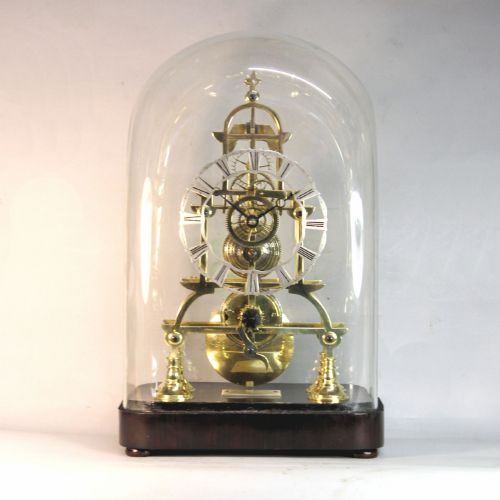


Glass Dome Mantle Clock
These glass dome mantle clock pieces combine intricate timepieces with protective blown glass covers, offering collectors a striking glimpse into historical horology.
Glass Dome Mantle Clock
A glass dome mantle clock brings together a delicate horological movement and a transparent glass cover designed to protect the mechanism from dust. These pieces span the Victorian, Edwardian, and Art Deco periods, showcasing diverse mechanical styles including skeleton movements, torsion mechanisms, and portico designs.
The assortment on this page includes English skeleton clocks alongside French ormolu and porcelain mantle clocks, often accompanied by their original glass domes and stands. Buyers encounter varied forms such as cathedral clock garnitures and torsion anniversary clocks housed in wood, ebonised bases, and brass frames.
Originating predominantly from the nineteenth and early twentieth centuries, these clocks reflect the industrial and decorative tastes of the era. Whether housed under a hand-blown dome or featuring Sevres style panels, each glass dome mantle clock offers a distinct mechanical display.
Materials and construction methods
Maker workshops utilised brass, ormolu, and mahogany to construct the structural clock cases and bases. Metal components were cast, gilded, or ebonised to create contrasting textures beneath the transparent enclosures.
Glass domes were produced using traditional hand-blown techniques, resulting in clear protective covers that rested upon wood or ebonised bases. Dial faces incorporated enamel and porcelain, often detailed with painted numerals and signature cartouches.
Some clocks keep track of time through twisting pendulums that slowly turn back and forth like a mesmerising slow-motion dance.
Distinctions in quality and execution
The refinement of the clock movement and the crispness of the ormolu casting distinguish higher quality pieces. Elaborate skeleton frames and finely painted porcelain panels indicate superior workshop production.
The presence of an original hand-blown glass dome and matching wooden stand adds significant integrity to the piece. Preservation of the original enamel dials and delicate hands further elevates the standard of the clock.
Richard Winter Of Chieveley·Maurice Marcel Moulin Favre Bulle·Allen Colyer·Ferdinand Barbedienne
The Glass Dome Mantle Clock Glossary
- Skeleton clock
- A timepiece designed with an open framework that exposes the gear train and escapement mechanism. This design allows observers to view the inner workings from multiple angles.
- Ormolu
- Gilded bronze or brass applied to decorative mounts and clock cases. It provides a rich golden finish characteristic of nineteenth-century French pieces.
- Torsion clock
- A clock regulated by a torsion pendulum that rotates rather than swings. These mechanisms often run for extended periods between windings.
- Portico clock
- A clock housed within a architectural frame supported by columns. The pendulum typically swings visibly in the open centre space.
- Garniture
- A set comprising a central clock accompanied by matching ornamental vases or candelabra. These matched suites formed a complete decorative mantel display.
Glass Dome Mantle Clock: Frequently Asked Questions
What is a glass dome mantle clock?
A glass dome mantle clock is a timepiece encased beneath a transparent glass cover to protect its delicate movement from dust and environmental wear.
These pieces typically sit upon a wooden or ebonised base, allowing the internal mechanics or decorative dial to remain fully visible while sheltered.
How do I maintain the glass dome?
Maintaining the glass dome requires careful cleaning with a soft cloth and mild glass cleaner, lifting the cover gently off its base.
Avoid using harsh abrasives and handle the hand-blown glass with extreme care to prevent accidental chips or scratches.
Are these clocks mechanical or electric?
The listings show a variety of mechanical movements, including traditional spring or weight-driven systems, skeleton gear trains, and torsion mechanisms.
Electric skeleton movements also appear from later twentieth-century production periods, demonstrating the evolution of timekeeping technology.