
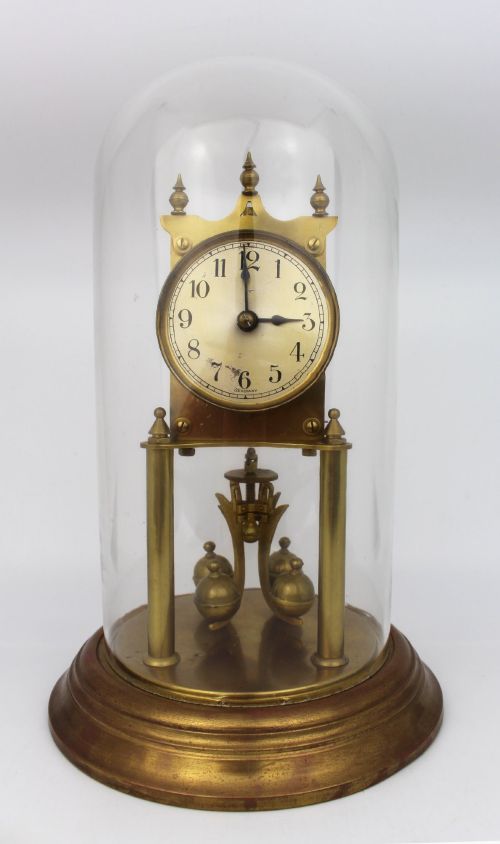


Brass Anniversary Clock
These brass anniversary clock pieces are mechanical torsion timekeepers housed beneath glass domes, prized for their complex suspended pendulum movement and traditional appearance.
What brass anniversary clock pieces are
When you search for brass anniversary clock examples, you encounter timepieces designed to run for a very long period on a single winding. These items belong to the Edwardian period and take the form of mantel clocks.
The pieces available on this page date to nineteen hundred and originate from Germany. You meet torsion year clocks alongside domed mantel clocks within this specific selection.
How they were made
Construction relies on brass components for the mechanical movement and framing, paired with glass domes that protect the delicate interior. Wooden elements appear alongside enamel details on the clock faces.
Makers utilise torsion pendulum technology, often called a year clock mechanism, which rotates back and forth rather than swinging conventionally. Signed movements indicate workshop production during the traditional horology era.
These clocks are famously wound just once a year, making them the ultimate test of remembering where you put the key.
What varies in quality
Quality differences emerge in the execution of the brass work and the clarity of the glass dome protecting the mechanism. Finer examples display crisp enamel dial markings and precise signed movements from established workshops.
The overall proportion and finishing of the wooden bases distinguish standard production from superior examples. Traditional horology standards dictate the precision of the torsion movement and the integrity of the suspension spring.
B H A
The Brass Anniversary Clock Glossary
- Torsion pendulum
- A suspended metal strip or wire that rotates back and forth to regulate the clock speed. This slow oscillation allows the mechanism to run for long periods without rewinding.
- Anniversary clock
- A timepiece designed to run for a full year on a single winding. It is also known as a four hundred day clock.
- Dome
- A blown or moulded glass cover placed over the clock to keep dust away from the delicate mechanism. These covers sit upon a wooden or metal base.
- Signed movement
- A clock mechanism bearing the maker name or trademark engraved on the backplate. This feature indicates workshop origin and aids dating.
Frequently Asked Questions
What is a brass anniversary clock?
It is a mechanical timekeeper featuring a rotating torsion pendulum beneath a glass dome. The design allows the clock to run for an extended period between windings.
Such timepieces date to the early twentieth century and were often given to mark special occasions. Their exposed mechanisms distinguish them from standard mantel clocks.
How do year clocks work?
These clocks use a slow-moving torsion suspension spring instead of a traditional swinging pendulum. Energy is conserved efficiently through this rotational movement.
Because the power drains very gradually, the mainspring requires winding only once every twelve months. This mechanical setup demands careful handling during placement.
Where were these clocks made?
Production was centered in European workshops, notably in Germany, during the Edwardian era. Skilled horologists assembled the brass frames and signed the movement plates.
Export networks distributed these dome-protected timepieces across international markets. Surviving examples retain their original German manufacturing traits from nineteen hundred.
How should I display one?
Place the clock on a stable, level surface where it will not experience vibrations. A mantelpiece or sturdy cabinet top works well for keeping the torsion pendulum safe.
Keep the glass dome clear of dust using a soft cloth and avoid moving the clock without securing the pendulum first. Proper placement ensures the delicate suspension wire remains undamaged.