
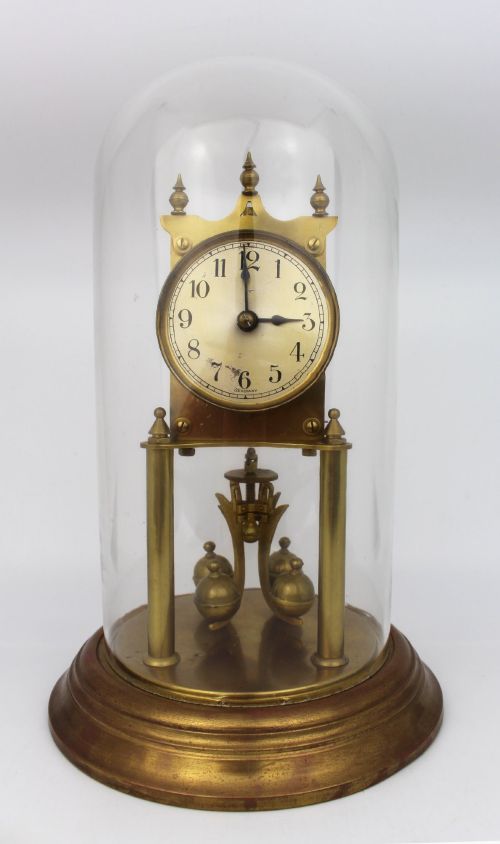


Mechanical Torsion Clock
A mechanical torsion clock keeps time through a rotating pendulum, offering the fascinating engineering of perpetual or year-long motion.
Mechanical Torsion Clock
A mechanical torsion clock relies on a slowly rotating pendulum that twists and untwists on a suspension spring rather than swinging side to side. When searching for a mechanical torsion clock, buyers encounter pieces ranging from German year clocks to Swiss perpetual motion models.
The selections span periods from the 19th Century through the Edwardian era into the 1940s, 1950s, and 1960s. These timepieces take the form of mantel clocks housed beneath protective glass bell-jars or traditional wooden cases.
Edwardian and 1900 examples frequently present as traditional anniversary clocks, while later mid-century models showcase clean geometric dials and minimalist housings. Both styles share the characteristic rotating mechanism that distinguishes them from standard pendulum clocks.
How they were made
Dials incorporate enamel for legible numerals, while wooden elements provide sturdy foundations for traditional mantel clock housings. Steel and various metals contribute to the internal gears and suspension springs required to maintain steady rotational energy.
Listings feature items spanning the 19th Century, Edwardian period, and the decades of 1940, 1950, and 1960 in traditional horology and Mid-Century Modern styles.
What varies in quality
Quality in a mechanical torsion clock rests upon the precision of the movement, visible in signed mechanisms and complex jewel counts. Swiss perpetual motion systems represent a different tier of horological engineering compared to standard spring-driven year clocks.
The housing materials and dial design further separate standard production from specialised output, such as rhodium-plated finishes or distinct square dials versus traditional round faces. Original packaging and documentation add historical completeness to surviving pieces.
Jaeger Le Coultre·B H A
The Mechanical Torsion Clock Glossary
- Torsion pendulum
- A suspended weight that rotates back and forth through a twisting motion. This slow oscillation stores energy efficiently to run for long periods without frequent winding.
- Anniversary clock
- A timekeeper designed to run for a full year on a single winding. They are often associated with German makers and glass domes.
- Atmos clock
- A perpetual motion timepiece driven by thermal expansion in a sealed gas capsule. Changes in ambient temperature wind the mainspring automatically.
- Bell-jar case
- A removable glass cover shaped like a bell that protects the delicate movement from dust and air currents. These housings allow an unobstructed view of the rotating pendulum.
- Suspension spring
- A thin, delicate strip of metal that supports the torsion pendulum. Its precise elasticity dictates the accuracy of the clock's beat.
Mechanical Torsion Clock: Frequently Asked Questions
How do mechanical torsion clocks run for a whole year?
These clocks utilise a slow-moving torsion pendulum that requires minimal energy to maintain its rotational arc. By reducing friction and using a delicate suspension spring, the stored power in the mainspring depletes very gradually over twelve months.
Traditional German models require manual winding once a year, typically chosen around commemorative dates. This slow release of energy distinguishes them from standard clocks that need weekly attention.
What makes an Atmos clock different from other torsion clocks?
An Atmos clock operates without a key or battery by responding to changes in room temperature. A hermetically sealed capsule contains a gas and liquid mixture that expands and contracts with thermal shifts, winding the mainspring continuously.
This perpetual motion system means the clock runs indefinitely as long as the ambient temperature fluctuates. It represents a pinnacle of Swiss horological engineering within mid-century design.
Why do these clocks have glass domes?
The glass bell-jar case shields the extremely sensitive torsion pendulum from drafts and airborne dust particles. Air currents can easily disrupt the delicate twisting motion and affect the timekeeping accuracy.
These transparent covers also display the intricate internal mechanics from every angle. Preserving the original glass enclosure maintains the intended appearance of the mantel clock.
How should I place a torsion clock in my home?
Position the timepiece on a sturdy, level mantelpiece or shelf away from direct sunlight and heavy foot traffic. Because the suspension spring is sensitive to vibrations, a stable surface prevents the rotating pendulum from stalling.
Level the base carefully using any integrated feet or adjustments to ensure the torsion mechanism swings evenly. Proper placement guarantees reliable operation and protects the vintage housing.