

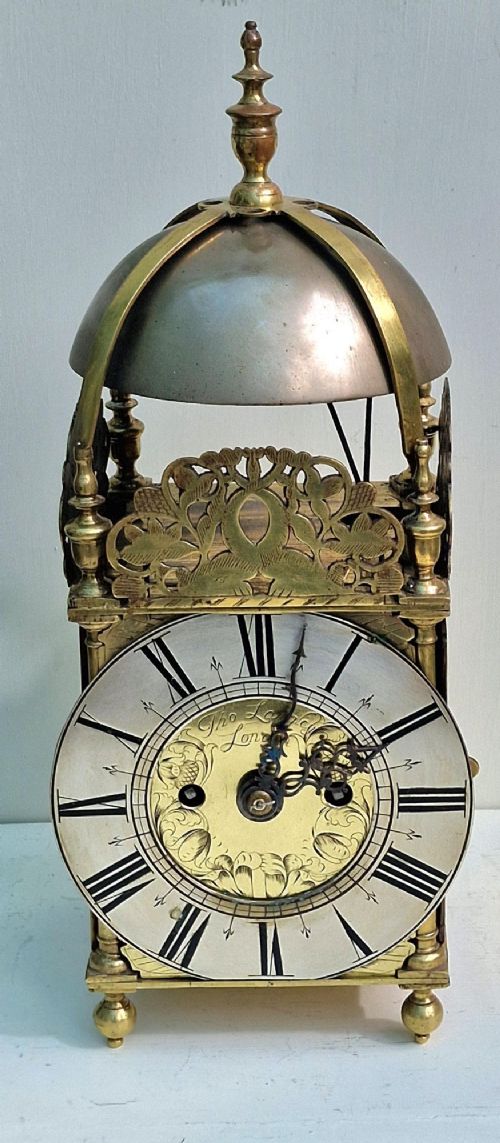
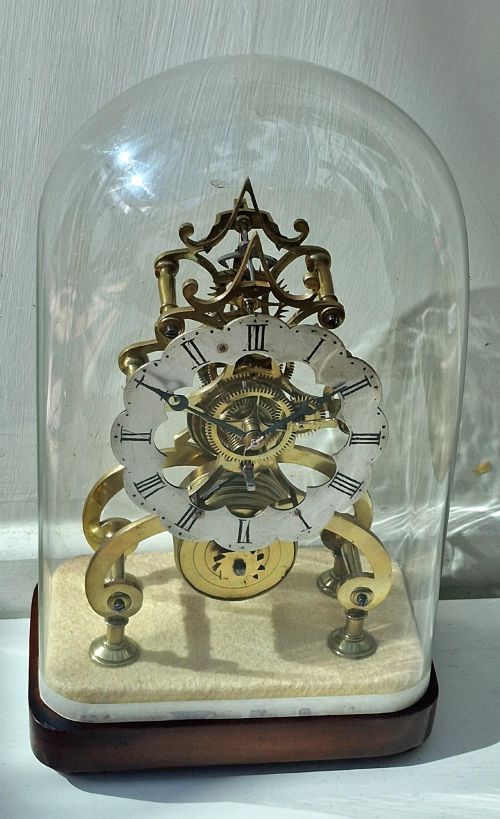
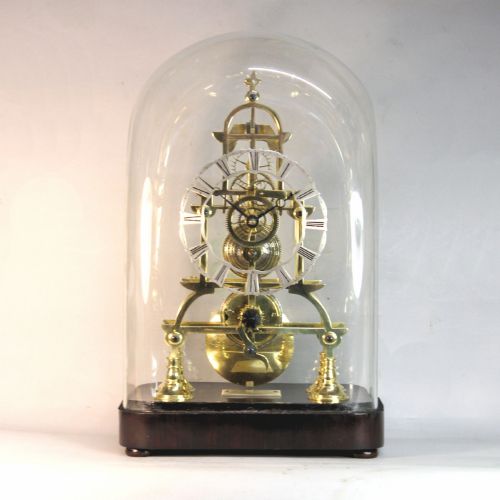


Vintage Skeleton Mantel Clock
A vintage skeleton mantel clock displays its gear train openly beneath glass, offering the room a kinetic sculpture that reveals the passage of time.
Vintage Skeleton Mantel Clock
A vintage skeleton mantel clock strips away the conventional wooden or metal case to expose the brass movement directly to the eye. Most examples encountered here hail from the Victorian period through the mid-twentieth century, with English and French originations predominating.
Forms span traditional Gothic cathedral designs, double fusee movements under glass domes, and later mid-century inline timepieces. Buyers encounter both striking models and simple timepieces designed to sit on a desk, shelf or mantelpiece.
The aesthetic merges technical engineering with domestic display, turning escapements, wheels and dials into the principal ornament. Every piece maintains the domestic utility of a clock while functioning primarily as a mechanical focal point.
How they were made
Makers constructed these movements primarily from brass, shaping the plates and wheels to reduce mass while maintaining structural rigidity. Steel components provide the arbors, pinions and springs necessary to drive the gear train.
Enamel serves for chapter rings and dial faces, while glass domes protect the delicate mechanisms from dust and damage. Secondary materials include marble bases, mahogany plinths, and ebonised wood mounts that ground the exposed brass frames.
Vintage Skeleton Mantel Clock Retail Price Guide 2026
Typical asking prices for vintage skeleton mantel clock among the pieces listed under this phrase on Sellingantiques today, from the lower quarter to the upper quarter. They describe what is for sale here now, not the wider market.
The listings include brass, glass, wood, enamel, steel, marble, mahogany and ebonised wood across Victorian, Edwardian and mid-century periods.
What varies in quality
Quality separates by the complexity of the movement architecture, such as the presence of fusee setups or passing strikes versus simple timepieces. Hand-finished engraving on the brass plates and quality of wheel cutting dictate the mechanical grade.
The survival of original glass domes and matching bases alters the integrity of the piece. Superior examples exhibit refined proportion in the brass skeleton framework and clean execution of enamel dials.
Thomas Langley·Richard Winter of Chieveley·B H A·Jaeger-LeCoultre·Bulle
The Vintage Skeleton Mantel Clock Glossary
- Skeleton clock
- A timepiece designed with open brass plates that expose the entire gear train and movement to view. This layout emphasises the mechanical architecture rather than hiding it behind a solid dial case.
- Fusee
- A conical pulley used with a cord or chain to maintain equal force on the clock movement as the mainspring winds down. It ensures more consistent timekeeping across the power reserve.
- Four glass clock
- A mantel clock housed in a brass-framed case with glass panels on all four sides and the top. This style allows light to pass entirely through the movement.
- Torsion clock
- A clock regulated by a torsion pendulum that rotates back and forth rather than swinging. These often run for extended periods on a single winding.
- Passing strike
- A mechanism that strikes a bell or gong once on the hour or half-hour without counting the exact time. It provides an audible note to mark the passage of hours.
Vintage Skeleton Mantel Clock: Frequently Asked Questions
How do I wind a skeleton clock?
Most mechanical skeleton clocks require a key to tension the mainspring barrels at regular intervals, typically weekly or daily depending on the train. Care must be taken not to over-wind the movement.
Electric and torsion variants bypass manual key winding through batteries or perpetual motion designs, requiring different handling for their specific power sources.
Why do some clocks have glass domes?
Glass domes protect the exposed brass and steel components of skeleton and precision clocks from dust, moisture and accidental knocks. They preserve the delicate finish of the open movement.
Many period domes remain with their original turned wood or marble bases, forming an integrated enclosure for the clock.
What is the difference between a timepiece and a clock?
In horological terms, a timepiece is a clock that indicates the time but does not include a striking or chiming mechanism. They are simpler movements focused purely on motion.
Clocks with striking trains include additional gear work, hammers and gongs to sound the hours or pass the time audibly.
Where should I place a skeleton mantel clock?
These clocks require a stable, level surface away from direct sunlight, draughts and heavy vibrations that could disrupt the pendulum or balance wheel. A mantelpiece, desk or cabinet top works well.
Because the movement is visible from all angles, placement where light can pass through the brasswork and glass highlights the intricate mechanics.