



Vintage Pewter Vessel
A vintage pewter vessel brings a solid, heavy-metal weight to a table, offering centuries of utilitarian history.
Vintage Pewter Vessel
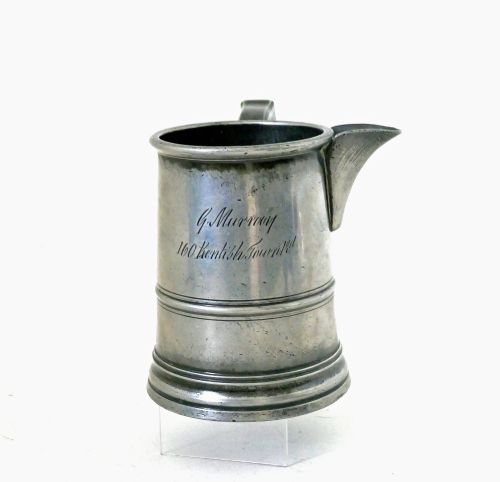
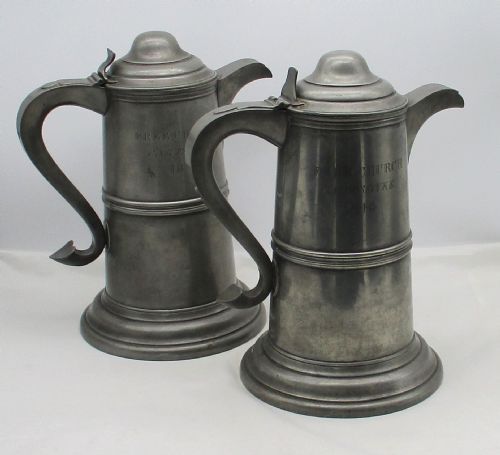
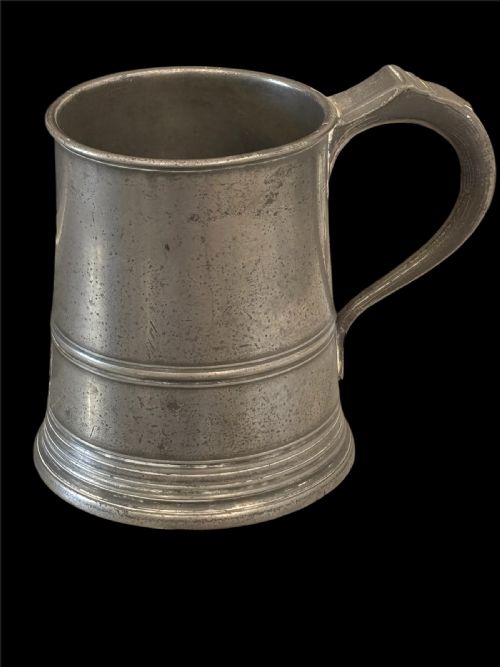
A vintage pewter vessel covers a range of utilitarian drinking and serving forms, primarily tankards, flagons, jugs, and vases spanning the eighteenth to the twentieth centuries. The pieces on this page lean heavily towards English public house tankards, measured ale jugs, and decorative Continental items.
Buyers will encounter Georgian flat-lid flagons, Victorian quart measures, and later Arts and Crafts or Art Nouveau designs featuring organic motifs and cobalt glass or enamel combinations. These objects transition easily from tavern tools to display pieces in a modern interior.
Materials and construction
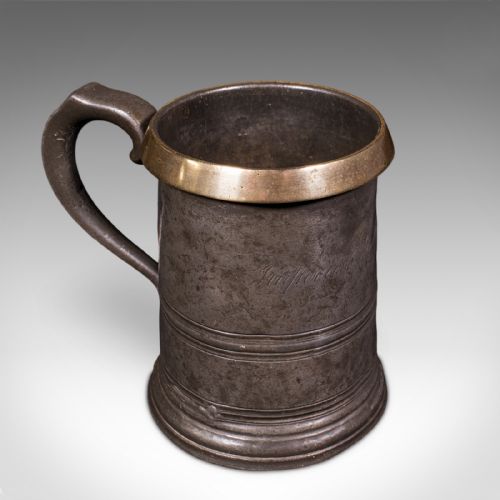
These items are constructed predominantly from pewter, an alloy traditionally composed of tin alloyed with copper, antimony, and sometimes lead, giving the metal its characteristic dull lustre and malleability. Some examples incorporate contrasting elements such as brass handles, cobalt glass liners, or white stoneware bodies overlaid with pewter.
Forming methods visible across the inventory include casting, hammering, and relief-moulding, alongside hand-engraving for maker marks and tavern names. Artisans soldered components together or utilised overlay techniques to bind metal mountings directly to glass and ceramic vessels.
Listings span multiple eras, encompassing eighteenth-century English flagons, Victorian ale measures, and twentieth-century Arts and Crafts chalices.
Assessing quality and character
Quality in these objects rests upon the thickness of the metal casting, the crispness of any applied relief decoration, and the survival of original touchmarks or touch plates. Heavy-gauge metal retains its structural integrity better over generations of use in public houses and domestic settings.
The balance of the form and the subtlety of handling, such as the sweep of a handle or the precision of an engraved inscription, separate standard utilitarian containers from exceptional examples of metalwork art.
G.Murrouy·Charles Meigh·Frederic Sanders
The Vintage Pewter Vessel Glossary
- Flagon
- A large drinking vessel with a handle and spout, often fitted with a lid for holding ale or wine. Early examples feature flat lids or spire tops.
- Tankard
- A tall, cylindrical drinking vessel with a single handle, commonly used in public houses for serving beer. Measured variations indicate specific volumes such as pints and quarts.
- Touchmark
- An official stamp or hallmark impressed into the pewter by a maker or guild to guarantee the purity and standard of the alloy. These marks help historians date and localise the piece.
- Arts and Crafts
- A design movement valuing handcraftsmanship and simple, functional forms over mass production. Pieces from this style often display Celtic revival motifs or hammered surfaces.
- Pewterware
- General nomenclature for domestic and tavern objects fashioned from tin alloy. The category encompasses everything from plain measures to decorative vases.
Vintage Pewter Vessel: Frequently Asked Questions
How do I clean an old pewter vessel?
Wash the metal gently with warm soapy water and a soft cloth, then dry it immediately to prevent spotting. Avoid harsh chemical polishes that strip away the aged patina.
Leaving a dull surface preserves the historical character and the natural oxidation built up over decades of handling.
Can I still drink from these vessels?
Many historical pieces contain lead within the alloy mix, which can leach into acidic liquids or alcohol over time. It is safer to keep them as decorative display items.
Modern pewter uses safer metal formulations, but vintage tavernware remains best enjoyed purely for its visual and tactile history.
What does a touchmark tell me?
A touchmark acts as a maker's signature or guild stamp, indicating where and roughly when an object was produced. Finding a legible mark helps trace the lineage of a piece.
Many utilitarian items bear tavern names or capacity stamps instead of maker signatures, reflecting their daily working life.
Why do some flagons have flat lids?
Flat lids were common on seventeenth and eighteenth-century flagons to keep contents covered in busy public houses. The hinge construction allows easy flipping with a thumb grip.
Over time, styles shifted towards domed and spire lids before decorative Art Nouveau forms emerged.