


Vintage Mantel Clock Garniture
A vintage mantel clock garniture brings together a central timekeeper and matching side pieces to transform a fireplace into a composed focal point.
Vintage Mantel Clock Garniture
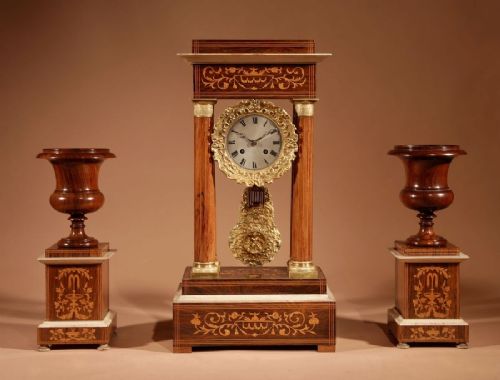
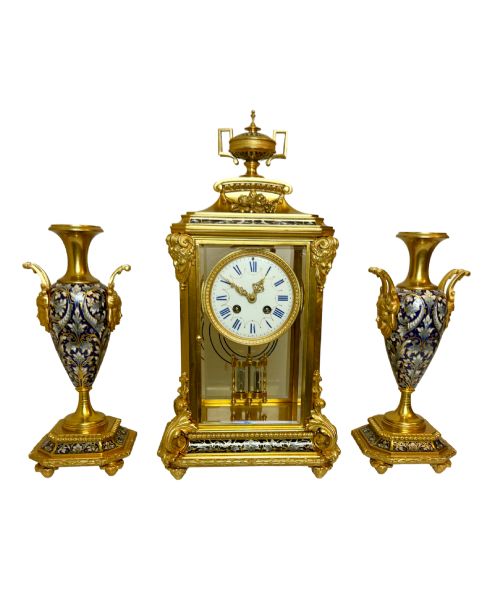
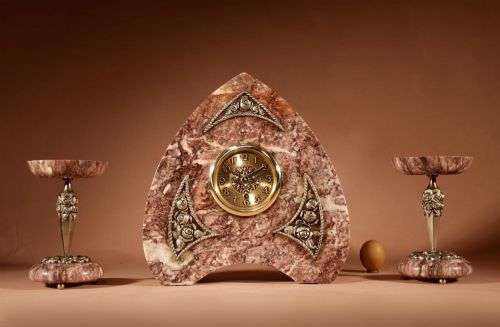
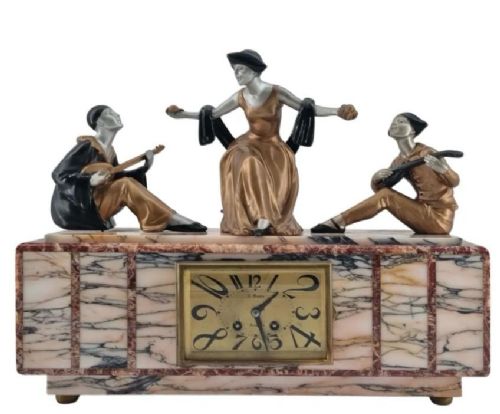
A vintage mantel clock garniture comprises a central timepiece accompanied by a matching pair of decorative side pieces, such as candelabras, urns or sculptural figures. When buyers search for a vintage mantel clock garniture, they encounter a coordinated three-piece set designed to sit symmetrically upon a mantelpiece or shelf.
The selections span distinct historical movements, with Victorian and nineteenth-century examples sitting alongside geometric Art Deco designs from the nineteen-twenties and nineteen-thirties. French origins dominate the available forms, ranging from ornate period revivals to sleek twentieth-century figural compositions.
Most pieces encountered on this page arrive as complete sets where the central clock and its flanking companions share identical materials and ornamental motifs. These matched assemblies provide a complete decorative scheme straight from the period of their manufacture.
How they were made
The construction of these sets relies heavily on dense stones such as marble, onyx and breccia, which provide sturdy architectural housings for mechanical eight-day movements. These stone bodies are frequently accented with cast metals including brass, ormolu, gilt bronze, silver-plated bronze and spelter.
Visual depth is achieved through the integration of champleve enamel dials, porcelain panels and glass covers that protect delicate internal escapements and visible pendulums. Sculptural elements on the clock cases and side garnitures are cast as distinct figures, depicting animals like greyhounds and German shepherds, or human subjects such as Pierrot and Columbine.
Several Art Deco sets feature sculptural figures of dogs and dancers keeping watch beside the ticking dial.
What varies in quality
Quality differences emerge in the weight and selection of the stone body, where dense, finely cut marbles and rich green onyx command greater presence than simpler housings. The precision of the cast metal mounts and the artistry of figural sculptures, such as signed bronzes, separate standard production pieces from finer works.
The cohesion of the three pieces dictates overall success, as sets maintaining exact material matches and unified decorative motifs across the clock and its flanking companions represent the higher tiers of craftsmanship.
Sega·Michel Decoux
The Vintage Mantel Clock Garniture Glossary
- Garniture
- A set of ornamental objects designed to match and be displayed together, typically consisting of a central clock and two side pieces.
- Portico clock
- A architectural style of timekeeper featuring a dial suspended within a frame supported by four columns.
- Champleve enamel
- A technique where troughs are carved into metal and filled with vitreous enamel powder before firing.
- Breccia marble
- A composite stone made of broken rock fragments embedded in a fine-grained matrix, creating a variegated surface pattern.
- Ormolu
- A gilded bronze technique applied to metal mounts and decorative ornaments during the eighteenth and nineteenth centuries.
Vintage Mantel Clock Garniture: Frequently Asked Questions
What is a clock garniture?
A clock garniture is a matched set consisting of a central mantel clock and a pair of decorative side objects.
These side pieces are typically designed to echo the materials and artistic style of the clock itself.
How do I date a garniture?
Dating relies on identifying the prevailing aesthetic, such as ornate Victorian casting or geometric Art Deco forms.
Materials like green onyx, gilt bronze and specific marble types also point directly to distinct manufacturing decades.
Where should I place a set?
These three-piece sets are traditionally arranged symmetrically across a fireplace mantelpiece or a wide sideboard.
The central clock anchors the display, flanked by the matching urns, candelabras or figures on either side.
Are the movements mechanical?
Many period examples feature mechanical eight-day movements that require manual winding with a key.
Some incorporate visible pendulums or striking mechanisms that mark the passage of time audibly.