
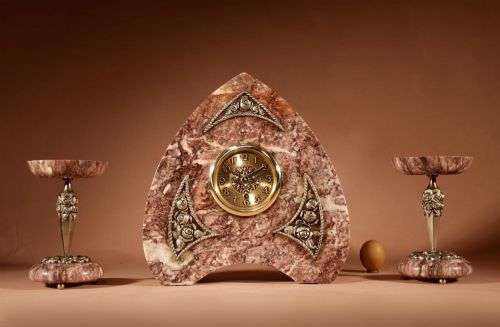
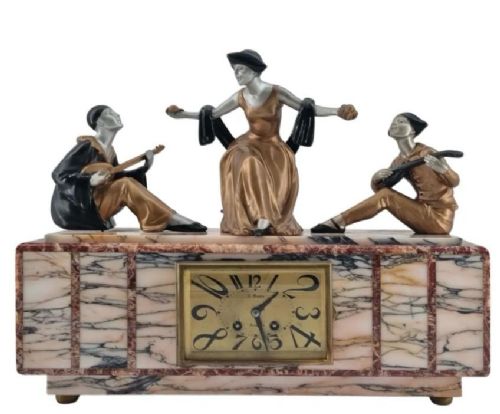


Pink Marble Mantel Clock
A pink marble mantel clock brings striking mineral colour and formal presence to a room, driven by French nineteenth-century and Art Deco design.
What a pink marble mantel clock is
A pink marble mantel clock combines solid natural stone with classical or modern geometric forms, intended for domestic display upon a fireplace or sideboard. These pieces span the nineteenth century and the nineteen-twenties, incorporating French regional work and distinct decorative movements.
The varieties encountered on this page range from classical architectural shapes and lyre designs to angular Art Deco silhouettes. Many examples integrate contrasting metals or garniture elements, forming coordinated sets designed to command attention within a period interior.
How they were made
Construction relies upon heavy slabs of marble and pink marble shaped into architectural or sculptural cases, often combined with onyx, spelter, gilt metal, gilt bronze, and ormolu. Artisans mounted enamel dials behind protective glass, driven by mechanical movements housed securely within the stone body.
Surface detailing involves precision cutting of the stone alongside cast metal ornaments applied to the corners, bezels, and crests. The interplay between polished mineral surfaces and gilded or patinated bronze demonstrates traditional nineteenth-century and early twentieth-century foundry techniques.
Retail Price Guide 2026
Typical UK retail prices for pink marble mantel clock, calculated from the Sellingantiques database of over a million retail prices indexed since 2003. This retail price guide relies exclusively on Sellingantiques data; no external sources or auction records are used, so the figures do not describe the wider market.
Some clocks take the shape of a musical lyre, proving that even heavy stone can pretend to sing.
What varies in quality
Quality rests upon the depth of colour and structural integrity within the marble, alongside the crispness of the cast bronze or ormolu mounts. Finer examples display harmonious proportions where the mineral grain complements the metallic details rather than competing with them.
The sophistication of the dial design and the weight of the bronze elements separate standard production from superior pieces. Coordinated garniture sets demand careful inspection of how uniformly the stone and metal components have aged together.
Mougin
The Pink Marble Mantel Clock Glossary
- Garniture
- A set of decorative mantel ornaments, typically comprising a central clock flanked by matching vases or urns.
- Ormolu
- Gilt bronze ornamentation applied to furniture and clock cases, created using a mercury-gilding technique during the eighteenth and nineteenth centuries.
- Spelter
- A zinc alloy frequently used as a cost-effective substitute for bronze in decorative clock figures and mounts, typically given a bronze-coloured finish.
- Enamel
- A glassy substance fused to a metal dial face under high heat, providing a smooth white ground for painted numerals.
Frequently Asked Questions
How do I date a pink marble mantel clock?
Dating relies on examining the stylistic cues, such as whether the piece follows classical Louis XVI symmetry or later geometric Art Deco lines. Materials like spelter versus gilt bronze also point towards specific manufacturing decades.
Examining the construction of the movement and the style of the enamel dial provides further confirmation of the period of origin.
What is a clock garniture?
A clock garniture is a matched set designed to sit together on a mantelpiece, featuring a central clock accompanied by side pieces such as urns or candelabra. These sets created a balanced, symmetrical display popular in nineteenth-century formal interiors.
The side pieces repeat the marble and metal motifs found on the main clock case.
How should I clean a marble clock?
Maintenance requires only a soft, dry cloth to remove dust from the polished marble and glass surfaces. Avoid chemical cleaners or excessive moisture, which can damage the delicate enamel dials and corrode the metal mounts.
Professional servicing is recommended to keep the mechanical movement functioning properly.
Where were these clocks made?
The pieces recorded here originate predominantly from French workshops and foundries active during the nineteenth and early twentieth centuries. France dominated the production of decorative mantel clocks featuring marble and ormolu during this era.
Regional makers and larger industrial potteries or bronze-workers supplied these luxury goods to the international market.