



French Mantle Clock Set
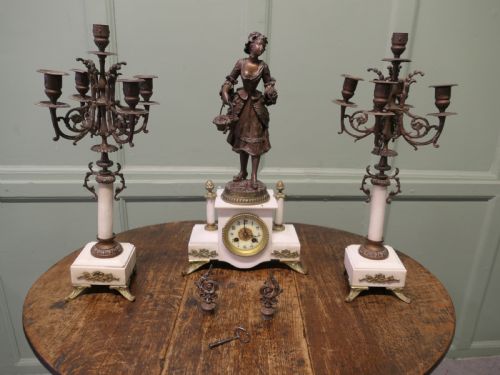
A French mantle clock set brings monumental presence to a room, pairing a striking timepiece with matching side garnitures like candelabras.
French Mantle Clock Set
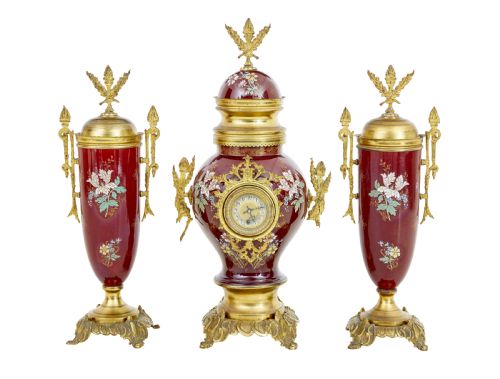
A French mantle clock set comprises a central clock accompanied by matching side pieces such as candelabras, urns or vases designed to display together on a mantelpiece.
Most examples found here date from the nineteenth century, spanning Victorian, Rococo Revival, Louis XVI Revival and French Empire styles.
Common forms include heavy block marble structures, gilt bronze or ormolu mounts, and painted porcelain panels depicting pastoral or classical scenes.
Materials and construction
Maker workshops combined heavy natural stones like marble, onyx and alabaster with cast metals such as brass, gilt bronze and ormolu.
Clock dials frequently feature hand-painted enamel numerals or individual cartouches set into porcelain faceplates, housed beneath protective glass bezels.
Garniture side pieces utilised matching materials to the main clock body, often incorporating cast figures, cherubs or decorative toleware.
Art Deco examples on this page introduce streamlined geometric forms in marble and brass, contrasting with earlier ornate Victorian and Rococo Revival designs.
Judging quality and craftsmanship
Quality rests in the weight and crispness of the cast metal mounts, where deeply chased ormolu and detailed bronze work distinguish superior pieces from simpler gilt metal.
The choice of body material alters the character entirely, moving from standard polished marble to intricate cloisonne, fine Paris porcelain or multi-toned siena marble.
Integration between the central clock and its matching garnitures dictates overall visual harmony, separating unified decorative suites from assembled groupings.
Finnigan Manchester·Ferdinand Barbedienne·Etienne Maurice Falconet
The French Mantle Clock Set Glossary
- Garniture
- A set of matching decorative objects designed to be displayed together, typically consisting of a central clock flanked by two matching candelabras or urns. These companion pieces create a balanced arrangement on a mantel.
- Ormolu
- Finely ground high-carat gold applied to a bronze base using a mercury-gilding technique. This process creates a rich, enduring metallic finish seen on many nineteenth-century mounts.
- Cloisonne
- An ancient decorative technique where enamel paste is applied within compartments created by soldered wire strips on a metal base. It appears on select clock faces and garniture bodies.
- Toleware
- Painted or lacquered sheet metal items produced for decorative household use. These pieces bring colourful painted surfaces to specific garniture sets.
- Cartouche
- A framed panel or oval surround enclosing numbers or painted scenes on a clock dial. They are frequently rendered in white enamel with black painted numerals.
French Mantle Clock Set: Frequently Asked Questions
How do I wind a French mantle clock?
Most eight-day movements require a dedicated winding key inserted into the dial holes to tension the springs.
Care must be taken not to over-wind the mechanism, stopping as soon as resistance is felt.
What is a clock garniture?
A clock garniture is a matched suite containing a central timepiece accompanied by side ornaments.
These side pieces often take the form of candelabras, urns or matching vases.
How do I identify a Louis XVI style set?
Louis XVI style pieces display neoclassical restraint, featuring geometric symmetry, straight architectural lines and classical motifs.
Ormolu mounts on these clocks typically showcase ribbons, urns and floral swags rather than asymmetrical scrolls.
Where should I place a heavy marble clock?
Due to substantial weight from marble and bronze components, these clocks require a deep, sturdy mantelpiece or reinforced console table.
Ensuring a level surface prevents the pendulum from hanging unevenly and stopping the movement.