
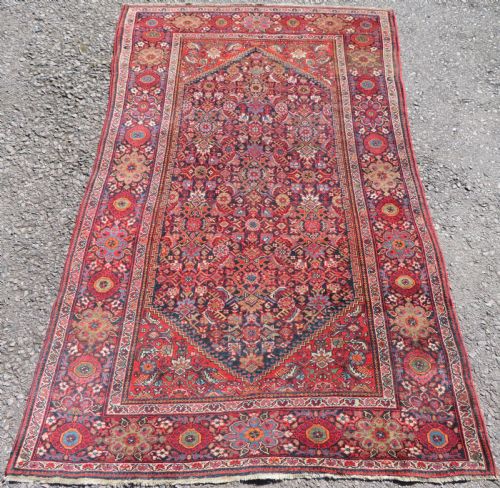


Vintage Malayer Rug
A vintage malayer rug brings West Persian craftsmanship into your home, offering distinctive tribal and traditional motifs woven in wool and cotton.
Vintage Malayer Rug
A vintage malayer rug is a woven textile originating from West Persia, encompassing various forms such as area rugs, carpets, and long hallway runners. These pieces display traditional Persian designs influenced by village and tribal workshops.
Buyers encountering this selection will most frequently find examples dated between eighteen ninety and nineteen thirty. The inventory contains standard rectangular formats alongside exceptionally long runners suitable for corridors.
Materials and Techniques
The construction relies on a foundation of cotton threads supporting a dense wool pile. Artisans knotted the wool by hand to create durable floor coverings designed for everyday use.
Weavers employed traditional Persian styles, incorporating specific patterns such as the Herati design, boteh motifs, and occasional pictorial elements like birds and lions.
Vintage Malayer Rug Retail Price Guide 2026
Typical asking prices for vintage malayer rug among the pieces listed under this phrase on Sellingantiques today, from the lower quarter to the upper quarter. They describe what is for sale here now, not the wider market.
Keep an eye out for the occasional rogue lion hiding among the traditional floral motifs.
Variations in Quality
Quality rests upon the fineness of the knotting and the clarity of the design work executed across the wool pile. Pieces featuring intricate botanical layouts or uncommon pictorial details demand closer appreciation.
The sophistication of the soft colour palette and the condition of the cotton foundation distinguish standard village productions from finer collector examples.
The Vintage Malayer Rug Glossary
- Malayer
- A type of Persian rug originating from the town and surrounding villages of Malayer in West Persia. These pieces are celebrated for blending tribal spontaneity with refined village weaving traditions.
- Boteh
- A traditional Persian motif resembling a almond or paisley shape, often arranged in rows across the field. This ancient symbol represents life and eternity in textile design.
- Herati
- A repeating floral and geometric pattern featuring a central rosette enclosed by leaf-like motifs and curved lancet leaves. It remains one of the most enduring designs in Persian rug production.
- Kelleh
- A large format rectangular rug, typically longer than it is wide, designed for specific room proportions. These formats occupy a middle ground between standard area rugs and full-sized carpets.
- Runner
- A long, narrow carpet format specifically suited for hallways and corridors. Surviving examples often measure several metres in length.
Vintage Malayer Rug: Frequently Asked Questions
Where were these rugs made?
These textiles were produced in the Malayer region of West Persia, encompassing both town workshops and surrounding rural villages.
Local weavers drew upon diverse tribal and traditional Persian design vocabularies to create these distinctive floor coverings.
What materials are used?
The construction consists of a sturdy cotton foundation that supports a hand-knotted wool pile.
Natural fibres were spun and dyed locally, resulting in the soft colour palettes seen in surviving pieces.
How do I care for my rug?
Protect the textile by placing it in low-moisture areas out of direct sunlight to preserve the wool pile and dyes.
Gentle surface cleaning and professional maintenance ensure the cotton foundation remains stable over decades.
What motifs appear on them?
Common decorative elements include the Herati pattern, boteh motifs, and cream or ivory grounds.
Some select pieces incorporate pictorial elements such as birds and lions into the field.