


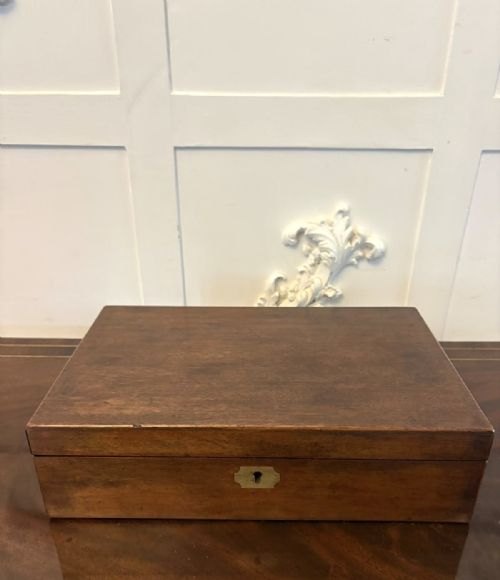

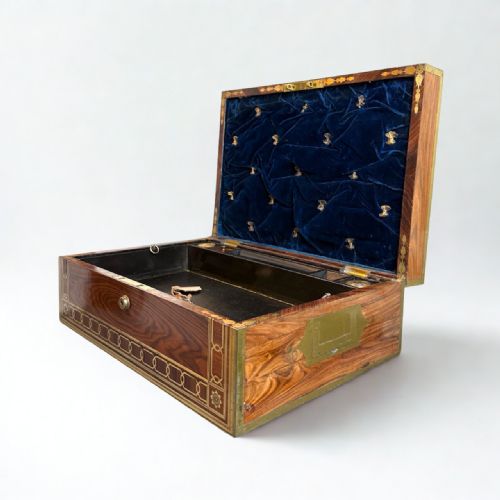


Vintage Lap Desk
A vintage lap desk offers a portable writing surface used by travellers and officers during the Georgian and Victorian periods.
Vintage Lap Desk
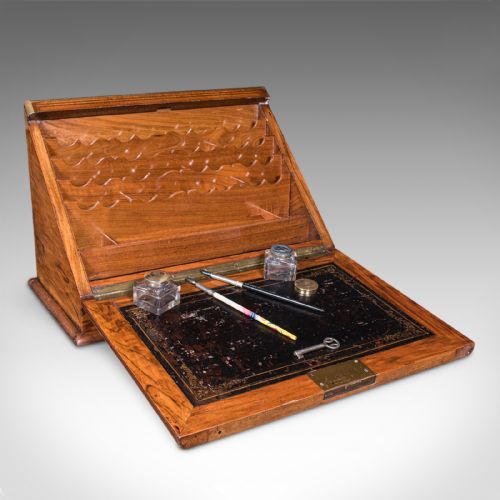
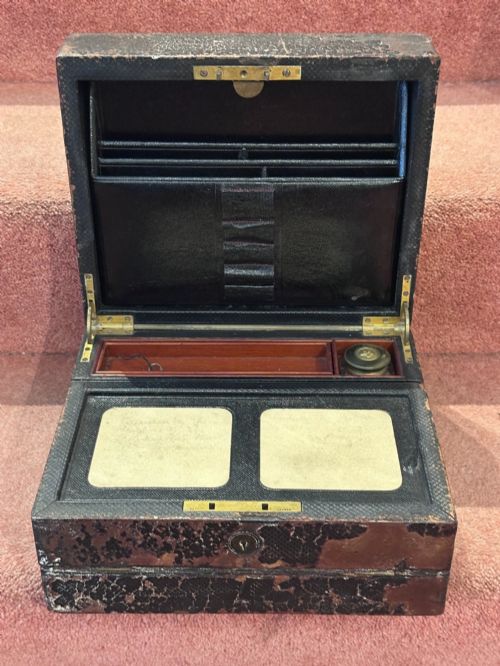
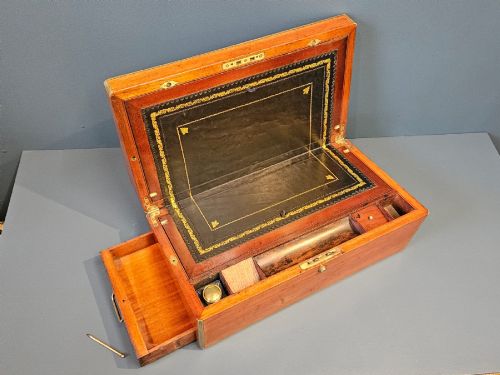
A vintage lap desk, commonly listed as a writing slope, writing box, or campaign box, provides a hinged folding surface that opens to reveal a slanted writing bed and compartments for inkwells and pens. Most pieces found here originate from the Georgian, Regency, and Victorian eras, reflecting an age when correspondence required dedicated portable cabinetry.
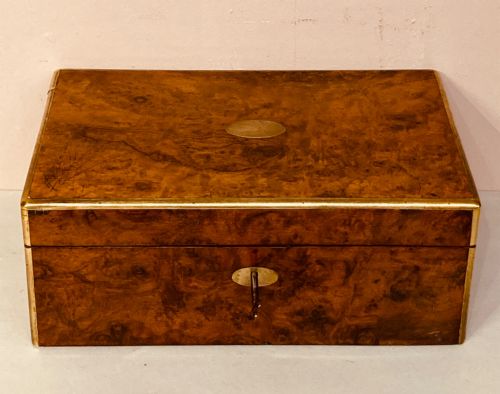
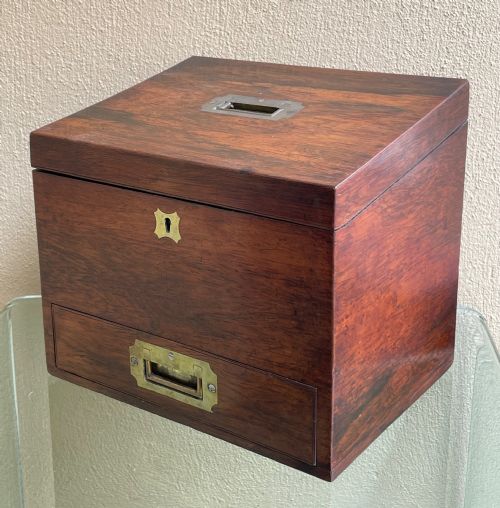
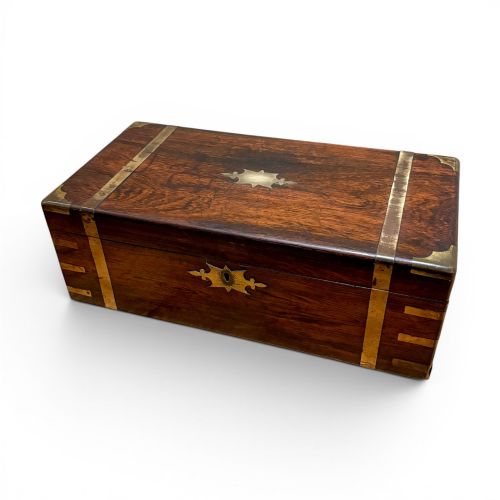
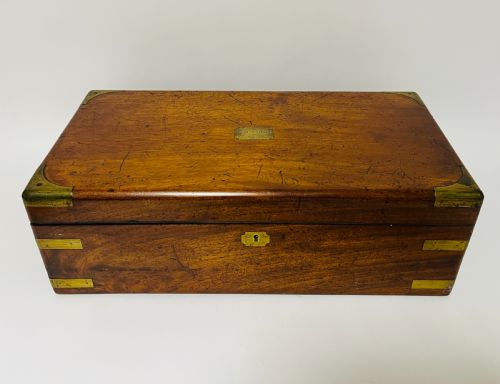
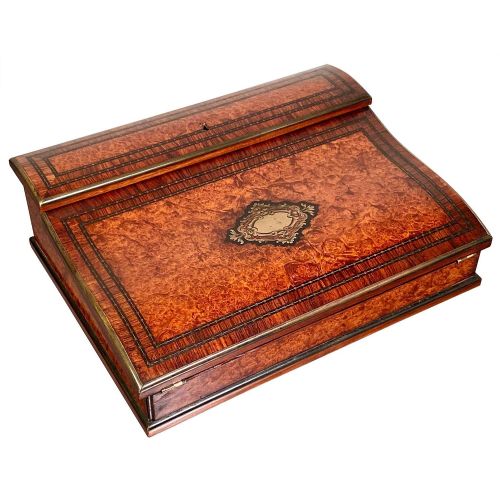
The dominant forms are timber boxes strengthened for travel with brass banding, corner guards, and inset carrying handles. Buyers encounter variants ranging from modest mahogany and walnut slopes to elaborate rosewood, burr walnut, and coromandel examples fitted with secret drawers and leather-lined writing surfaces.
Regional variations appear among the standard British pieces, including Anglo-Indian and Ceylonese ebony boxes featuring intricate carved decoration, alongside specialised items like document boxes, stationery cases, and officer's campaign desks.
Materials and construction methods
Cabinetmakers constructed these desks from dense hardwoods such as mahogany, rosewood, walnut, and pollard oak, often utilising decorative veneers like burr walnut and satinwood on the exterior surfaces. Brass featured prominently as structural reinforcement for campaign pieces, appearing as edge banding, corner brackets, and flush lifting handles designed to withstand rigorous travel.
Interiors combined secondary softwoods with fitted partitions in cedar or mahogany, incorporating leather writing slopes, velvet inserts, and hidden compartments secured by secret mechanisms. Specialised regional items integrated carved solid woods, mother-of-pearl inlay, and reeded detailing to ornament the surfaces.
The listings demonstrate a strong presence of 19th-century and Victorian pieces, constructed primarily in mahogany, rosewood, and walnut with brass campaign mounts.
Assessing quality and execution
Quality rests upon the selection of timber figures, such as the richness of burr walnut grain or the depth of figured mahogany, combined with the precision of brass inlay and corner mitres. Superior pieces exhibit seamless joints, substantial brass hardware secured with properly aligned screws, and secondary timbers of matching quality within the hidden compartments.
Interior complexity further separates standard utility boxes from high-tier examples, with finer items offering sophisticated secret drawer mechanisms, complete sets of original glass inkwells with brass lids, and finely tooled leather or velvet writing surfaces.
William Austin·George Austin, Dublin
The Vintage Lap Desk Glossary
- Writing slope
- A portable box with a hinged lid that opens to form an inclined writing surface. These objects fold flat for transport and contain internal storage for stationery.
- Campaign box
- A piece of portable furniture constructed for military officers or travellers. They typically feature recessed brass handles and reinforced corners to endure transit.
- Secret compartment
- A concealed drawer or sliding panel hidden behind the main interior fittings. Cabinetmakers built these spaces to secure private papers and valuables.
- Brass banding
- Metal strips inlaid flush into the edges and corners of a box. This technique protected the wooden carcase from the impacts of travel.
- Coromandel
- A dense, heavy timber sourced from Southeast Asia featuring dark brown grain with contrasting light streaks. It was utilised for high-status Victorian boxes.
Vintage Lap Desk: Frequently Asked Questions
What is a vintage lap desk?
A vintage lap desk is a portable wooden box designed to open into an inclined writing surface. These pieces contained compartments for inkwells, pens, and paper before the era of fountain pens and modern desks.
Craftsmen built them in various sizes to sit on a lap, table, or campaign stand. They allowed writers to maintain correspondence while travelling by coach, ship, or rail.
How were campaign desks used?
Campaign desks served military officers, colonial administrators, and wealthy travellers who needed a mobile administrative station. The sturdy brass hardware protected the wood during rough transit.
Inside, compartments held documents, wax seals, and ink securely in place. The folding lid provided an immediate writing desk wherever the owner stopped.
How do I date a writing slope?
Dating relies on timber choices, construction methods, and hardware styles found across different eras. Georgian pieces often show simpler lines in mahogany, while Victorian versions frequently use rosewood, burr walnut, and extensive brass inlay.
Secret drawers, escutcheon shapes, and interior leather tooling also help narrow down the period of manufacture. Cabinetmakers altered their interior layouts as writing materials evolved through the nineteenth century.
Are inkwells usually included?
Many writing boxes retain their original glass inkwells, often fitted with brass or silver-plated screw caps. Because inkwells were fragile and prone to loss or breakage, replacement vessels frequently appear in older desks.
Finding matching glass bottles with functional hinged lids adds to the completeness of a box. Collectors look for fitted interior trays designed specifically to hold these ink containers.
How do I care for wooden writing boxes?
Maintenance involves keeping the timber nourished with suitable wax polish and avoiding placement near direct heat sources or strong sunlight. Changes in humidity can cause old veneers to lift or timber to split.
Leather writing surfaces benefit from gentle cleaning without harsh chemicals. Brass hardware can be polished sparingly if desired, though many prefer the aged patina.