




Vintage Kidney Writing Desk
A vintage kidney writing desk brings a graceful, serpentine curve to domestic workrooms through Edwardian, Victorian, and later revival forms.
Vintage Kidney Writing Desk
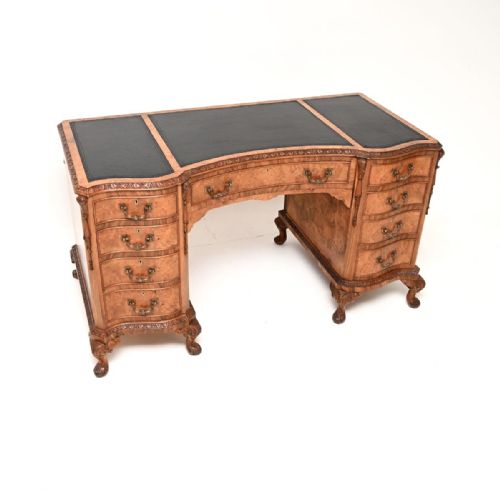
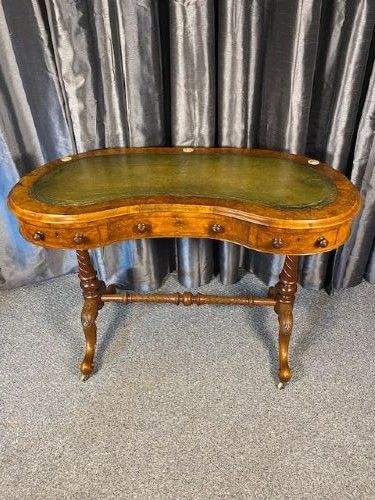
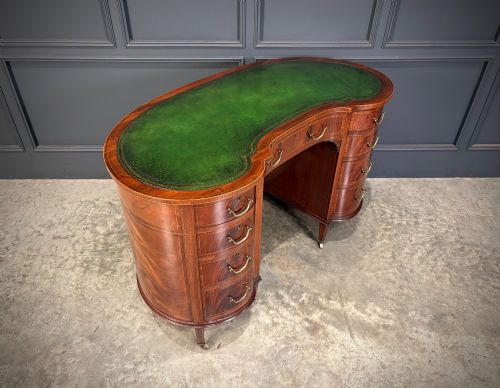
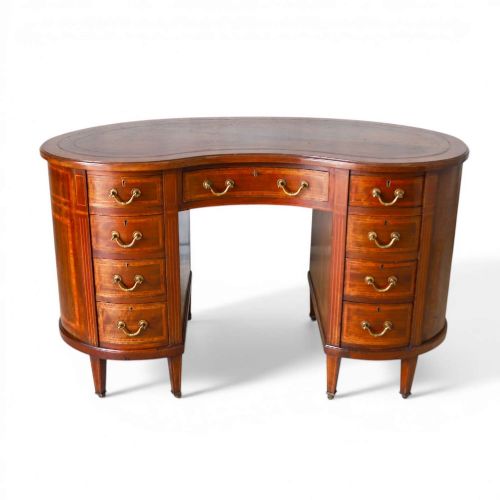
A vintage kidney writing desk takes its characteristic serpentine plan from mid-eighteenth-century French and English precedents, designed to curve comfortably around the sitter. On this page, the form appears most frequently in Edwardian and Victorian iterations, alongside pieces dating from the nineteenth century and the early decades of the twentieth century.
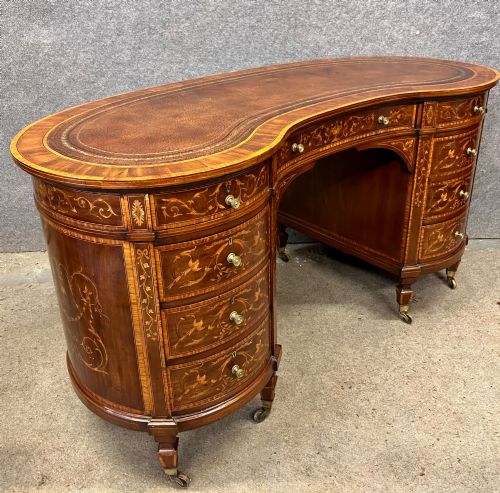
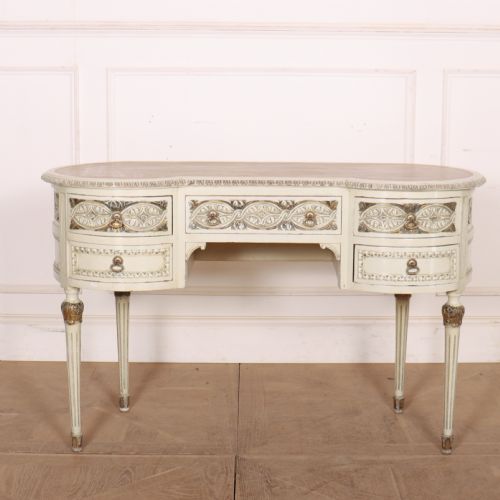
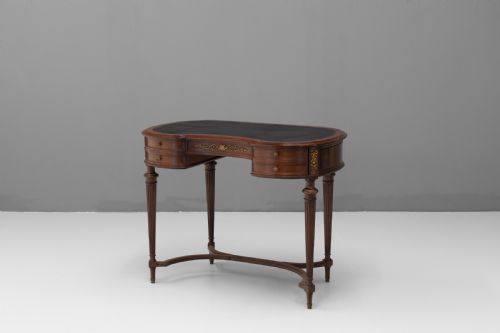
The objects span formal writing tables, pedestal desks, and occasional side tables, often equipped with leather inserts and multiple drawers following the curved outline. Makers adopted styles ranging from Sheraton Revival and Queen Anne Revival to Louis XV Revival and Neoclassical, creating varied interpretations of the distinctive shape.
Surviving examples utilise woods such as mahogany, burr walnut, satinwood, and painted finishes, sometimes mounted with ormolu or brass details. These pieces function as writing desks, dressing tables, and library tables, combining domestic utility with decorative marquetry and inlay work.
Materials and Construction
Cabinet makers constructed the curved carcasses of these desks using solid and veneered timbers such as mahogany and burr walnut, shaping the complex kidney outline to receive inset leather writing surfaces. Marquetry and delicate stringing frequently decorate the writing surfaces and drawer fronts, demonstrating precise joinery suited to serpentine furniture.
Metal mounts in brass and ormolu secure corners and drawers, while traditional patinated leathers form the central writing areas. Painted wood surfaces display layered pigments applied to wooden bases, occasionally paired with fine inlay work in contrasting satinwood.
Listings feature periods from eighteen fifty to nineteen thirty, with Edwardian and nineteenth-century examples appearing most frequently.
Quality and Execution
Quality rests upon the precision of the serpentine curve and the selection of timber veneers, such as burr walnut or figured mahogany, matched symmetrically across the curved top. Superior examples demonstrate tight joints, smooth drawer movement, and refined marquetry inlay rather than simpler painted or plain timber surfaces.
The integration of mounts, brass hardware, and original leather writing panels distinguishes finer workshops from standard production. Execution of revival styles, whether Sheraton, Louis XV, or Neoclassical, relies on the crispness of carved details and the depth of the polished finish.
Wolfe and Hollander·Gillows·Maurice Adams
The Vintage Kidney Writing Desk Glossary
- Kidney shaped
- A curved furniture plan resembling a kidney bean, designed to wrap around the user and provide close access to writing surfaces and drawers.
- Marquetry
- Decorative patterns formed by fitting small pieces of veneer into a wooden background, frequently seen in floral or geometric arrangements on Edwardian desks.
- Ormolu
- Gilded bronze mounts applied to furniture edges and feet, adding decorative metallic highlights to nineteenth-century and revival pieces.
- Pedestal desk
- A heavy freestanding desk supported by two banks of drawers beneath the writing surface, occasionally built in the curved kidney format.
- Sheraton Revival
- A late nineteenth and early twentieth-century style drawing on the light, elegant furniture designs of Thomas Sheraton.
Vintage Kidney Writing Desk: Frequently Asked Questions
What is a kidney writing desk?
A kidney writing desk is a table shaped with a concave front curve that wraps around the user, typically featuring inset leather writing surfaces and multiple small drawers beneath the top.
First popularised in eighteenth-century Europe, the form was revived extensively during the Victorian and Edwardian periods in mahogany, walnut, and inlaid timbers.
How do I date an Edwardian kidney desk?
Edwardian kidney desks date from the period between nineteen hundred and nineteen ten, often identifiable by lighter mahogany timbers, satinwood stringing, and delicate inlaid marquetry.
They frequently display simpler structural lines compared to heavier Victorian predecessors, alongside factory production methods typical of the early twentieth century.
Are these desks suitable for daily work?
These desks provide functional surfaces for writing and administrative tasks, though the curved front naturally limits knee space compared to rectangular pedestal desks.
Buyers often pair them with armchairs or small desk chairs that slide comfortably beneath the central curve of the writing surface.
What woods were used for these desks?
Cabinet makers utilised mahogany, burr walnut, satinwood, and painted finishes to construct these tables, often selecting highly figured veneers for the top surface.
Secondary woods like oak or pine frequently form the internal drawer linings and hidden framing components.