
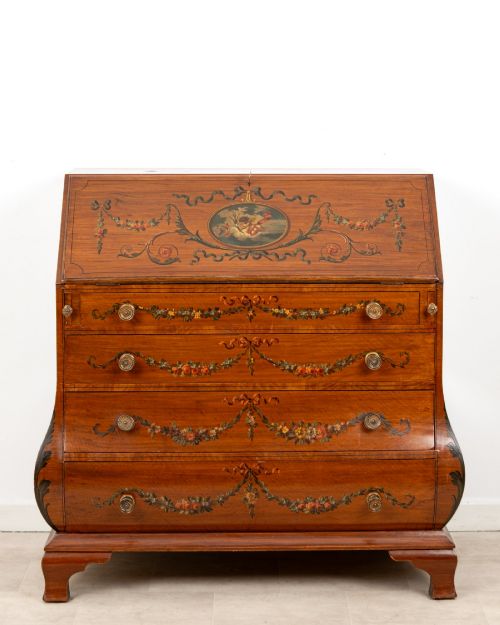
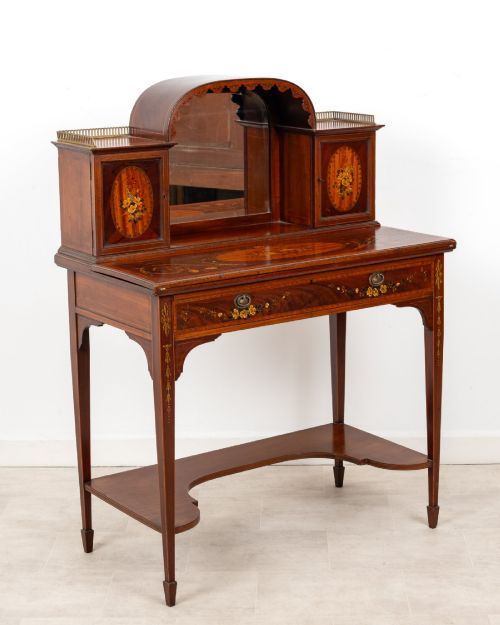


Floral Painted Writing Desk
These floral painted writing desks bring together satinwood, mahogany, and papier-mache to offer a surface for correspondence that brightens any room.
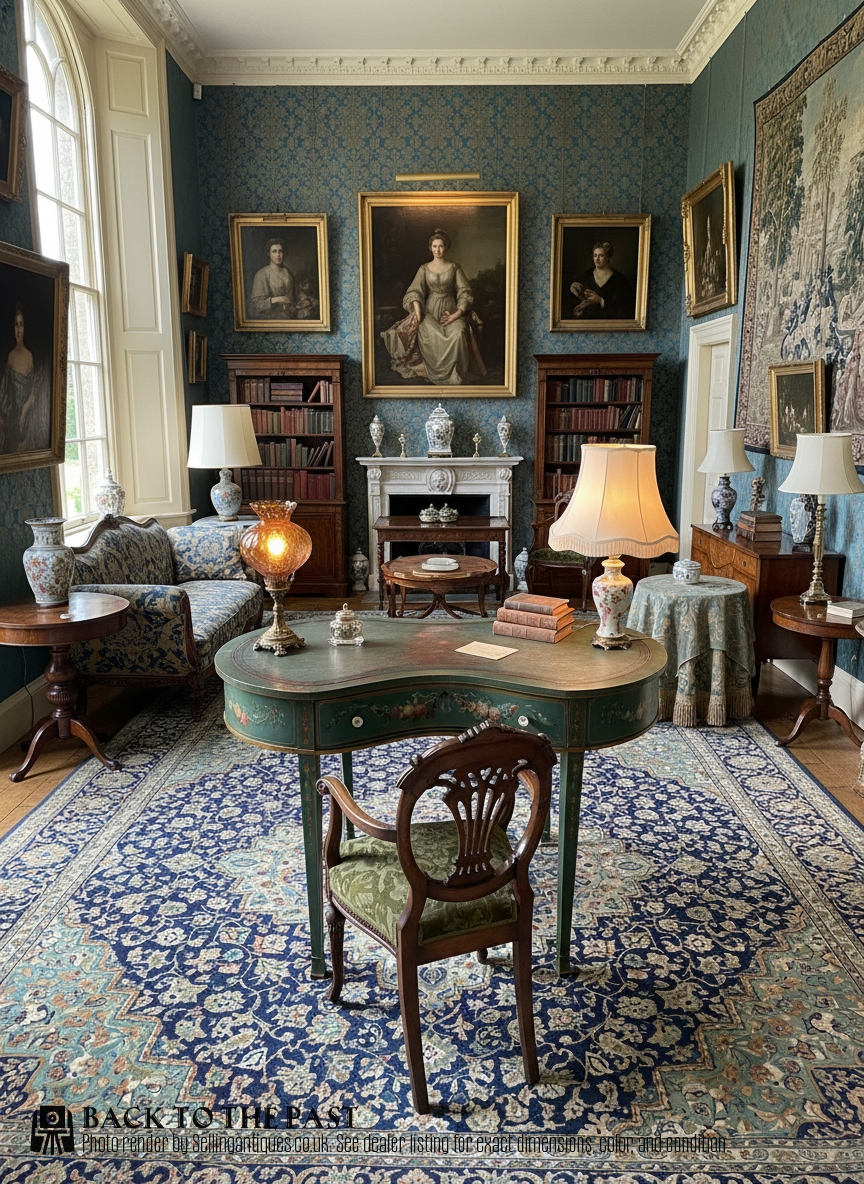
Floral Painted Writing Desk
A floral painted writing desk combines a practical writing surface with decorative floral artwork, spanning periods from George III through to the Edwardian era. You will most frequently encounter Edwardian satinwood and mahogany examples on this page, alongside kidney-shaped desks and bureau chests of drawers.
Beyond standard writing tables, the selection extends to related forms such as bonheur du jour pieces, Carlton House desks, and dressing tables that double as writing spaces. Smaller accessories like porcelain inkstands and papier-mache desk sets also appear alongside the larger furniture.
Origins stretch from the eighteenth century into the twentieth, showing influences from Sheraton Revival, Victorian, and Rococo styles. These pieces serve both as functional furniture and as decorative focal points for a study or bedroom.
How they were made
Cabinetmakers used timbers such as satinwood and mahogany as the structural foundation, often applying detailed paintwork directly onto the wood or incorporating papier-mache for specialised desk sets. Brass handles and leather inserts provide functional contrast to the painted decorative surfaces.
The painted decoration relies on hand-decorated floral motifs, sometimes complemented by porcelain elements such as German inkstands with Schneeballen covers. Construction methods reflect the prevailing cabinetmaking standards of Georgian, Victorian, and Edwardian workshops.
Listings feature periods spanning from the eighteenth century to the 1930s, utilising materials including satinwood, mahogany, brass, leather, porcelain, and papier-mache.
What varies in quality
The finesse of the hand-painted floral decoration separates standard production from finer work, with delicate brushwork and well-preserved pigments indicating superior craftsmanship. The choice of underlying timber, such as figured satinwood rather than plain secondary woods, also elevates a piece.
Structural complexity, such as the curved galleries of a Carlton House desk or the intricate joinery of a kidney-shaped knee-hole desk, marks out the more ambitious examples. The integration of quality brass hardware and intact leather writing surfaces further distinguishes the range.
The Floral Painted Writing Desk Glossary
- Satinwood
- A durable hardwood with a lustrous, golden-yellow sheen that takes painted decoration well. It appears frequently in Edwardian and Sheraton Revival writing furniture.
- Bonheur du jour
- A light lady's writing desk featuring a small cabinet or set of drawers on the upper surface. This French form gained popularity in eighteenth-century England.
- Carlton House desk
- A freestanding writing table featuring a curved superstructure of small drawers and compartments enclosing the rear and sides of the desk. The layout provides numerous organised pigeonholes.
- Papier-mache
- A composite material made from paper pulp or reinforced paper sheets mixed with adhesive, moulded and painted when dry. It provides a smooth base for lacquer and floral designs on nineteenth-century desk sets.
- Schneeballen
- A German ceramic technique utilising applied porcelain rosettes or snowball blossoms densely covering a vessel surface. It is seen on period inkstand covers.
Floral Painted Writing Desk: Frequently Asked Questions
What is a floral painted writing desk?
A floral painted writing desk is a piece of antique furniture designed for correspondence, featuring hand-painted floral motifs on surfaces such as satinwood or mahogany. These desks range from compact Edwardian bureau chests to larger knee-hole tables.
They combine practical writing surfaces with ornamental artistry, often reflecting Georgian, Victorian, or Edwardian design traditions.
How do I date a painted desk?
Dating relies on examining the timber construction, the style of the painted decoration, and the overall cabinet form. Edwardian pieces often utilise bright satinwood and delicate floral sprays, while Georgian examples show heavier proportions and restrained ornamentation.
Hardware styles and secondary woods inside drawers also help establish the correct period of manufacture.
How do I care for painted wood surfaces?
Care involves keeping the desk away from direct sunlight and excessive heat to prevent the painted decoration and timber from fading or cracking. Dusting with a soft, dry cloth is usually sufficient for maintenance.
Harsh chemical polishes should be avoided to protect the integrity of the original hand-painted floral artwork.