


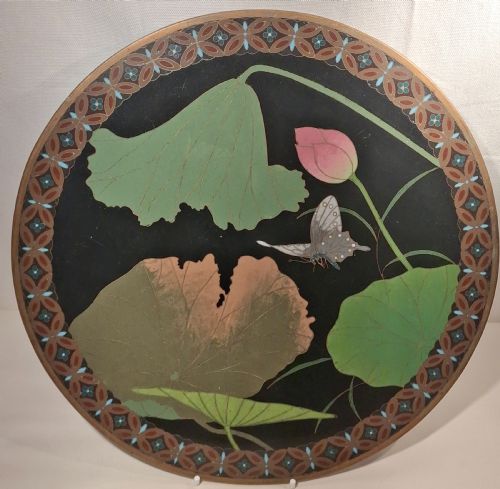


Vintage Japanese Cloisonne Dish
These vintage japanese cloisonne dish pieces bring intricate enamelling and rich metalwork into a room, offering collectors bold imagery from nature and folklore.
Vintage Japanese Cloisonne Dish
A vintage japanese cloisonne dish encompasses chargers, plates, bowls, trays, and plaques created across the Edo and Meiji periods. You are most likely to meet circular decorative chargers and plates adorned with birds, dragons, koi, and mount fuji.
The objects stem from workshops operating between the mid nineteenth century and the opening years of the twentieth century. Examples range from compact trays to large chargers measuring over thirty centimetres across.
Makers shaped these surfaces to depict auspicious symbols, samurai, demons, and detailed floral tendrils. Each vessel functions primarily as a decorative display piece rather than practical tableware.
How they were made
Artisans formed the body using copper, bronze, or copper alloy to create the foundational plate, bowl, or charger. They then soldered fine brass wire or silver wire onto the metal base to map out intricate cellular designs.
Craftsmen filled the created compartments with coloured enamel paste before firing the metal object in a kiln. Successive applications of enamel built up the design until the surface reached the desired depth and smoothness.
Listings feature items from the eighteen fifties through to nineteen hundred, encompassing both Edo and Meiji periods.
What varies in quality
The fineness of the wirework dictates much of the visual precision, separating dense, complex cellular patterns from simpler layouts. Artisans who executed tighter curves and thinner metal lines achieved greater detail in motifs like feathers, scales, and foliage.
Colour depth and the smoothness of the polished enamel surface also set pieces apart. Superior examples display even vitrification across the entire plate without pitting, while master workshops achieved subtle tonal gradations in subjects such as dragons, koi, and birds.
Kinkozan
The Vintage Japanese Cloisonne Dish Glossary
- Cloisonne Enamel
- A technique where metal wires are soldered to a base to form cells that hold coloured glass paste. Craftsmen fire the vessel repeatedly to fuse the enamel before polishing the surface flat.
- Charger
- A large decorative plate intended for display on a wall or stand rather than for dining use. These pieces often feature the most ambitious pictorial compositions.
- Meiji Period
- The historical era spanning from eighteen sixty-eight to nineteen twelve, noted for exceptional metalwork and cloisonne production. Objects from this time often exhibit highly refined pictorial detail.
- Edo Period
- The period lasting from sixteen hundred and three to eighteen sixty-seven, preceding the Meiji era. Vessels from this earlier time employ robust forms and traditional motifs.
- Ho-o
- A mythical bird or phoenix frequently depicted in Japanese art as a symbol of virtue and grace. Artists rendered this creature with elaborate plumage and trailing tail feathers.
- Mon
- A traditional Japanese heraldic emblem or crest used to identify families or clans. These circular badges appear frequently among floral tendrils and geometric borders.
Vintage Japanese Cloisonne Dish: Frequently Asked Questions
How should I display a large charger?
Large chargers work best mounted securely on a wall or supported by a sturdy display stand on a cabinet. Ensure the mounting hardware accommodates the weight of the metal and enamel body.
Keep the piece away from direct sunlight to preserve the richness of the coloured enamel over time.
What motifs appear on these dishes?
Common subjects include dragons, leaping koi, owls, ibises, phoenixes, and Mount Fuji. Many pieces also incorporate auspicious symbols, mon crests, and detailed floral tendrils.
Fewer examples focus purely on geometric patterns without central animal or landscape imagery.
How do I distinguish Edo from Meiji pieces?
Edo period vessels often date from the mid nineteenth century and tend to feature heavier construction with traditional designs. Meiji period items typically display finer wirework and highly detailed pictorial scenes.
Both eras utilise copper and bronze bases with vibrant enamel fills.
Are these vessels signed by makers?
Some pieces carry artist signatures or workshop marks embedded into the base or incorporated into the design. Signatures help attribute the work to specific producers like Kinkozan.
Unsigned pieces remain common and are judged purely on their artistic execution and technical merit.