
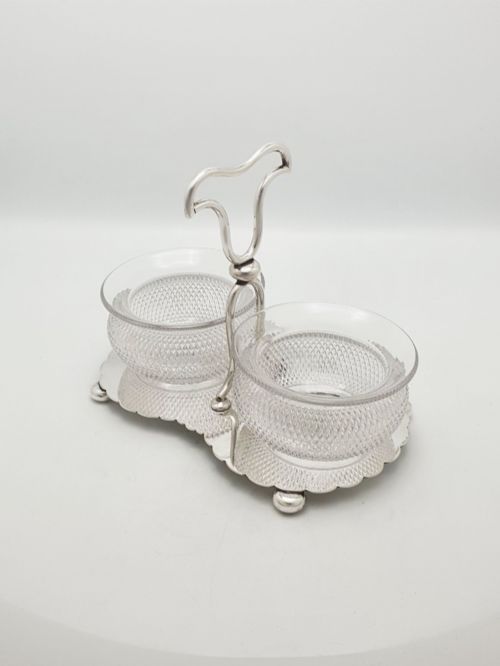


Vintage Jam Dish
A vintage jam dish brings table service alive, offering brilliant colour and bright metalwork to hold preserves with genuine period character.
Vintage Jam Dish
A vintage jam dish serves preserves at the table, combining a glass vessel with a supportive metal stand or frame. These pieces range across several periods, drawing on Victorian, Edwardian, and Art Deco designs to hold jams, jellies, and relishes.
You will most frequently meet examples featuring vibrant cranberry glass or cut glass paired with silver plate. Many include fitted spoons or twin bowls set into metal frames.
The form adapts to various table settings, appearing as single pots with lids, open baskets with swinging handles, or twin condiment stands. Each variation reflects the dining customs of its specific era.
Materials and construction
Glass production relies on lead crystal and pressed glass techniques, particularly shaped as cut glass or rich cranberry glass. These glass bodies provide both the visual weight and the translucent colour central to each piece.
Metal components utilise silver plate and sterling silver over a base metal, alongside copper and brass for stands and frames. Silversmiths formed these mounts to cradle the glass securely while adding decorative handles and rims.
Listings feature items spanning the Georgian period through to Art Deco designs of 1930.
Judging quality and design
Quality rests in the harmony between the glass vessel and its metal mount, where precise fitting distinguishes superior work. Heavy lead crystal and thick silver plating demonstrate a higher standard of manufacture than lighter, utilitarian alternatives.
Design distinction separates standard production from exceptional pieces shaped like natural forms, such as an apple. The execution of chased metalwork and the depth of glass cutting determine the overall refinement of the object.
Hukin and Heath
The Vintage Jam Dish Glossary
- Cranberry glass
- A rich red-pink glass coloured with gold chloride during melting. This material gained immense popularity during the Victorian period for tableware.
- Silver plate
- A thin layer of pure silver bonded to a base metal such as copper or nickel brass. This technique allowed manufacturers to produce tableware with the appearance of solid silver at a lower cost.
- Lead crystal
- Glass containing lead oxide to increase brilliance, weight, and clarity. It allows for deep, sharp cutting that reflects light brightly.
- Preserve pot
- A dedicated vessel designed to hold jams, marmalades, or fruit preserves. They frequently include a matching lid and an aperture for a spoon.
- Relish caddy
- A metal frame or basket designed to hold multiple small glass condiment or preserve bowls together. They often feature a central carrying handle for table service.
Vintage Jam Dish: Frequently Asked Questions
What is a vintage jam dish used for?
These dishes served jams, marmalades, and fruit preserves during breakfast and afternoon tea. They kept sweet spreads neatly contained on the dining table.
Many designs included a matching spoon and a fitted lid to keep preserves fresh between uses.
How do I identify an Edwardian jam dish?
Edwardian pieces often feature bright silver plate frames combined with vibrant cranberry glass bowls. The styling leans towards light, elegant mounts rather than heavy Victorian ornamentation.
Look for pieces dated around the early twentieth century that display refined floral or simple geometric motifs in the metalwork.
What is cranberry glass?
Cranberry glass is a distinctive transparent red glass created by adding gold to the molten batch. It became a staple of Victorian and Edwardian dining tables.
The colour ranges from a pale pink to a deep rich red depending on the gold concentration and manufacturing technique.
How should I clean silver plated stands?
Clean silver plated mounts gently using a soft cloth and a specialised silver polish formulated to protect thin plating. Avoid harsh abrasives that can wear away the silver layer.
Wash the glass bowls separately in warm soapy water and dry them thoroughly before placing them back into the metal frame.