



Vintage Green Glass Goblets
These vintage green glass goblets bring deep colour and historic weight to the table, combining functional drinking vessels with rich decorative presence.
Vintage Green Glass Goblets
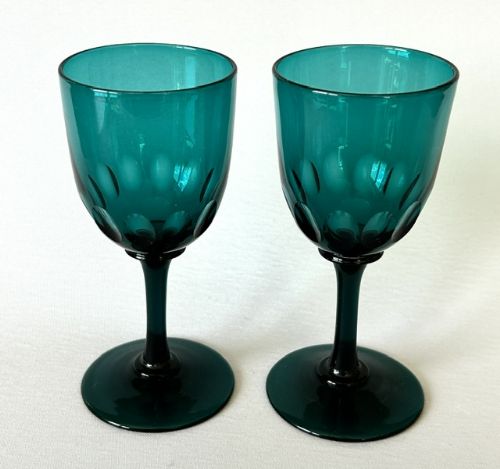
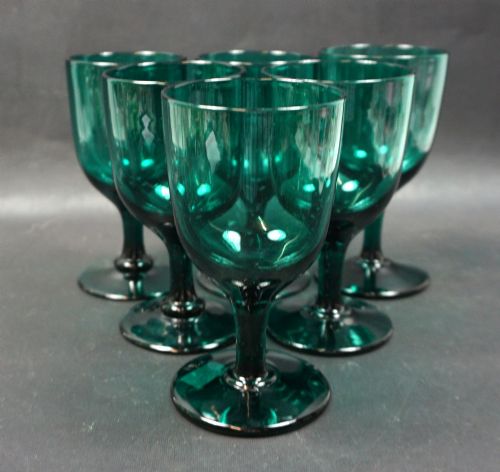
Vintage green glass goblets encompass a rich variety of drinking vessels spanning the Georgian, Victorian, and Edwardian eras, extending into the Art Deco period. Buyers seeking vintage green glass goblets will encounter forms ranging from heavy rummers and roemers to slender hock glasses and champagne coupes.
The selection includes English Bristol green sets alongside continental European pieces from makers in Bohemia, France, and Germany. Most examples date from the nineteenth and early twentieth centuries, reflecting diverse regional tastes in coloured tableware.
Materials and methods
Maker utilisation of glass and lead glass formed the structural base for these vessels, often through traditional blowing techniques. Cased glass methods allowed layers of coloured crystal to be fused, creating deep tones like emerald and turquoise.
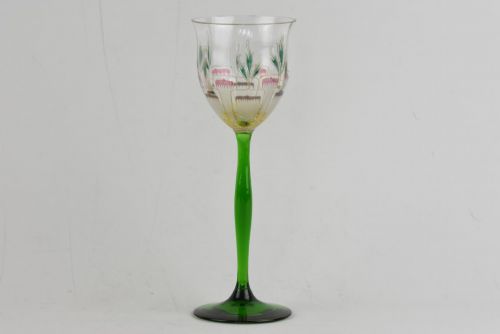
Surface decoration frequently involved polychrome enamel, gold leaf, and hand-cutting to reveal contrasting layers beneath. These finishing techniques demanded skilled handwork, particularly on floral enamelling and geometric cut facets.
The listings span from the Georgian period through Victorian times to Art Deco twentieth-century production.
Assessing quality
Quality rests upon the depth and clarity of the coloured glass, the precision of lead crystal ringing, and the fineness of the hand-applied enamel or cut facets. Superior pieces display crisp optical lines and securely adhered decorative pigments rather than muddy hues or blurred engraving.
The weight and balance of the stem and foot relative to the bowl indicate the maker's skill. Matched sets with uniform thickness and consistent colour distribution command greater interest than assembled groups with tonal variations.
Baccarat·Harry Powell for James Powell·Theresienthal·St Louis Massenet·Frits Hechert
The Vintage Green Glass Goblets Glossary
- Roemer
- A large traditional continental drinking vessel featuring a wide bowl and a stem studded with prunts. These pieces often display rich forest or pale green hues.
- Cased glass
- A method where a layer of coloured glass is fused over a clear or contrasting inner layer. Cutting through the outer layer reveals the contrasting colour underneath.
- Hock glass
- A tall stemmed wine glass traditionally used for German white wines. They frequently appear in vibrant green or turquoise shades with elaborate bowl decoration.
- Rummer
- A heavy, short-stemmed drinking glass popular in the Georgian and Victorian periods. They were designed for robust use with ale, wine, or punch.
- Prunt
- An applied blob of molten glass melted onto the stem of a goblet to provide a secure grip. They are characteristic of traditional Germanic and Bohemian glassware.
Vintage Green Glass Goblets: Frequently Asked Questions
Were these goblets used for wine?
Many were indeed utilised for wine, hock, or cordials, though their specific function depended on the era and the capacity of the bowl.
Smaller vessels served for liqueurs and dessert wines, while larger rummers accommodated heavier tavern drinks.
How can I tell Victorian from Georgian pieces?
Georgian examples often display heavier pontil marks on the base and thicker, hand-blown forms with simpler, robust profiles.
Victorian pieces frequently introduce more complex mould-blowing, brighter chemical colours like vaseline green, and elaborate surface engraving or enamelling.
Can I use them for daily dining?
While structurally sound, antique glass benefits from careful handling and is best reserved for special occasions rather than rough everyday service.
Hand-enamelled and gilded surfaces require gentle treatment to preserve the historic decoration over time.