


Vintage Glass Powder Jar
A vintage glass powder jar sits on the dressing table as a useful receptacle for cosmetics, rendered here in styles from Victorian to Art Deco.
Vintage Glass Powder Jar
When you search for a vintage glass powder jar, you encounter vanity vessels designed to hold loose powder, creams, and toilet preparations on dressing tables. These objects combine functional glassware with decorative lids, appearing most frequently in forms dating from the Edwardian period and the 1920s Art Deco era.
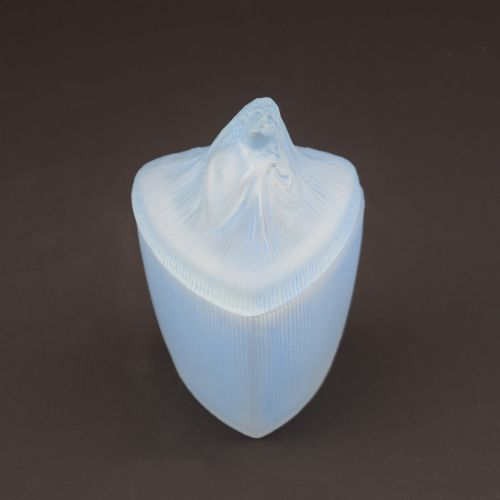
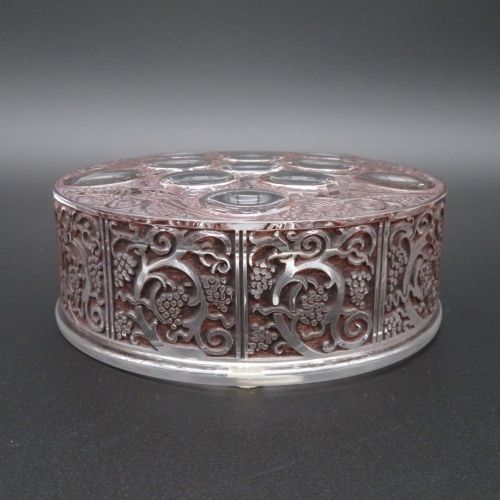
The assortment spans diverse silhouettes, including circular powder boxes, heart-shaped crystal containers, and tall dressing table jars. Makers utilised coloured, frosted, cut, and overlay glass to create these vanity accessories, often pairing them with matching trays or perfume bottles.
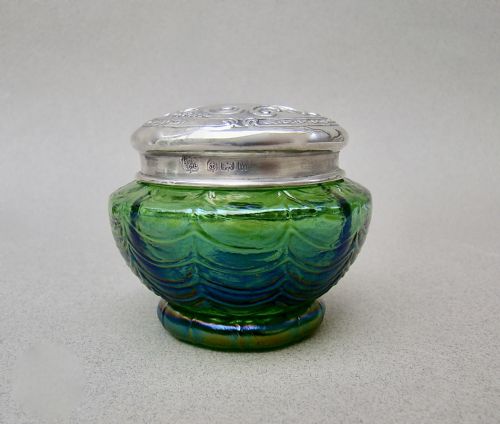
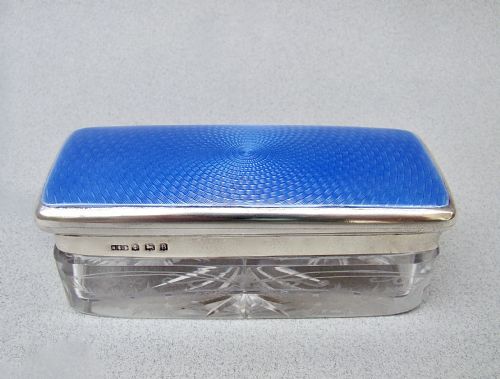
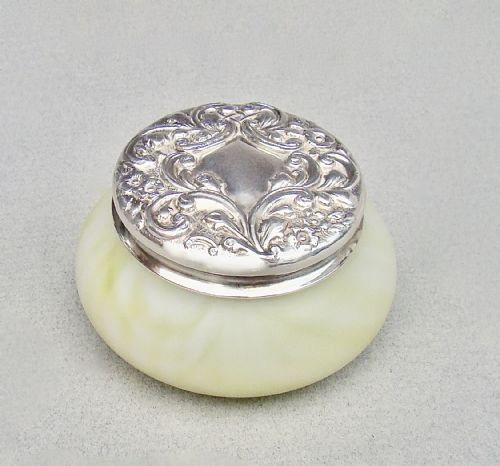
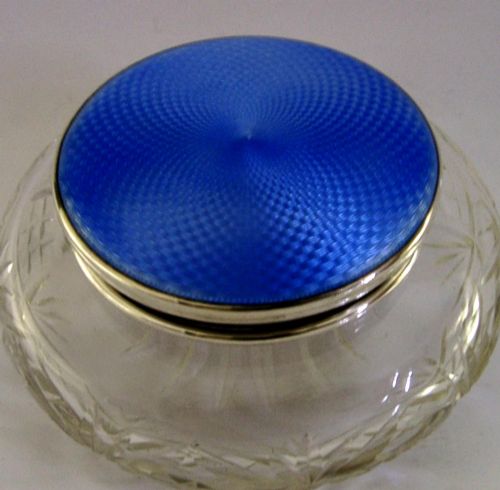
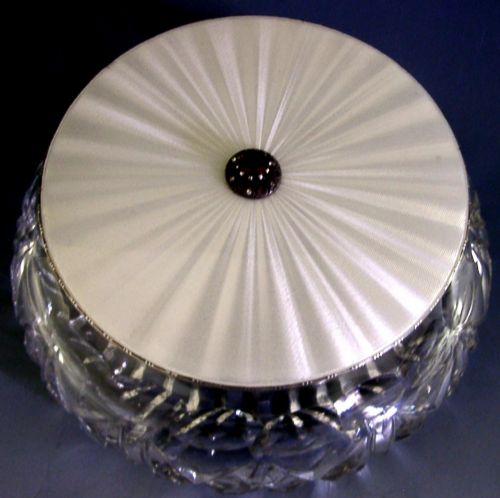
Many examples incorporate precious metal mounts, pairing crystal bases with sterling silver lids bearing hallmarks from assay offices such as Birmingham. Others feature intricate guilloche enamel decoration or coloured glass bodies in shades of blue, green, amethyst, and cranberry.
Materials and Manufacture
Craftsmen produced these vessels using heavy lead crystal, cut glass, or moulded glass, sometimes employing satin or frosted finishes to diffuse light. Coloured glass varieties - such as deep cranberry, vibrant blue, and rich amethyst - were achieved through metallic oxides added during the melting process.
Lids and mounts typically rely on sterling silver, shaped to fit the contours of the glass rim and secured with hinges or lift-off fittings. Silversmiths embellished these metallic elements with engine-turned guilloche enamel, translucent coloured enamel layers, or inset tortoiseshell panels.
Specialised manufacturers utilised press-moulding techniques for artistic crystal pieces, creating three-dimensional motifs such as figurative panels or geometric patterns characteristic of the early twentieth century.
Some powder jars double as rouge pots, proving that past generations took serious, portable vanity very seriously indeed.
Markers of Quality
The distinction between standard commercial pieces and finer examples rests on the depth and clarity of the glass cutting and the weight of the metal mount. Heavier crystal bases with sharp, well-defined faceting indicate superior material and skilled hand-polishing.
The execution of the enamel work and the precision of the silver hallmarks determine the tier of craftsmanship. Intricate engine-turning beneath translucent guilloche enamel or intact, hand-painted details on coloured glass elevate the piece significantly above plain production wares.
A. J. Pepper & Co·Henry Clifford Davis·A. Bromet & Co·Rene Lalique·Posen
The Vintage Glass Powder Jar Glossary
- Guilloche enamel
- A decorative technique involving precise mechanical engraving beneath a translucent layer of coloured enamel. This method produces repeating geometric patterns that catch the light.
- Cut crystal
- High-clarity glass containing lead oxide, shaped and patterned with wheel-cut facets. The lead content increases the refractive index, giving the material a brilliant sparkle.
- Satin glass
- Glass treated with hydrofluoric acid vapour or sandblasting to produce a dull, velvety surface texture. It diffuses light softly across the body of the jar.
- Sterling silver
- An alloy consisting of 92.5 percent silver and 7.5 percent other metals, usually copper. It provides the durable framework for fitted lids and collars on dressing table jars.
- Assay office
- An official body that tests the purity of precious metals and stamps them with hallmarks. Marks from Birmingham indicate the specific origin and year of manufacture for the silver mounts.
Vintage Glass Powder Jar: Frequently Asked Questions
What were glass powder jars used for?
These jars held face powder, dusting powders, and cosmetic preparations on Victorian and Edwardian dressing tables. They kept powders dry and hygienic while contributing to the decorative arrangement of dressing table sets.
As dressing habits evolved through the twentieth century, they transitioned from utilitarian dressing room items into decorative display pieces. Collectors now use them on modern vanity surfaces to store small trinkets and accessories.
How do I identify an Art Deco powder jar?
Art Deco examples feature geometric motifs, stylised floral reliefs, and strong symmetrical lines. They frequently employ contrasting materials, such as clear cut glass paired with brightly coloured blue or pink enamel on silver lids.
Look for streamlined silhouettes and moulded crystal forms produced during the 1920s and 1930s. Maker signatures or hallmarks from this period often confirm the specific decade of manufacture.
What is guilloche enamel?
Guilloche is a decorative technique where a metal surface is mechanically engraved with intricate, repetitive geometric patterns using a rose engine lathe. A translucent layer of coloured enamel is then applied over the engraving so the pattern shows through.
This finish appears frequently on silver lids from the early twentieth century, particularly in shades of blue, pink, and white. The quality depends on the clarity of the enamel and the precision of the underlying metalwork.
How do I date a silver lidded jar?
British silver mounts feature a series of hallmarks that indicate the assay office, the standard of silver, and the year of manufacture. A specific letter stamp corresponds to the year the piece was tested and certified.
Style indicators also help establish the era, with heavy ornamentation pointing towards the Victorian and Edwardian periods, while clean geometric lines suggest the 1920s and 1930s.