


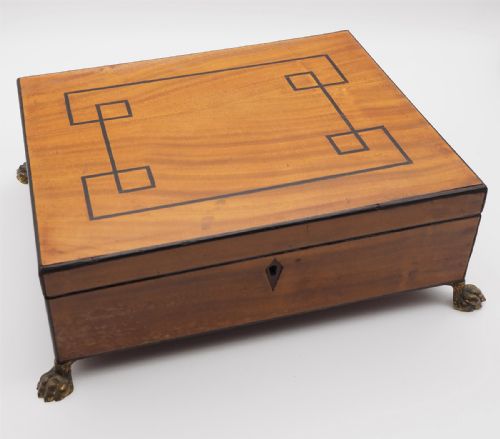


Brass Footed Trinket Box
These brass footed trinket box pieces are small containers raised on metal supports, offering a neat way to store small personal valuables.
Brass Footed Trinket Box
When you search for a brass footed trinket box, you are looking at small lidded containers designed to hold jewellery, keepsakes, and personal items. The pieces on this page span several distinct periods including the Georgian and Victorian eras, alongside Regency designs.
The forms vary from dedicated jewellery caskets to small decorative boxes and tea caddies adapted for domestic storage. Most examples rely on timber foundations enriched with metal mounts, while others utilise glass or leather coverings.
Origin points range from British workshops to French studios and Anglo-Indian makers. You are most likely to meet 19th-century timber boxes featuring distinct metal feet and structural mounts.
Materials and construction
Maker workshops built these pieces using solid or veneered hardwoods such as rosewood, sandalwood, and satinwood over sturdy timber carcases. Exterior surfaces frequently received decorative treatments including penwork, leather binding, and inlay work.
Metal components, particularly brass mounts and claw and ball feet, were cast or stamped separately before being fixed to the base and corners of the box. Glass panels and enamelling appear on specific French pieces from the later nineteenth century.
Brass Footed Trinket Box Retail Price Guide 2026
Typical asking prices for brass footed trinket box among the pieces listed under this phrase on Sellingantiques today, from the lower quarter to the upper quarter. They describe what is for sale here now, not the wider market.
Listings feature wood, leather, bone, and glass materials across the nineteenth century.
Qualities of craftsmanship
The standard of a brass footed trinket box rests on the precision of its timber construction and the crispness of its metal mounts. Finer examples display meticulous inlay, well-fitted lids, and securely fastened feet that integrate naturally with the box proportions.
Lower tiers of quality show simpler timber selection and cast metal elements with softer detail or less careful attachment to the main body. The complexity of the surface decoration, whether penwork, ebony stringing, or glass enamelling, further separates basic containers from more ambitious studio work.
The Brass Footed Trinket Box Glossary
- Regency
- A style period dating from the early nineteenth century defined by classical restraint and elegance. Pieces from this era often incorporate fine timber veneers and delicate metal mounts.
- Rosewood
- A dense, dark timber prized for its rich grain and deep colour. It provides a durable and polished exterior surface for nineteenth-century boxes.
- Penwork
- A surface decoration technique using ink applied by pen to create intricate monochrome designs on wood. This detailed work appears on Georgian pieces.
- Claw and ball
- A decorative foot shape representing a talon gripping a sphere. It raises the box slightly off the surface and adds a sculptural element to the base.
- Sandalwood
- An aromatic timber native to India used in the construction of imported boxes. It brings a distinctive pale tone and natural scent to the object.
Brass Footed Trinket Box: Frequently Asked Questions
What fits inside a trinket box?
These small containers suit rings, brooches, small pocket watches, and other delicate personal items that require safe storage on a dressing table.
Historically, owners used them for everyday valuables rather than bulkier possessions.
How do I care for wooden boxes?
Keep timber boxes away from direct sunlight and sudden temperature shifts to protect the wood and veneer from drying out.
An occasional light dusting with a dry cloth maintains the polished finish without harming antique surfaces.
How are Regency and Victorian boxes different?
Regency pieces lean towards classical lines with restrained brass mounts and exotic timber veneers like satinwood and rosewood.
Victorian boxes often introduce wider material variety, including glass panels, enamelling, and heavier surface ornament.
Were these boxes made in Britain?
Many examples originate from British workshops, though the listings also include imported pieces from French makers and Anglo-Indian craftsmen.
Materials such as sandalwood point directly to global trade routes active during the nineteenth century.