

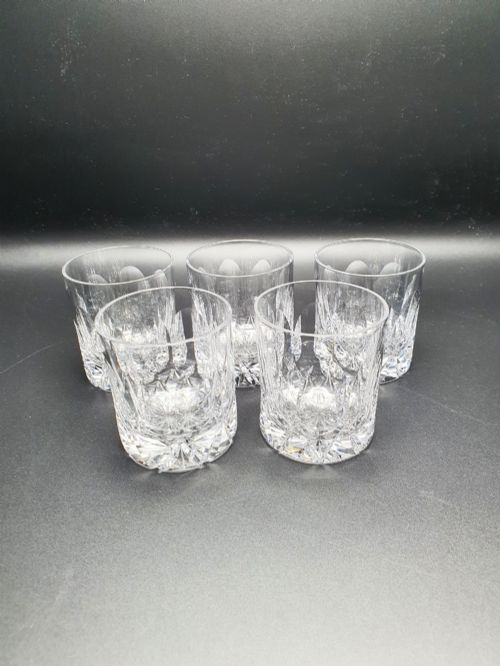
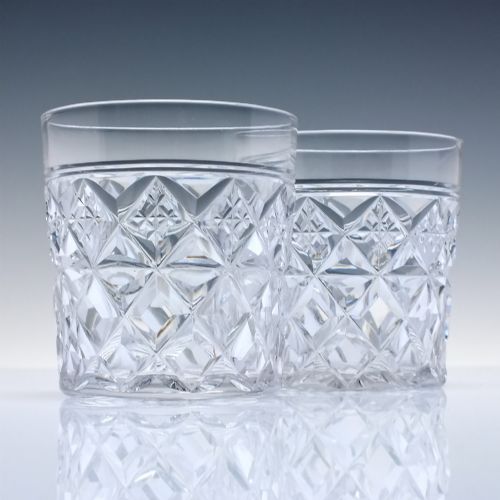
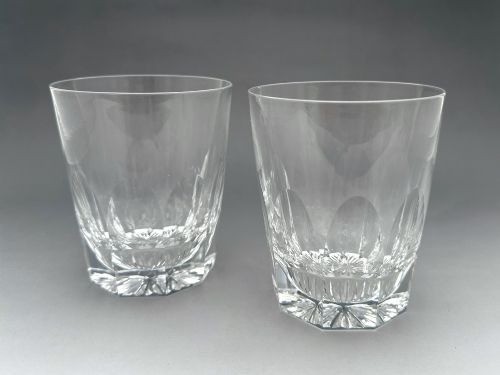
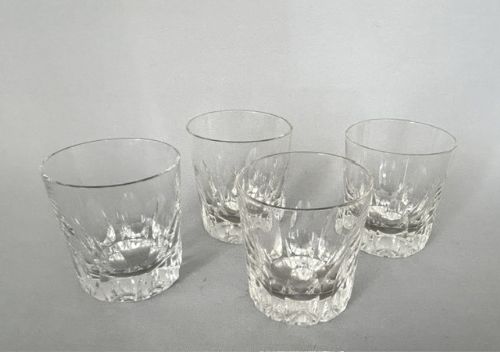


Vintage Cut Glass Tumblers
Vintage cut glass tumblers bring weight and sparkle to the table, and choosing the right set is simply a matter of looking at how the facets catch the light.
Vintage Cut Glass Tumblers
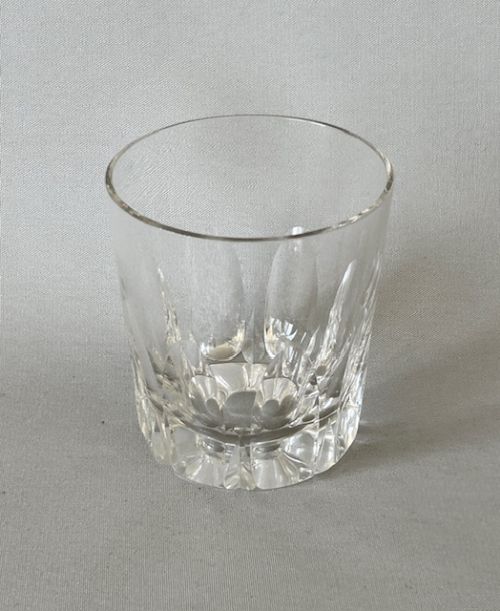
Vintage cut glass tumblers span the Victorian era, the Edwardian period, and the 1920s and 1930s, turning everyday drinkware into heavy, decorative drinking vessels. When searching for vintage cut glass tumblers, buyers encounter everything from small Victorian whisky beakers to robust sets from the early twentieth century.
The pieces on this page include Georgian and Victorian origins, alongside Bohemian and Czech examples in clear or ruby flash glass. Many take the form of heavy whiskey tumblers, cordial glasses, or matched sets designed for spirits.
Most pieces date from the nineteenth and early twentieth centuries, reflecting changing tastes from ornate Victorian engraving to geometric Art Deco forms. Buyers will find individual beakers, pairs, and larger matched sets ready for use.
Materials and construction
These items are shaped from crystal, lead glass, and clear or coloured glass, relying on heavy material composition to achieve a substantial feel in the hand. The glass is worked while hot, then left to cool before decorators apply surface designs.
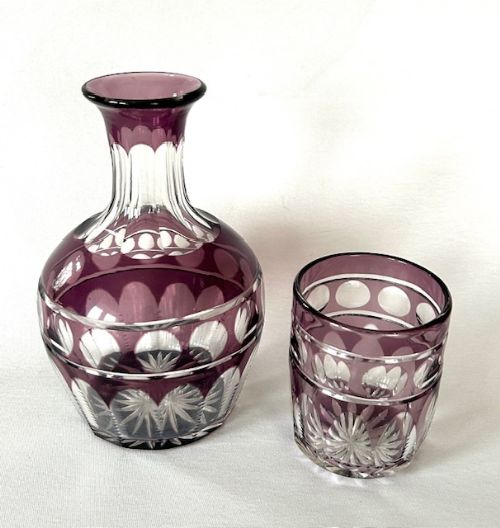
Makers utilised wheel engraving and deep cutting techniques to carve geometric, floral, or figurative patterns directly into the surface. Ruby flash glass pieces combine clear material with a thin coloured outer layer that is partly cut away to reveal the clear glass beneath.
Vintage Cut Glass Tumblers Retail Price Guide 2026
Typical asking prices for vintage cut glass tumblers among the pieces listed under this phrase on Sellingantiques today, from the lower quarter to the upper quarter. They describe what is for sale here now, not the wider market.
The object forms on this page range from whisky tumblers and cordial glasses to carafes, decanter sets, and engraved vases.
Quality and craftsmanship
The distinction between standard drinkware and finer examples lies in the crispness of the wheel engraving and the depth of the cuts. Sharper facets refract light more cleanly, while softer or shallower marks indicate a simpler production method.
Weight and metal content also separate the tiers, with lead crystal vessels offering a clearer ring and greater heft than ordinary soda-lime glass. Consistency across a set of multiple tumblers dictates the overall desirability for collectors.
Stuart Crystal
The Vintage Cut Glass Tumblers Glossary
- Cut glass
- Glassware decorated by grinding and polishing facets into the surface using rotating wheels. This process creates geometric patterns that catch and scatter light.
- Lead crystal
- Glass containing a high proportion of lead oxide, which increases the weight, refractive index, and clarity of the material. It allows for deeper and sharper cutting.
- Ruby flash glass
- Clear glass coated with a thin outer layer of red glass before being cut or engraved. The process exposes the clear base beneath to create contrasting red and clear patterns.
- Wheel engraving
- A decoration technique where a small rotating copper or stone wheel cuts fine figurative or floral details into the glass surface. It requires a high degree of skill from the artisan.
- Tumbler
- A flat-bottomed drinking glass without a handle or stem, designed originally for spirits and water. Antique versions often feature heavy bases and thick walls.
Vintage Cut Glass Tumblers: Frequently Asked Questions
How do I date vintage cut glass tumblers?
Dating relies on stylistic clues, weight, and the sharpness of the facets. Victorian pieces often feature softer hand-cut designs, whereas Edwardian and 1920s examples show crisper wheel work.
Material composition also helps narrow the era, as heavier lead crystal became more common towards the late nineteenth century and beyond.
Can I use antique tumblers for daily drinks?
Most antique tumblers are robust enough for occasional use with spirits or water, provided they are handled with care. Hand washing is essential to preserve the clarity and surface facets.
Avoid sudden temperature changes, such as pouring boiling water into cold lead glass, to prevent thermal shock.
What is the difference between glass and crystal?
Traditional glass is lighter and more basic in composition, while crystal contains added metal oxides that increase its density and brilliance. This extra weight makes crystal tumblers feel more substantial in the hand.
Crystal also produces a distinct resonant ring when tapped gently, unlike standard glass.
Why do some ruby tumblers look clear in places?
Those pieces are made using ruby flash glass, where a clear glass vessel receives an outer coating of red glass. The maker cuts through the red layer to reveal the clear glass underneath, forming a two-tone pattern.
This technique creates strong visual contrast without requiring the entire piece to be cast in solid coloured glass.