



Cut Glass Drinking Tumblers
These cut glass drinking tumblers are heavy, light-catching vessels for the table, prized for their brilliant wheel-cut facets and solid hand-finished bases.
Cut Glass Drinking Tumblers
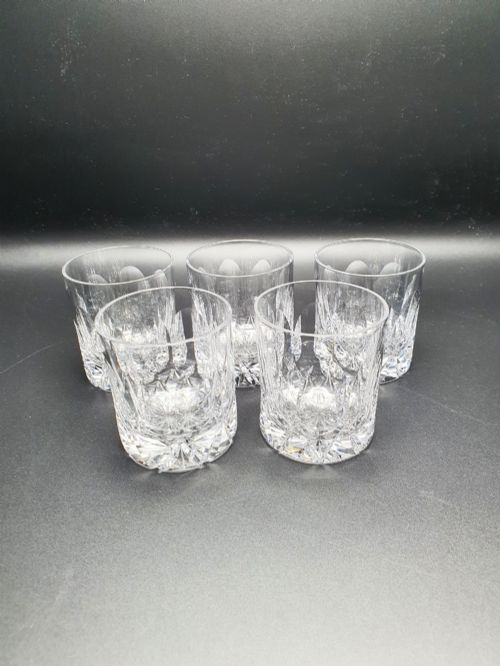
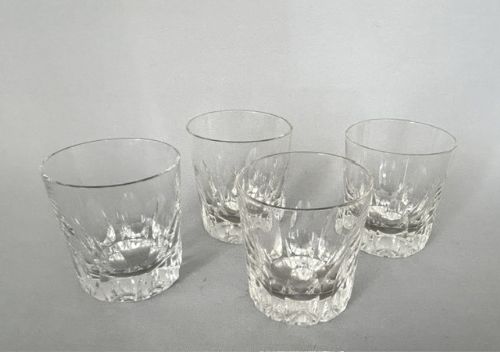
When buyers search for cut glass drinking tumblers, they encounter robust vessels spanning the Georgian, Victorian, and Edwardian eras. The selection ranges from single Georgian flip glasses and blaze-cut whisky tumblers to matched sets of six or eight Edwardian crystal glasses.
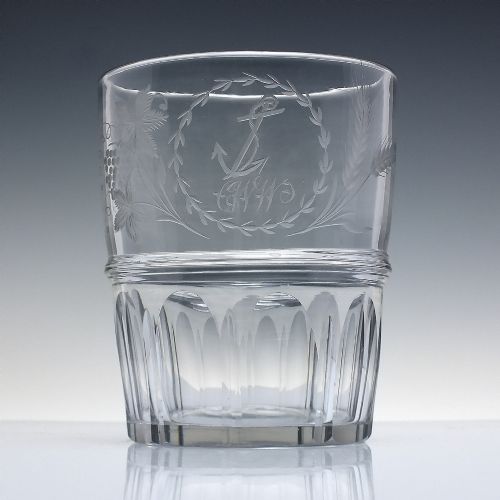
Most examples found here take the form of small whisky tumblers, heavy beakers, and engraved drinking vessels intended for daily service or formal dining. Origins lean towards English workshops alongside Bohemian pieces featuring ruby flash glass.
Forms include straightforward cylindrical shapes as well as taller flip glasses designed for specific historical drinks. Collectors find pairs, small groupings, and occasional larger sets preserved from the nineteenth and early twentieth centuries.
How they were made
The makers relied on heavy lead glass and crystal glass, blown by hand into forms that could withstand deep wheel-cutting. This dense material allowed artisans to cut sharp, light-catching facets across the surface without compromising the structural integrity of the vessel.
Decoration combined mechanical wheel-cutting with hand engraving and acid etching to create contrasting matte and polished motifs. Ruby flash glass pieces involved casing a clear glass body with a thin layer of red glass before cutting through the coloured exterior to reveal the clear metal beneath.
Cut Glass Drinking Tumblers Retail Price Guide 2026
Typical asking prices for cut glass drinking tumblers among the pieces listed under this phrase on Sellingantiques today, from the lower quarter to the upper quarter. They describe what is for sale here now, not the wider market.
Some heavy Georgian flip glasses were designed with exceptionally thick bases so patrons could slam them onto tavern tables without breaking the bowl.
What varies in quality
Quality rests in the crispness of the wheel-cut facets and the weight of the metal itself. Superior pieces display sharp, precise geometric cuts that feel substantial and balanced in the hand.
Engraving depth and clarity distinguish standard production from finer work. Pieces with finely detailed acid etching or hand engraving exhibit greater precision in the decorative motifs.
The Cut Glass Drinking Tumblers Glossary
- Flip glass
- A tall, tapered drinking tumbler popular in the Georgian period, often featuring engraved decoration. These vessels were used for serving specific mixed drinks.
- Ruby flash glass
- Clear glass coated with a thin layer of red glass before being cut. The cutting process exposes the clear glass underneath to form contrasting patterns.
- Lead crystal
- Glass containing a high proportion of lead oxide, increasing weight, brilliance, and refractive index. This material is standard for quality cut glassware.
- Blaze cut
- A specific style of bold, linear faceting found on Georgian and Regency drinking vessels. The cuts create broad flashes of reflected light across the heavy base.
Cut Glass Drinking Tumblers: Frequently Asked Questions
How do I date an old tumbler?
Dating relies on the weight of the metal, the style of the cutting, and the shape of the base. Georgian and Regency pieces often feature thicker pontil marks and heavier, simpler forms.
Victorian and Edwardian examples introduce more varied acid-etched decoration and lighter crystal walls. Comparing the rim finish and facet style against known period pieces clarifies the age.
Can I use these for daily drinks?
These historical vessels were built for actual use and remain robust enough for regular service today. Hand washing in warm, soapy water preserves the bright finish of the lead glass.
Sudden temperature changes should be avoided to protect the antique metal from thermal shock. Careful handling ensures these practical antiques continue to function on the modern table.
What is ruby flash glass?
Ruby flash glass consists of a clear glass body coated with a thin outer layer of red glass. During manufacture, artisans cut through the red layer to reveal the clear glass underneath.
This technique creates striking two-tone patterns popular in nineteenth-century Bohemian and English glassware. The contrast between the deep red and sparkling clear facets remains highly decorative.
Why are some tumblers sold in sets?
Many surviving tumblers were produced as matched services for dining rooms and drawing rooms. Finding a true set of four, six, or eight pieces from the nineteenth century is uncommon due to breakage over time.
Pairs are more frequently encountered for modest households or specific drinking pairings. Complete sets command attention from those seeking uniform table settings.