


Vintage Chart Barometer
A vintage chart barometer records atmospheric pressure continuously on paper, giving a physical history of the weather that dial instruments miss entirely.
Vintage Chart Barometer
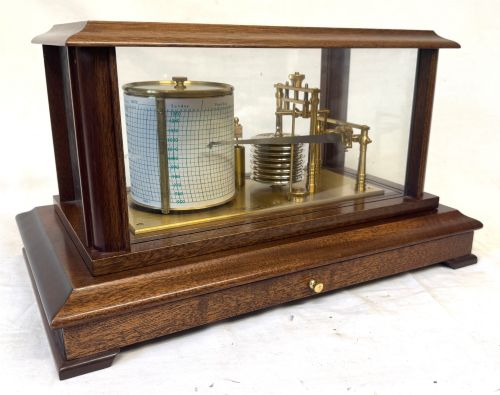
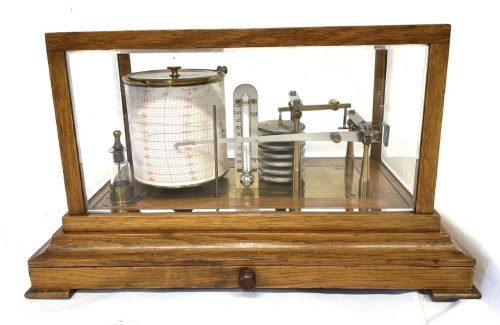
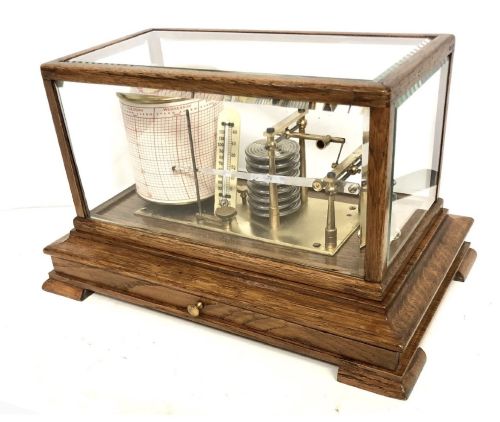
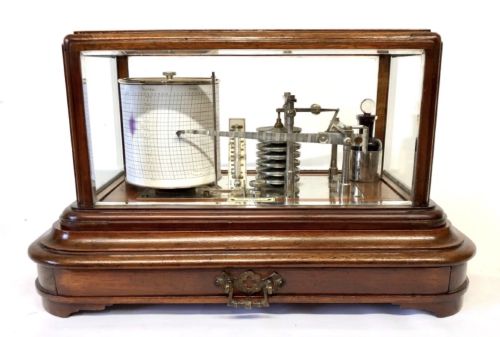
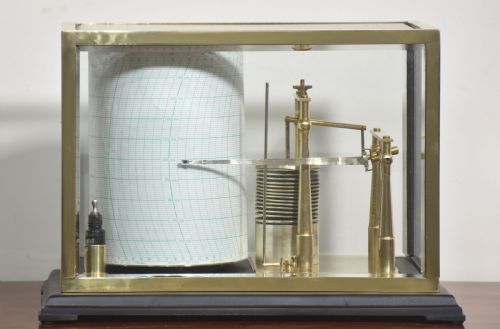
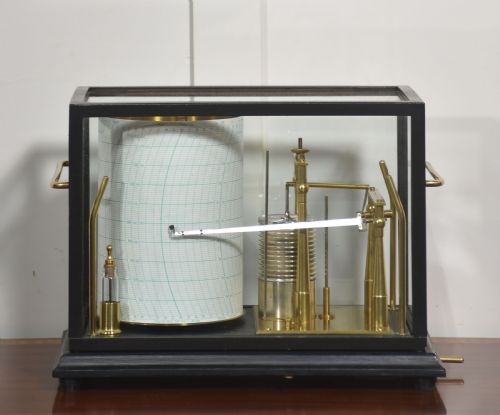
A vintage chart barometer, often styled as a barograph, records barometric pressure onto a paper drum rather than simply pointing to a current reading. The most common format met here is a five-glass wooden case housing brass mechanisms and a rotating cylinder.
The form spans several decades, with examples appearing from the Victorian and Edwardian eras through to the interwar period and the mid twentieth century. Oak and mahogany predominate as the primary woods used for the protective housing.
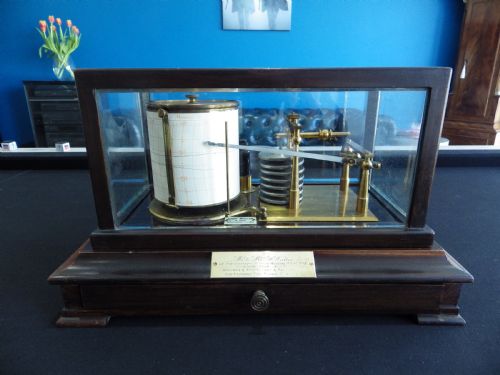
Many of these scientific instruments include a chart drawer beneath the main mechanism to store spare paper sheets and spare ink bottles. Some models also incorporate a thermometer mounted directly on the bedplate alongside the recording drum.
Materials and construction
Recording drums utilise metal cylinders driven by internal clockwork movements that rotate once every week. A pen arm, holding ink or marking a paper chart, traces the rise and fall of the pressure curve driven by the expansion and contraction of stacked metal diaphragms.
Current listings feature oak and mahogany cases housing precision brass mechanisms across the Victorian, Edwardian, and mid twentieth-century periods.
Quality and execution
Quality rests in the precision of the brass linkages and the crispness of the cabinetry, particularly the neatness of the mitred joints and the clarity of the bevelled glass. Finer instruments display refined engraving on the bedplates and robust clockwork movements designed for sustained accuracy.
The choice of timber and the inclusion of fitted accessories like chart drawers and matched thermometers elevate specific pieces. Maker reputation also dictates standing, with established scientific instrument makers commanding distinct attention for their engineering standards.
Short and Mason·Negretti and Zambra·Casella London·Jules Richard·Robson of Newcastle
The Vintage Chart Barometer Glossary
- Barograph
- A recording barometer that plots atmospheric pressure onto a graduated paper chart over a set period. This mechanical device provides a continuous visual trace of weather patterns.
- Aneroid
- Operating without liquid, utilising a flexible metal vacuum box that expands or contracts with changing air pressure. This movement drives the recording arm.
- Chart drawer
- A small compartment built into the base of the wooden case specifically to hold spare recording sheets and ink supplies. It keeps necessary maintenance items together with the instrument.
- Bedplate
- The heavy metal base casting that supports the recording mechanism, clockwork drum, and aneroid stack. It must remain rigid to ensure measuring accuracy.
Vintage Chart Barometer: Frequently Asked Questions
How do I change the paper chart?
Lift the pen arm gently off the rotating drum to prevent damage to the delicate nib. Slide the used paper chart off the cylinder and wrap a fresh chart around, securing it neatly.
Ensure the start time aligns correctly with the timing mechanism before lowering the pen back onto the paper surface.
How often should the clockwork be wound?
Most recording drums are driven by a weekly clockwork movement that requires attention every seven days. Winding too tightly can damage the internal spring, so turn the key smoothly until resistance is felt.
Regular winding keeps the rotation steady and prevents gaps in the continuous pressure trace.
Where should I place a barograph at home?
Position the instrument on a stable, level surface away from direct sunlight, radiators, and heavy foot traffic. Vibrations from doors or machinery can disturb the pen and distort the pressure recording.
A quiet shelf or mantelpiece where temperature remains relatively constant provides the ideal environment for reliable operation.
How do I date an oak cased barograph?
Examine the style of the wooden case, the shape of the feet, and any maker signatures engraved on the bedplate. Edwardian and Victorian models often feature heavier mouldings and distinct brass fittings compared to later interwar pieces.
Original paper paperwork or retailer labels found inside can also provide precise chronological clues.