




Edwardian Mahogany Barograph
An edwardian mahogany barograph combines mechanical precision with domestic furniture, recording atmospheric pressure on paper drums for the observant household.
What an edwardian mahogany barograph is
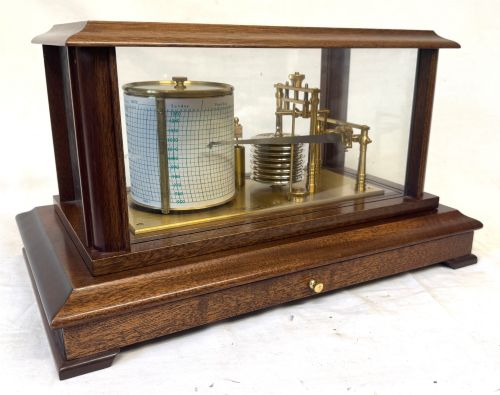
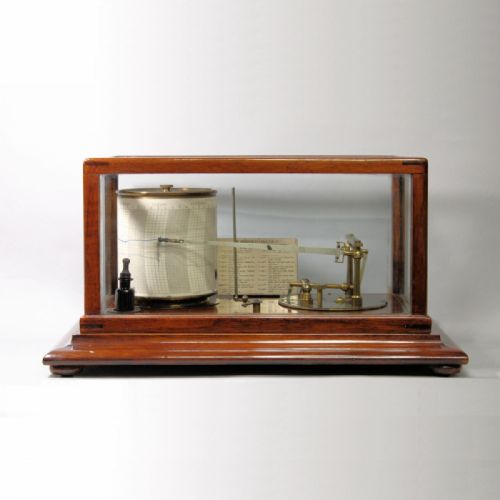
The edwardian mahogany barograph sits within a polished wooden case fitted with five glass panels to protect the delicate mechanism inside while allowing a clear view of the recording drum and arms. These instruments record barometric pressure continuously over the course of a week using paper charts secured to a rotating cylinder driven by a clockwork movement.
Most examples date from the Edwardian period or shortly thereafter, often featuring integrated chart drawers in the base and occasionally incorporating thermometers or aneroid barometer dials. The combination of rich timber and bright brass makes these scientific instruments appear as much like decorative mantel pieces as functional meteorological tools.
Origins span standard domestic models to specialised variants such as ex-military instruments, yet all share the characteristic table-top case construction. Buyers encounter pieces ranging from plain polished timber boxes to inlaid versions reflecting Art Nouveau tastes.
How they were made
Cases combine solid and veneered mahogany shaped with mitred joints and fitted with bevelled or plain glass panes held in brass frames. The timber is French polished to a deep lustre that highlights the grain while protecting the wood from atmospheric moisture.
The internal movements utilise brass, steel, and glass components, featuring stacked aneroid vacuum capsules that expand and contract with barometric changes. A pivoted brass arm linked to the capsules carries a nib that traces the pressure variations onto inked paper charts held on the clockwork drum.
Retail Price Guide 2026
Typical UK retail prices for edwardian mahogany barograph, calculated from the Sellingantiques database of over a million retail prices indexed since 2003. This retail price guide relies exclusively on Sellingantiques data; no external sources or auction records are used, so the figures do not describe the wider market.
Listings feature periods spanning the nineteenth century through the Edwardian era up to nineteen-twenty-one, constructed in mahogany, brass, glass, steel, and paper.
What varies in quality
Quality rests in the precision and finish of the mechanical movement, where makers like Negretti and Zambra or Short and Mason employed finely cut gears and compensated barometric capsules. Heavier brass castings and clean, crisp engraving on the scale plates distinguish superior instruments from standard production models.
Cabinetwork varies from simple planked boxes to substantial five-glass cases with dovetailed drawers, book-matched mahogany veneers, and subtle string inlay. The inclusion of secondary instruments, such as integrated thermometers or auxiliary aneroid chapter rings, marks out the more ambitious examples.
NEGRETTI & ZAMBRA LONDON·CASELLA LONDON·GLUCK·SHORT & MASON LIMITED
The Edwardian Mahogany Barograph Glossary
- Aneroid
- Operating without liquid. This describes barometers and barographs that use expanding metal vacuum chambers to measure air pressure.
- Barograph
- A self-recording barometer. It uses a clockwork drum and an inked arm to produce a continuous graphical record of atmospheric pressure.
- Chapter ring
- A graduated circular dial for reading values. These appear on secondary dials alongside the main recording drum.
- Clockwork movement
- A spring-driven mechanical assembly. This regulates the rotation speed of the recording drum, usually completing one full revolution per week.
- Five-glass case
- A protective wooden frame with glass panels on the top and all four vertical sides. This design provides unobstructed visibility of the working parts.
Frequently Asked Questions
How do I change the chart?
Lift the inked arm clear of the drum and release the paper clip or retaining spring holding the chart in place. Slide the old paper off the brass cylinder and wrap a fresh weekly chart around, ensuring the edges align before securing it.
After positioning the new chart, gently lower the arm so the nib rests lightly on the paper line. Check that the clockwork is wound sufficiently to drive the rotation over the coming week.
Are these instruments still accurate?
Many surviving examples continue to record barometric changes reliably if the mechanical linkages remain clean and free from obstruction. The aneroid capsules can lose their spring over long decades, but careful calibration often restores general working order.
Treat the readings as historical weather patterns rather than certified meteorological data. Regular maintenance of the clockwork drum keeps the mechanical timing steady.
Where should I place a barograph?
Position the instrument on a stable, level surface away from direct sunlight, radiators, and heavy vibrations that might disturb the delicate arm. Hallways or studies where temperature remains relatively constant suit them best.
Avoid damp rooms, as excess moisture tarnishes the exposed brass components and warps the paper charts stored within the base drawer.