




Mahogany Barograph
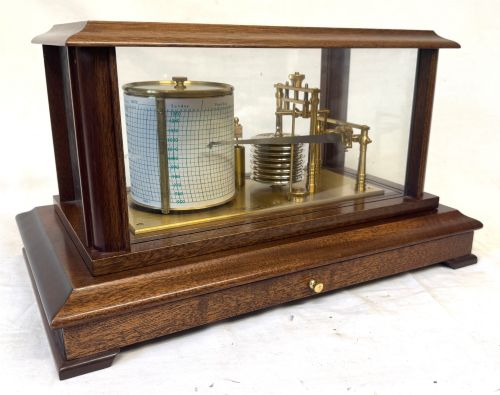
A mahogany barograph is a recording barometer housed in a glazed timber case, prized by collectors of scientific instruments for tracking atmospheric pressure.
Mahogany barographs through the periods
When you search for a mahogany barograph, you encounter scientific instruments spanning the late Victorian, Edwardian, and interwar periods down to the mid-twentieth century. These pieces record continuous barometric pressure on rotating paper charts driven by clockwork mechanisms.
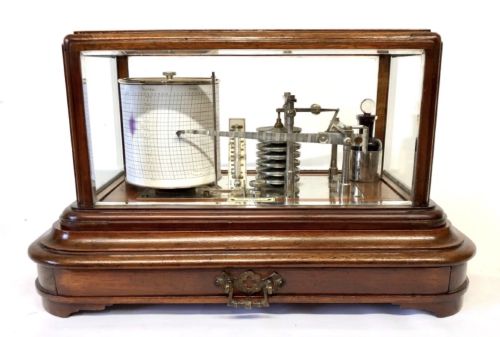
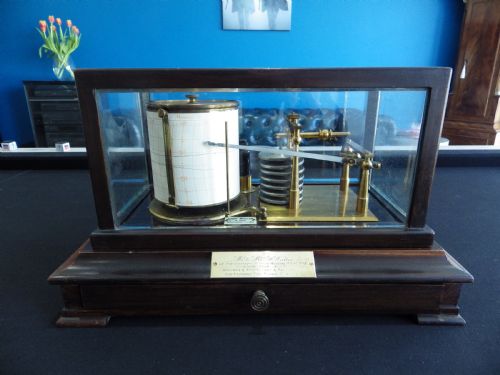
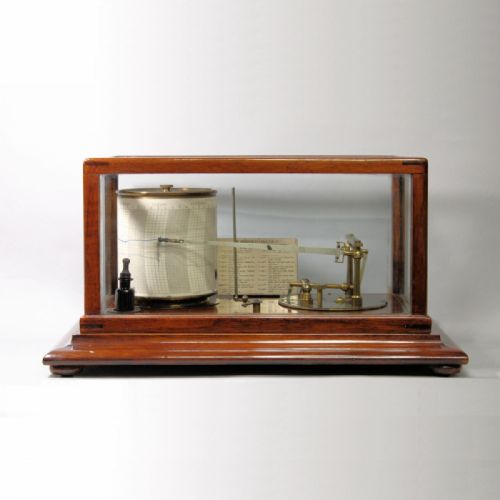
The version you are most likely to meet on this page is the classic five-glass mahogany case enclosing a brass and steel recording mechanism, often incorporating a chart drawer in the base. Examples range from unmarked workshop pieces to specialised items bearing retailer or maker signatures from London and regional centres.
Materials and construction
Maker construction relies heavily on solid and veneered mahogany for the protective housing, joined with glazed panels of bevelled or plain glass to display the movement. Brass forms the sensitive aneroid chambers, lever arms, and clockwork drums, while steel provides the springs and pivots.
Cases frequently feature brass carrying handles, hinged lids, and purpose-built lower drawers for storing spare weekly or daily paper recording charts. Movements utilise precision gear trains to rotate the drum once every seven days beneath an ink-filled nib.
Retail Price Guide 2026
Typical UK retail prices for mahogany barograph, calculated from the Sellingantiques database of over a million retail prices indexed since 2003. This retail price guide relies exclusively on Sellingantiques data; no external sources or auction records are used, so the figures do not describe the wider market.
Many surviving charts record historical storms, capturing drops in barometric pressure from a century ago.
Distinctions in craftsmanship
Quality rests in the precision of the brass mechanism and the timber selection of the case, where superior examples display finely figured mahogany grain and tight joinery. Signed movements by notable makers and retailers command stronger interest than unsigned workshop output.
The presence of auxiliary equipment, such as an integrated thermometer, an additional aneroid chapter ring, or original paperwork and chart drawers, elevates the completeness of the instrument. Refined cast brass fittings and clean mechanical design separate standard production pieces from top-tier models.
Russell Norwich·Gaupp & Co Hongkong & Singapore·Casella London·Harrods of London·Short & Mason Limited·Robson of Newcastle·J Lizars·R Stewart·Negretti & Zambra·Chadburns Ltd·O Comitti & Son London·G Lee & Son
The Mahogany Barograph Glossary
- Barograph
- A self-recording barometer that plots atmospheric pressure over time onto a revolving paper chart. It translates movement from stacked vacuum chambers into a continuous ink trace.
- Aneroid
- Operating without liquid, using flexible metal vacuum boxes that expand and contract with changes in air pressure. This expansion moves the recording arm across the paper drum.
- Chart drawer
- A shallow compartment built into the wooden base beneath the instrument mechanism. It stores spare weekly recording papers and spare ink bottles.
- Five-glass case
- A protective wooden enclosure with glazed panels on top and all four vertical sides. This configuration allows clear visibility of the moving parts from every angle.
- Drum
- The rotating brass cylinder driven by an internal clockwork movement. The paper chart wraps around this cylinder to record seven days of pressure data.
Frequently Asked Questions
How does a barograph work?
Stacked metal vacuum boxes expand or contract as air pressure shifts, moving a pivoted brass arm with an ink nib. This arm rests against a clockwork-driven paper drum that rotates once a week.
The resulting line forms a continuous record of meteorological trends, showing rising or falling pressure over days at a glance.
Where were barographs placed?
Owners kept these instruments in libraries, hallways, or estate offices where guests could observe scientific progress. Their polished wood and visible brass made them suitable for display in domestic rooms.
Portable versions also saw service in military contexts, aboard ships, or in specialised railway stations to log local weather conditions.
How do I read the charts?
Paper charts are marked with horizontal lines for pressure readings in millibars or inches, and vertical lines for days of the week. The ink trace rises as pressure climbs and drops as weather systems approach.
A rising line generally indicates improving weather, while a falling trace points towards wind or rain.
How do I date an Edwardian barograph?
Edwardian instruments often feature cleaner mahogany cabinet lines, restrained inlay, and specific maker signatures active in the early twentieth century. Retailer stamps and style clues help narrow the decade of production.
Internal clockwork components and paper chart styles also provide clues to the manufacturing era.