


Victorian Barograph Barometer
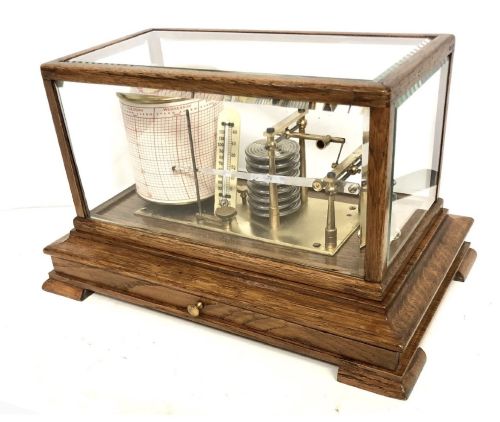
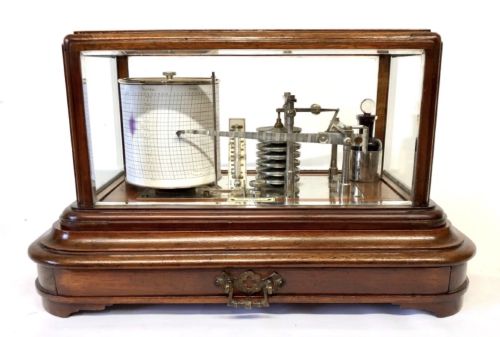
These Victorian barograph barometer instruments record atmospheric pressure on paper charts housed within glazed timber cases.
Victorian Barograph Barometer
A Victorian barograph barometer combines a recording weather instrument with a timber case, frequently incorporating bevelled glass panels and a chart drawer below the mechanism.
Most examples appearing here belong to the Victorian and Edwardian periods, housed in mahogany, oak or walnut cabinets rather than simple utilitarian boxes.
Some configurations pair the brass recording drum with an additional thermometer or a separate barometer dial set into the woodwork.
Materials and construction
Cabinetmakers constructed the enclosures from mahogany, oak and walnut, frequently fitted with bevelled glass to display the movement clearly.
The recording mechanisms utilise brass and steel components, paired with paper charts for tracking atmospheric changes over time.
Cabinet woods span mahogany, oak and walnut alongside specialised scientific instrument maker signatures.
Distinctions in quality
Makers distinguished their work through the crispness of the brass mechanism, the weight of the timber case and the inclusion of signed charts or retailer plaques.
Negretti & Zambra London·Short & Mason London·Gaupp & Co Hongkong & Singapore·Baines Harrogate·Robson of Newcastle·Antoine Redier·Richard Freres
The Victorian Barograph Barometer Glossary
- Barograph
- A self-recording barometer that plots atmospheric pressure onto a rotating paper chart.
- Aneroid barometer
- An instrument that measures pressure using a flexible metal capsule without employing liquid mercury.
- Bevelled glass
- Glass panes with angled edges fitted into the timber housing to showcase the internal mechanism.
- Chart drawer
- A small storage compartment built into the base of the wooden case for holding spare recording papers.
Victorian Barograph Barometer: Frequently Asked Questions
How do these instruments work?
A stack of metal capsules expands and contracts with shifting atmospheric pressure, moving a pivoted arm that carries an ink nib across a rotating paper drum.
Clockwork mechanisms inside the brass cylinder rotate the drum once a week, creating a continuous line that tracks the weather pattern.
Where should I place a barograph?
Position the instrument on a stable surface away from direct sunlight, radiators and heavy vibrations to ensure the delicate mechanism records accurate pressure changes.
Many owners choose a study, hallway or library where the timber case and brass movement can be observed safely.
How do I read the charts?
The paper charts feature horizontal lines marked in millibars or inches of mercury, crossed by vertical lines representing the days of the week.
Rising ink traces indicate improving weather conditions, while falling lines suggest approaching rain or wind.
How do I date a piece?
Examine the timber casing, the style of the maker's signature engraved on the bedplate and the construction of the glass cover.
Mahogany and walnut cases with heavy bevelled glass typically point towards Victorian or Edwardian production.