




Mahogany Barograph Barometer
These mahogany barograph barometer instruments record pressure changes on paper charts, bringing mechanical precision and rich timber cases into your study.
Mahogany Barograph Barometer
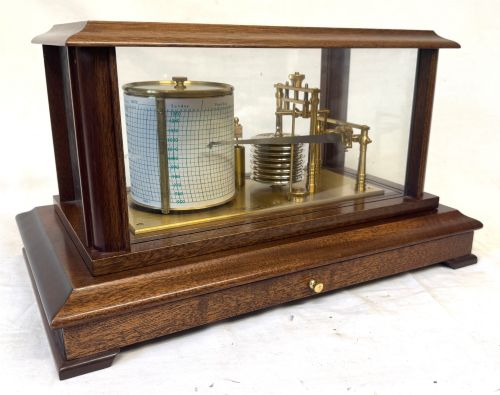
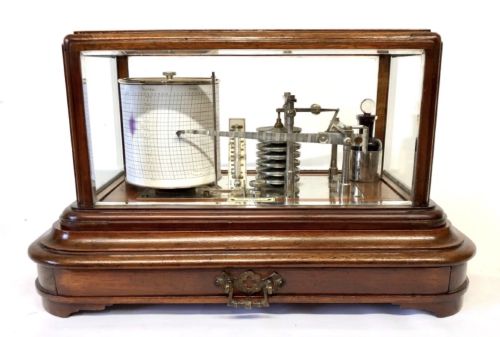
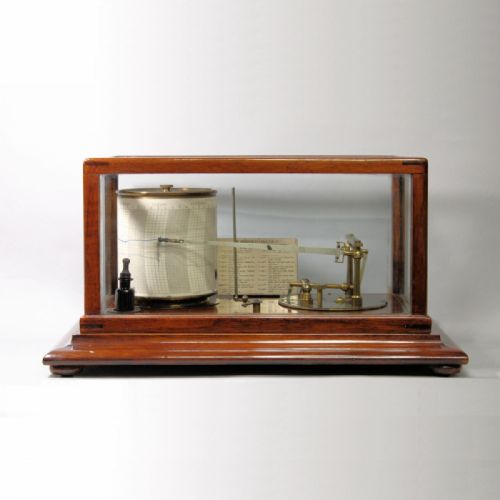
A mahogany barograph barometer combines a recording weather dial with a self-contained drum mechanism housed in a glazed timber case. You will most frequently encounter these instruments originating from the Victorian, Edwardian, and interwar periods.
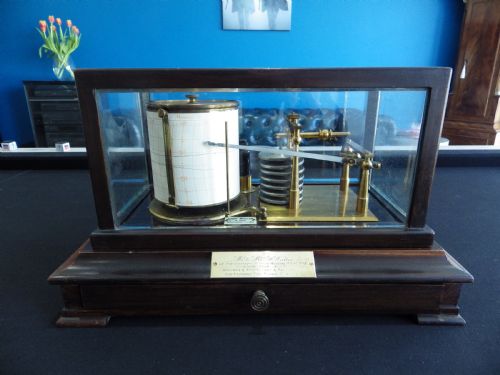
The selection ranges from simple chart-drawer models to complex configurations featuring auxiliary thermometers and barometer dials. Makers enclosed these mechanisms in five-glass mahogany boxes designed to protect the delicate movements while displaying the rotating drum clearly.
Scientific instrument makers adapted these devices for domestic interiors, resulting in robust yet elegant pieces intended for desks and tables. The integration of mahogany cabinetry ensured these scientific tools doubled as handsome household furniture.
What varies in quality
The refinement of the brass movement and the crispness of the maker signature engraved upon the bedplate distinguish superior examples. Heavy gauge mahogany framing and finely fitted glass panels separate master workshop output from ordinary production.
The presence of original paperwork, specialised thermometers, and intact chart drawers elevates the completeness of the instrument. Superior mechanisms exhibit smoother linkage articulation and more responsive aneroid stacks.
Listings feature mahogany, brass, glass, steel, and paper components combined across Victorian, Edwardian, and interwar scientific instruments.
Negretti and Zambra·Short and Mason·Casella London·Richard Freres·R Fuess
The Mahogany Barograph Barometer Glossary
- Barograph
- A self-recording barometer that plots pressure changes onto a paper chart over a set period. It uses a drum rotated by an internal clockwork movement.
- Aneroid
- Operating without liquid, utilising expanding metal vacuum capsules to measure atmospheric pressure. These capsules drive the mechanical arms that trace the graph line.
- Chart drawer
- A small storage compartment built into the base of the mahogany case to hold spare recording papers and spare ink bottles.
- Five-glass case
- A glazed timber enclosure with glass panels on the top and all four sides, allowing observation of the mechanical movement from every angle.
- Atmos barometer
- A clock-like timepiece and barometer driven by changes in temperature and atmospheric pressure, requiring no manual winding.
Mahogany Barograph Barometer: Frequently Asked Questions
How do I change the chart paper?
You lift the brass drum off its spindle, gently secure a fresh paper chart around the cylinder, and replace the drum.
Ensure the recording pen aligns with the correct pressure line before winding the clockwork movement.
Where should I place a barograph?
Position the instrument on a stable, level surface away from direct sunlight, radiators, and heavy vibrations.
Drafts and temperature extremes can interfere with the sensitivity of the internal aneroid metal capsules.
How often must the clockwork be wound?
Most standard drum movements require winding once every seven days using a matching key.
Take care not to over-wind the mechanism when the spring reaches full tension.
Can I still buy replacement charts?
Specialist suppliers continue to print weekly recording charts scaled correctly for these vintage drum dimensions.
Using the proper paper ensures the pressure markings align accurately with historical meteorological standards.