
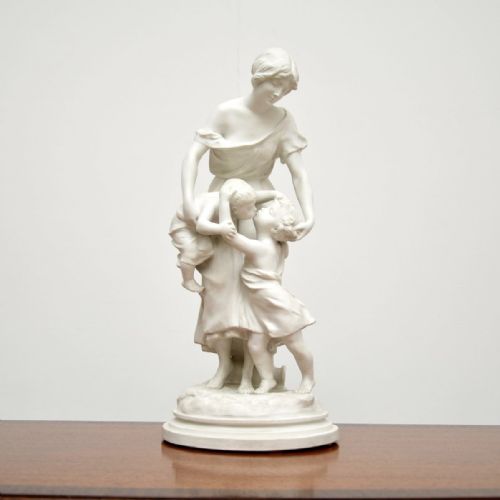


Victorian Unglazed Ceramic Statue
These Victorian unglazed ceramic statue pieces capture 19th-century subjects in fine detail, offering tactile surfaces and classic forms that collectors prize.
Victorian Unglazed Ceramic Statue
When you search for a Victorian unglazed ceramic statue, you encounter figures, sculptures, and statuettes from the 19th century. These objects represent classical women, historical figures, mythological characters, children, soldiers, and animals.
The versions most frequently met on this page include parian ware and biscuit porcelain figure groups. They range from single portrait busts and standing models to paired figures such as Fast Sleep Wide Awake or The Gardeners.
Makers such as Minton, Copeland, and Royal Worcester produced these pieces during the Victorian period. The styles span Victorian neoclassical and Victorian rococo revival forms.
How they were made
These items utilise unglazed ceramic materials such as parian porcelain, biscuit porcelain, and bisque ceramic. The firing process leaves the surface matte and porous rather than shiny.
Makers shaped the material into intricate sculptures and figurines, occasionally adding pigment for subtle surface contrast. The technique highlights fine lines in drapery, hair, and facial expressions without a glossy glaze.
Victorian makers named paired figures Fast Sleep and Wide Awake to capture childhood resting habits in stark white porcelain.
What varies in quality
The presence of named factory marks or specific literary and classical subjects also influences the standing of a piece within the range.
Minton·Copeland·Royal Worcester
The Victorian Unglazed Ceramic Statue Glossary
- Parian ware
- A type of fine biscuit porcelain developed in the 19th century to imitate carved marble. It possesses a smooth, unglazed surface suited to classical figures.
- Biscuit porcelain
- Porcelain fired without a glaze, leaving a matte, white texture. It is often used interchangeably with bisque.
- Bisque ceramic
- Unglazed ceramic material fired once or twice. It provides a tactile finish favoured for Victorian decorative figures.
- Neoclassical
- A style drawing inspiration from classical antiquity. It appears frequently in Victorian sculptures of mythological and historical subjects.
- Rococo revival
- A decorative style characterised by ornate curves and natural motifs. It influences the bases and postures of several Victorian figure groups.
Victorian Unglazed Ceramic Statue: Frequently Asked Questions
What is a parian statue?
A parian statue is a Victorian unglazed ceramic figure made from fine porcelain designed to resemble white marble. These pieces were popular in the 19th century for displaying literary, classical, and portrait subjects in domestic interiors.
The unglazed surface gives the material a matte texture that highlights delicate sculptural details, from flowing garments to facial expressions.
How do I clean unglazed ceramic?
Cleaning unglazed ceramic requires a gentle approach because the porous surface absorbs moisture and dirt easily. Soft brushes or dry microfiber cloths lift dust without harming the matte finish.
Water and harsh cleaning solutions should generally be avoided to prevent staining the unglazed body.
Where were these figures displayed?
Victorian households placed these ceramic sculptures on mantelpieces, sideboards, and occasional tables within the parlour or drawing room. They served as decorative talking points that reflected the owner's cultural interests.
Pairs were often arranged symmetrically to balance mantle displays or cabinet shelves.
What subjects are common?
Common subjects include classical women, historical characters, children, hunting dogs, and soldiers. Literary figures and allegorical groups also appear frequently among Victorian designs.
These themes reflect the Victorian taste for classical education, narrative art, and sentimental domestic scenes.