
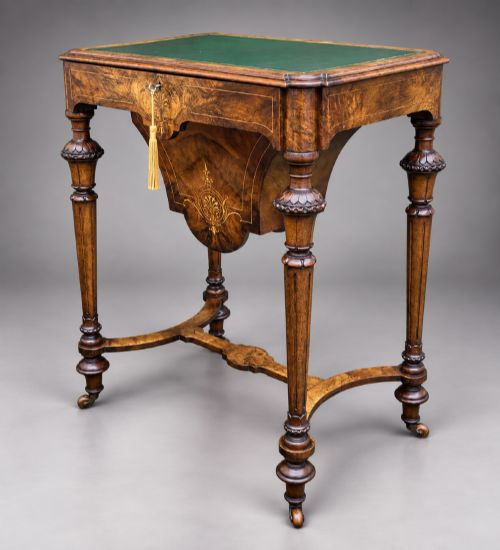
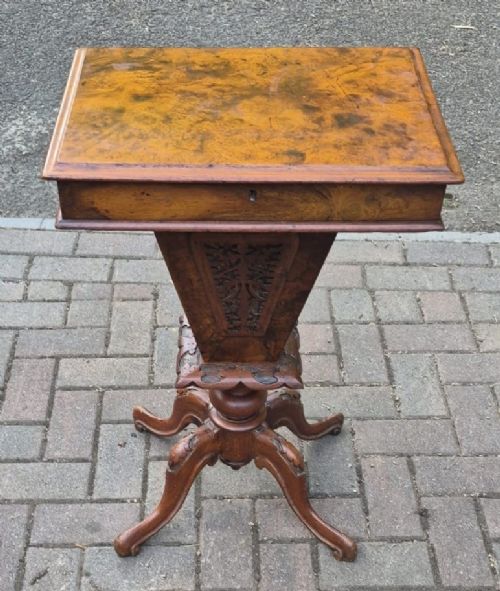


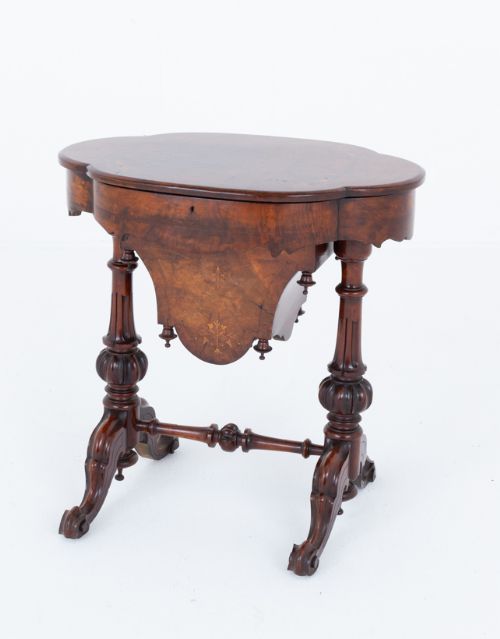


Victorian Trumpet Sewing Box
A victorian trumpet sewing box offers a flared octagonal body and compartmentalised interior, combining practical needlework storage with elegant parlour display.
Victorian Trumpet Sewing Box
A victorian trumpet sewing box takes the form of a freestanding table with a distinctive column or tripod base supporting an octagonal or cone-shaped upper compartment. These pieces date from the nineteenth century, with examples spanning from eighteen fifty to eighteen ninety, and function as both work tables and occasional side tables.
The version most commonly met on this page uses burr walnut, often enhanced with marquetry or boxwood inlay on the lid, paired with a fitted interior designed to hold cottons and needles.
Makers constructed these sewing tables in various formats, including drop-leaf designs, oval tops, and combined games tables featuring chessboard surfaces alongside the traditional sewing compartment.
Materials and construction
Cabinet makers utilised dense hardwoods, predominantly walnut and burr walnut, alongside rosewood and mahogany to build the structural body and the sweeping trumpet-shaped pedestal. Artisans applied intricate boxwood and marquetry inlay to the hinged lids, creating geometric or floral patterns across the veneered surfaces.
Internal sections incorporate fitted compartments and miniature lidded boxes fashioned from lighter woods, designed to organise sewing tools. Turned wooden columns connect the octagonal upper section to carved tripod or pedestal bases, often finished with brass fittings.
The archive shows variations ranging from standard cone-shaped workboxes to combined chess and games tables incorporating sewing compartments.
What separates the finest examples
Quality rests upon the selection of the timber veneers, where highly figured burr walnut or richly grained rosewood creates a striking visual depth across the lid. The precision of the marquetry and boxwood inlay distinguishes workshop output, alongside the complexity and intact survival of the internal fitted compartments.
Structural integrity of the pedestal and tripod base dictates everyday utility, where crisp carving and secure joints ensure the flared body remains stable. The retention of original fitted interiors and working locks elevates an example above altered or stripped pieces.
The Victorian Trumpet Sewing Box Glossary
- Trumpet workbox
- A nineteenth-century freestanding sewing container featuring a narrow base that flares upward into an octagonal or cone-shaped body. This form provides deep internal storage for textiles while maintaining a compact footprint.
- Burr walnut
- A highly prized wood harvested from the wart-like growths on walnut trees, yielding complex swirling grain patterns. Cabinet makers sliced this timber into thin veneers to ornament the lids of quality tables.
- Marquetry inlay
- Decorative woodwork created by fitting contrasting pieces of wood, shell, or ivory into a veneer ground to form pictorial or geometric motifs. Artisans used this technique to embellish table tops.
- Fitted interior
- A removable or hinged tray placed inside the upper compartment, divided into small sections for bobbins, thimbles, and pins. These inserts often include miniature lids and silk-lined pockets.
- Tripod base
- A three-legged support structure attached to the central column of the table, typically featuring carved cabriole legs. This design provides stability to the flared body above.
Victorian Trumpet Sewing Box: Frequently Asked Questions
What is a trumpet sewing box?
A trumpet sewing box is a nineteenth-century freestanding table featuring a flared octagonal body supported by a pedestal and tripod base. The hinged lid opens to reveal a compartmentalised interior designed for needlework accessories.
These pieces functioned primarily in Victorian parlours as decorative side tables that kept sewing projects neatly contained out of sight when guests visited.
How were these tables used?
Victorian women utilised these tables to store threads, needles, and ongoing needlework projects close to their seating area. The deep lower compartment held wools and fabrics, while the lift-out tray organised smaller notions.
Beyond sewing, the sturdy top surface allowed the tables to function as standard occasional furniture for holding small lamps or books in reception rooms.
What woods were used?
Cabinet makers predominantly built these pieces using walnut, burr walnut, and rosewood, occasionally employing mahogany or Irish yew wood. Burr walnut veneers provided decorative patterned surfaces for the lids.
Inlayers added contrasting boxwood and marquetry details to create geometric borders or floral motifs across the wood grain.
How do I date a sewing table?
Dating relies on stylistic shifts in timber choice, support structures, and inlay techniques across the nineteenth century. Pieces from eighteen fifty often display simpler rosewood or yew constructions, whereas high Victorian examples from eighteen sixty to eighteen eighty favour heavily figured burr walnut and complex marquetry.
Internal construction details, such as hand-cut dovetails and turned wooden knobs on the fitted trays, also provide clues to the manufacturing decade.