
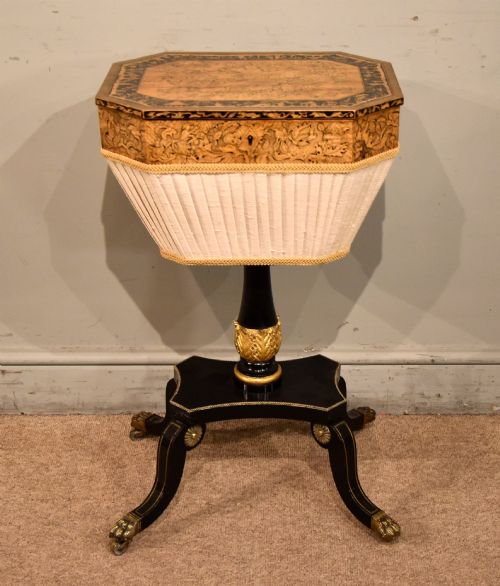


Antique Octagonal Workbox
These antique octagonal workbox pieces are purposeful sewing companions designed to house needlework essentials while bringing striking geometric form to a room.
Antique Octagonal Workbox
An antique octagonal workbox typically takes the form of a trumpet-shaped sewing table featuring an eight-sided hinged lid that lifts to reveal fitted compartments for threads and tools. These useful sewing pieces span the Regency, Victorian, and later nineteenth century eras, appearing in forms such as occasional tables, side tables, and dedicated work tables.
The versions most commonly met on this page are Victorian burr walnut trumpet workboxes dating from the mid to late nineteenth century, alongside occasional Regency period examples. Their distinctive multi-sided bodies sit upon carved pillar supports or tripod bases, blending practicality with decorative presence.
How they were made
Cabinetmakers utilised rich timber veneers such as burr walnut, pollard oak, and plain walnut, often pairing them with ebonised wood or contrasting boxwood stringing. Surfaces frequently feature decorative woodwork techniques including fine inlay and penwork decoration, complemented by brass fittings and silk-lined interiors.
The distinctive trumpet shape requires disciplined joinery to form the eight-sided tapered body, joined securely to sturdy pillar columns and carved tripod or pedestal bases. Internal compartments demand precise miniature woodworking to organise needles, bobbins, and sewing accessories.
Every trumpet workbox conceals a tiny, bustling metropolis of miniature wooden compartments beneath its polite octagonal lid.
What varies in quality
Quality reveals itself in the choice of timber veneer and the precision of the grain matching across the eight facets of the octagonal lid and body. Superior pieces display crisp carving on the support pillars and tripod feet, whereas simpler items rely on plain surfaces and minimal decoration.
The interior organisation further separates standard workboxes from finer examples, noting whether fitted compartments remain intact and whether delicate silk linings or intricate penwork details demonstrate superior craftsmanship.
The Antique Octagonal Workbox Glossary
- Workbox
- A portable or table-mounted container designed specifically for holding sewing implements, threads, and needlework supplies. These pieces often doubled as small side tables in nineteenth century parlours.
- Penwork
- A decorative technique using fine ink lines to draw motifs, often geometric or floral designs, directly onto a wooden surface. This method was popular on Regency period sewing tables before being protected by clear varnish.
- Burr walnut
- A highly prized timber veneer harvested from the gnarled growths of walnut trees, displaying swirling, highly decorative grain patterns. It was extensively utilised during the Victorian era for luxury occasional furniture.
- Pollard oak
- Timber taken from oak trees that were pollarded, creating dense clusters of branches that produced tightly patterned, mottled wood grain. This material appears on select nineteenth century occasional and lamp tables.
Antique Octagonal Workbox: Frequently Asked Questions
What is an antique octagonal workbox?
An antique octagonal workbox is a small table or box featuring an eight-sided lid, designed to store sewing materials while serving as a decorative occasional piece.
Most examples date from the nineteenth century, encompassing both portable boxes and freestanding trumpet tables supported by pedestals or tripod feet.
How were sewing tables used in the past?
These tables served as functional workstations for Victorian and Regency gentlewomen engaged in needlework, embroidery, and mending tasks. The hinged top lifted to reveal partitioned trays for threads, pins, and tools, keeping the lap free during handcrafts.
When closed, they functioned as polite side tables or lamp tables in parlours and drawing rooms, concealing sewing clutter entirely.
How do I identify a Victorian workbox?
Victorian workboxes frequently utilise walnut, burr walnut, or rosewood veneers, often incorporating turned tripod bases, trumpet-shaped bodies, and inlaid woodwork. The interior compartments generally feature fabric linings and small wooden partitions tailored for specific sewing tools.
Earlier Regency period examples lean toward mahogany or feature distinct penwork decoration, while Victorian pieces embrace the richly figured grains typical of the mid-nineteenth century.
Where should I place a work table at home?
These compact tables fit naturally beside an armchair, sofa, or in a corner as an occasional side table where surface space is limited. Their decorative eight-sided tops and figured wood grains allow them to stand out independently as sculptural room accents.
The lifting lid remains accessible when placed beside seating, making them practical for storing small modern items while preserving period character.