
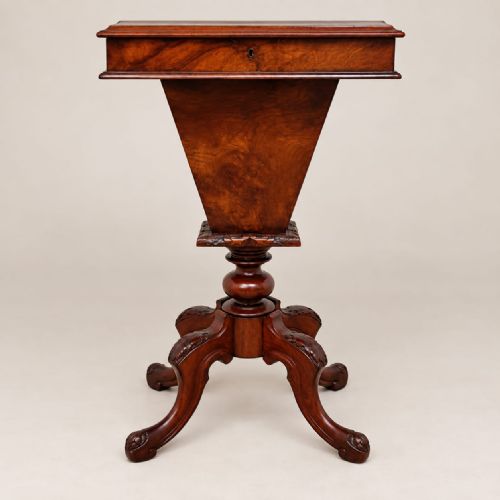


Octagonal Trumpet Table
An octagonal trumpet table is a clever Victorian work or sewing piece that collectors prize for its flared silhouette and fitted interior compartments.
Octagonal Trumpet Table
When you search for an octagonal trumpet table, you encounter Victorian work tables, sewing boxes, and games surfaces designed with eight-sided tops. These pieces originate primarily between eighteen fifty and eighteen ninety, spanning various decades of the Victorian era. The form combines a flared octagonal body resembling a trumpet with a tripod or pedestal base.
You are most likely to meet walnut and burr walnut versions on this page, alongside rosewood and occasional Irish arbutus wood or yew wood examples. Many incorporate mixed wood inlay or boxwood details, serving multiple domestic functions including needlework storage and chess playing. The interior compartments under the octagonal lids distinguish these items as practical Victorian sewing and work boxes.
How they were made
Cabinet makers utilised dense hardwoods such as walnut, burr walnut, and rosewood to construct the distinctive flared bodies. These woods were often selected for their rich grain patterns and polished to a high sheen. Marquetry and wood inlay, including boxwood and arbutus wood, decorated the lids and surfaces.
The structural form relied on solid timber framing for the tripod bases and eight-sided tops, with hinged lids revealing fitted compartments inside. Joinery techniques accommodated the widening trumpet shape, securing the column to the pedestal feet with stability.
Many an eight-sided lid conceals velvet-lined compartments secretly waiting for lost Victorian thimbles.
What varies in quality
The sophistication of the wood inlay and the choice of surface veneer dictate the upper tier of these pieces. Burr walnut and detailed rosewood marquetry represent finer selections compared to plain timber surfaces. Intricate boxwood detailing and specialised regional manufacture, such as Killarney ware, elevate individual examples.
The integrity of the interior compartment fittings and the joinery of the flared octagonal body indicate the standard of construction. Original tripod bases and well-preserved hinges contribute to a higher grade of craftsmanship.
The Octagonal Trumpet Table Glossary
- Trumpet table
- A Victorian occasional or work table featuring a flared octagonal body that widens from a slender stem toward the top. This shape resembles the bell of a musical instrument.
- Marquetry
- Decorative woodwork where pieces of veneer are fitted into a backing to form geometric or pictorial designs. Cabinet makers applied this technique extensively to table lids.
- Burr walnut
- A prized timber harvested from walnut tree growths, displaying complex swirling grain patterns. It provided highly decorative surfaces for Victorian furniture.
- Killarney ware
- Distinctive Irish Victorian turned and inlaid wooden items produced around Killarney, frequently utilising arbutus wood. These pieces often incorporate local motifs and marquetry.
- Workbox
- A lidded container or table designed to hold sewing implements, threads, and needlework supplies. Interiors typically feature partitioned compartments and velvet-lined trays.
Octagonal Trumpet Table: Frequently Asked Questions
What is a trumpet table?
A trumpet table is a Victorian sewing or work table named for its distinctive flared octagonal body that widens upward from the base. These pieces typically feature a hinged lid and an internal compartment for needlework.
Cabinet makers produced them primarily during the mid to late nineteenth century in woods such as walnut and rosewood. They functioned as both decorative occasional furniture and practical storage items for domestic textile work.
How were sewing tables used?
Victorian women used sewing tables to store threads, needles, fabrics, and unfinished needlework inside the partitioned compartments beneath the octagonal lids. Some variants also incorporated games boards on the top surfaces.
These pieces sat beside seating areas in parlours and drawing rooms, keeping sewing gear organised and accessible during social gatherings.
What woods are common?
Walnut and burr walnut appear most frequently in these listings, offering rich brown tones and decorative grain patterns. Rosewood also occurs regularly among the surviving pieces.
Regional examples introduce alternative materials such as Irish arbutus wood and yew wood, often enhanced by boxwood inlay and marquetry.
How do I date these tables?
Dating relies on stylistic clues, construction methods, and recorded production periods spanning the Victorian era from eighteen fifty to eighteen ninety. The presence of specific marquetry styles or regional timbers helps narrow the timeframe.
Changes in hardware, such as hinges and internal fittings, further distinguish mid-nineteenth-century examples from later decades.