




Victorian Stationery Casket
A victorian stationery casket is a desk accessory built to hold correspondence, and collectors prize them for their rich woods and meticulous metalwork.
Victorian Stationery Casket
A victorian stationery casket is a desk accessory designed to house letters and writing paper on a library table or Davenport. The pieces gathered here belong predominantly to the nineteenth century, spanning decades from eighteen hundred through to nineteen hundred.
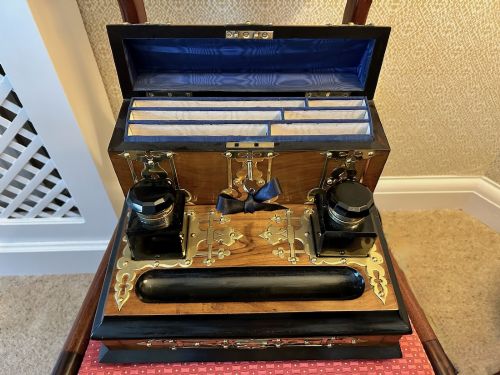
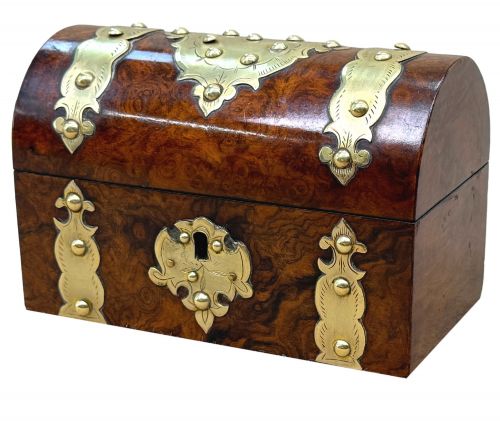
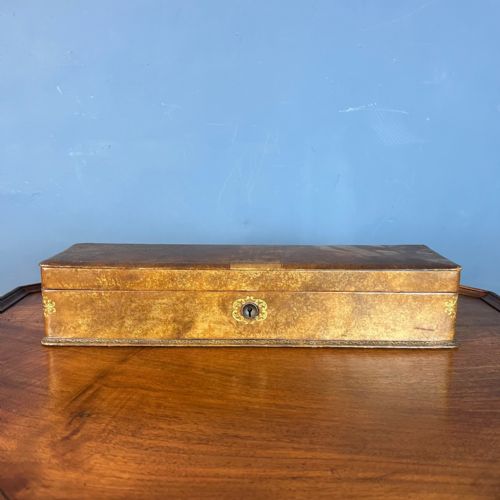
The selection ranges from simple oak desk sets to elaborate dome top caskets clad in coromandel wood and burr walnut. Buyers frequently encounter variations in form, from standard rectangular stationery boxes to sloping desk stands and fitted letter cases.
Materials and Construction
Cabinet makers built these pieces using dense hardwoods such as walnut, oak, satinwood, and coromandel, often framing them with structural brass mounts, hinges, and banding. More decorative examples incorporate inlays of pietra dura, hand-painted porcelain plaques, and semi-precious stone cabochons.
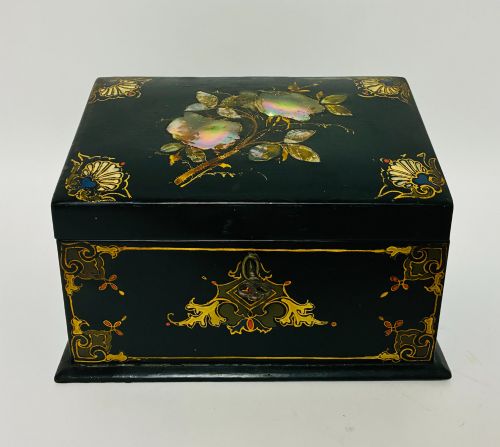
Surface decoration draws on diverse stylistic influences including Gothic Revival, Arts and Crafts pokerwork, French marquetry, and Anglo-Indian carved wood and bone. Artisans employed specialised techniques like lacquering papier mache and applying ormolu mounts to create structured desk tidies.
Materials documented in the collection include brass, burr walnut, coromandel, oak, satinwood, metal, agate cabochons, and hand-painted porcelain.
Judging Quality
The standard of a piece rests upon the choice of timber figure, such as the depth of grain in burr walnut or the dark contrast of coromandel. Superior examples display precise mitre joints, heavy gauge brass mounts, and intact interior partitions designed to sort envelopes and stamps.
Distinction also lies in the integration of decorative elements like pietra dura panels, agate stones, or intricate Tunbridge ware mosaics rather than plain veneered surfaces. The skill of the cabinet maker dictates whether the fitted interior compartments remain rigid and true over generations of use.
C.G. Hope Hastings·Trussell Brighton·Pugin
The Victorian Stationery Casket Glossary
- Coromandel
- A dense, heavily figured exotic timber with dark brown and black streaks, highly favoured for nineteenth century luxury boxes.
- Pietra dura
- An artistic technique using cut and fitted polished coloured stones to create pictorial inlay designs on stone or wood surfaces.
- Ormolu
- Gilded bronze or brass applied as decorative mounts and feet on nineteenth century cabinet work.
- Tunbridge ware
- A meticulous form of woodworking involving thousands of tiny coloured wood blocks assembled to create mosaic patterns.
- Cabochon
- A gemstone or polished mineral cut in a convex, rounded form without facets, frequently set into brass desk hardware.
Victorian Stationery Casket: Frequently Asked Questions
What is a victorian stationery casket?
A victorian stationery casket is a tabletop storage container built during the nineteenth century to organise letters, envelopes, and writing paper.
These pieces typically feature hinged lids and internal wooden dividers to keep correspondence sorted on a desk.
How were they used?
Owners placed them on library desks and Davenport writing tables to keep daily correspondence neat and private.
They provided a secure place for writing paper, sealing wax, and incoming letters before the widespread use of envelopes.
What woods are most common?
Walnut, oak, and coromandel appear frequently across the surviving examples from this era.
Makers often selected burr walnut and exotic tropical hardwoods for their rich grain patterns and durability.
How do I identify Gothic Revival pieces?
Gothic Revival stationery boxes draw inspiration from medieval architecture, often featuring pointed arches, heavy brass strapwork, and dark timber.
Designers like Pugin influenced this architectural style, which translates into robust desk accessories with strong structural metal mounts.