





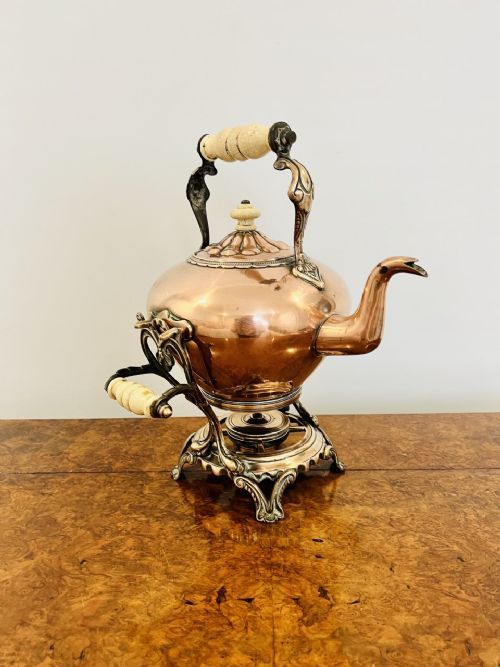


Victorian Spirit Kettle
A Victorian spirit kettle brings a warm focal point to the room, offering a functional vessel for boiling water at the tea table.
Victorian Spirit Kettle
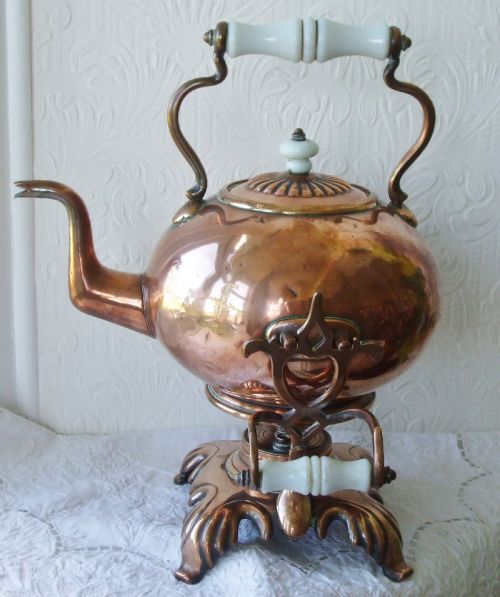
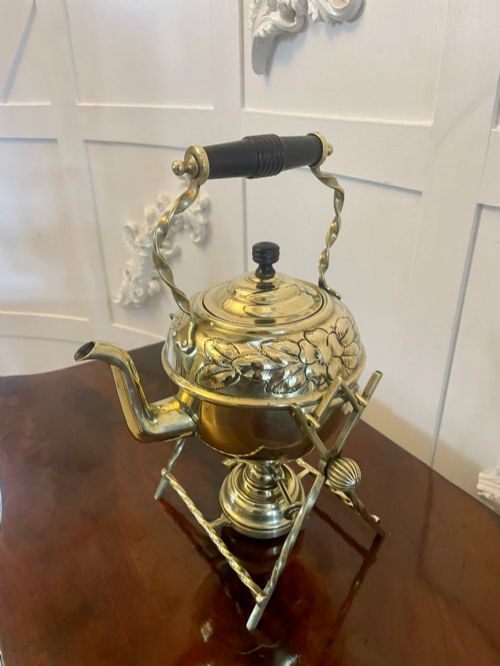
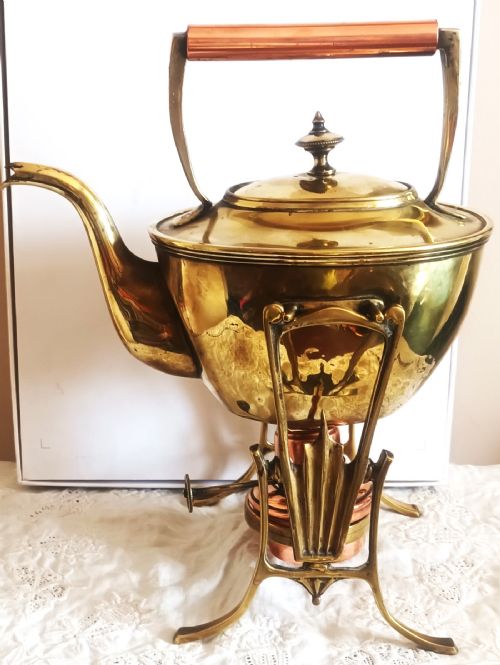
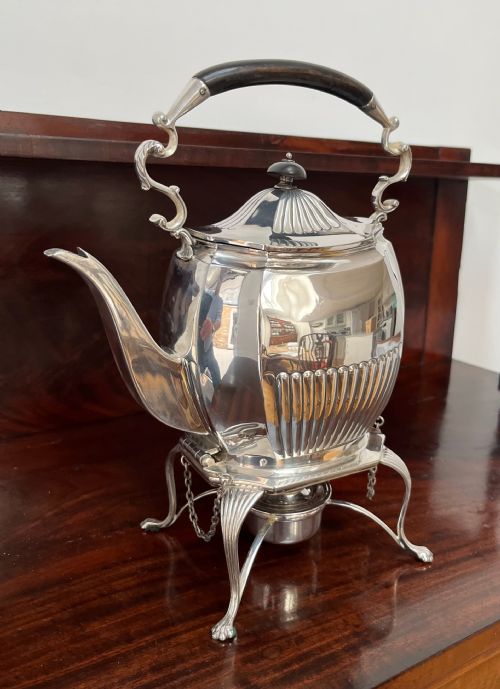
A Victorian spirit kettle sits upon a dedicated stand fitted with an underlying burner, designed to keep water hot during afternoon tea service. The examples appearing on this page span the nineteenth century into the Edwardian era, taking the form of complete tea kettles, hanging vessels, and tea urns.
Most pieces encountered here combine a metal kettle with a matching stand, often featuring insulators on the handle to protect hands from heat. The selection balances traditional Victorian forms with later Arts and Crafts and Aesthetic Movement designs.
Materials and construction
Makers utilised brass, copper, and silver plate over base metals, shaping vessels through heavy spinning and hammering techniques. Fittings frequently incorporate wood, bone, and ebony for handle insulation, while stands occasionally employ wrought iron.
Surface treatments range from bright silver plating to polished copper and brass, sometimes left with a textured finish characteristic of the Arts and Crafts style.
Victorian Spirit Kettle Retail Price Guide 2026
Typical asking prices for victorian spirit kettle among the pieces listed under this phrase on Sellingantiques today, from the lower quarter to the upper quarter. They describe what is for sale here now, not the wider market.
Materials across these listings span brass, copper, silver plate, wood, bone, ebony, and wrought iron.
Judging the standard
Quality rests in the heaviness of the metal gauge and the integrity of the stand's construction. Stronger examples display crisp proportions, secure mounts, and complete burners that integrate smoothly with the stand.
The refinement of decorative chasing and the presence of named maker marks elevate the piece, distinguishing standard utility items from finer parlour appointments.
William Soutter And Sons·Fenton Brothers·Frederik Ellis Tim And Co·Walker And Hall·Mappin Webb And Co
The Victorian Spirit Kettle Glossary
- Stand
- The metal frame that elevates the kettle above the burner. Stands vary from simple folding legs to elaborate architectural supports.
- Silver plate
- A thin layer of silver fused to a base metal such as copper or Britannia metal. This technique provided the appearance of solid silver at a lower cost.
- Aesthetic Movement
- A late nineteenth-century design style focusing on visual beauty rather than narrative meaning. Pieces in this taste often feature stylised ornamentation and distinct Japanese influences.
- Arts and Crafts
- A design movement valuing honest construction and visible handcraftsmanship. Objects from this tradition display hammered surfaces and simple, robust forms.
Victorian Spirit Kettle: Frequently Asked Questions
How do I use a spirit kettle?
Fill the kettle with water and place it securely upon the stand above the unlit burner. Fill the burner with methylated spirit, ignite the wick, and place it beneath the vessel to maintain the water temperature during tea.
Ensure the kettle remains stable on its stand before lighting the flame. Extinguish the burner with the snuffer cap once the tea service concludes.
Are these kettles safe for boiling water?
While many historical kettles remain structurally sound, older plated or lined interiors require careful inspection before use. Cleaning and checking the condition of the metal ensure safe operation.
Collectors often treat these pieces as decorative display items rather than daily kitchen utensils. Modern use depends entirely on the cleanliness and integrity of the internal water chamber.
What is the difference between Victorian and Edwardian kettles?
Victorian examples tend to feature heavier ornamentation, elaborate chasing, and robust proportions. They embrace traditional revival styles alongside Aesthetic Movement designs.
Edwardian pieces often display lighter mounts and simpler geometric profiles influenced by early twentieth-century tastes. The transition reflects a broader shift towards restrained domestic decoration.
How do I clean brass and copper kettles?
Remove dust with a soft cloth and apply a mild, non-abrasive metal polish formulated for brass or copper. Work gently around handles and engraved details to preserve the surface.
Avoid harsh scouring pads that strip the historical patina. Regular dusting prevents tarnish from accumulating in the recessed patterns.