
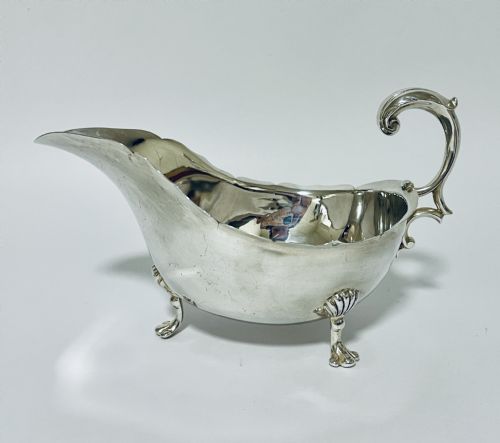


Victorian Silver Sauce Boat
A victorian silver sauce boat brings nineteenth-century weight and shine to the dining table, offering a solid vessel for gravies and sauces.
Victorian Silver Sauce Boat
A victorian silver sauce boat is a practical tabletop vessel designed to serve gravies, drawn butter and sauces during formal nineteenth-century meals. The pieces recorded here span from the mid-nineteenth century through to nineteen hundred, encompassing both solid sterling and plated metal variants.
You will encounter classic single vessels alongside matched pairs, taking forms such as standard sauce boats, gravy jugs, lidded tureens and swan-necked or sleigh shapes. Many examples adhere to Victorian interpretations of Georgian style, while others adopt naturalistic motifs like acorns or shell-shaped bowls.
Origins range across English assay offices and notable workshops, with several pieces bearing hallmarks from London and Chester. Alongside traditional metal boats, related serveware includes spoon warmers, gravy warmers and condiment holders.
How They Were Made
Makers shaped these vessels primarily from sterling silver or silver plate over a base metal, often utilising techniques such as casting, chasing and hand engraving to build form and surface detail. Solid silver pieces carry hallmarks denoting the assay office, standard and year, whilst plated alternatives utilise electroplate on nickel silver or similar metallic foundations.
Decorative elements like naturalistic acorn designs, shell bowls and hinged lids required skilled silversmithing, from soldering cast handles to forming wirework stands and silver-gilt interiors. Construction balances the need for a stable, weighted base with a pouring lip and secure handle suited to regular dining use.
Victorian Silver Sauce Boat Retail Price Guide 2026
Typical asking prices for victorian silver sauce boat among the pieces listed under this phrase on Sellingantiques today, from the lower quarter to the upper quarter. They describe what is for sale here now, not the wider market.
Swan-necked sauce boats bring an unexpected ornithological elegance to the nineteenth-century gravy table.
What Varies in Quality
The distinction between standard production and exceptional work rests on the crispness of the chasing, the gauge of the metal and the fidelity of the cast details. Heavier gauge sterling silver provides a substantial feel in the hand, whereas lighter vessels or plated items rely entirely on the integrity of the surface coating.
Design ambition also divides the range, moving from plain utilitarian sauce boats to sculptural naturalistic forms with bespoke handles, detailed feet and engraved heraldry. Maker attribution further elevates a piece, as does the survival of original matched pairs rather than assembled sets.
Padley Parkin and Staniforth·Tiffany and Co·JC Moore·William Comyns·Charles Stuart Harris·Horace Woodward and Co Ltd·Francis Higgins·Thomas Ducrow
The Victorian Silver Sauce Boat Glossary
- Sterling silver
- A silver alloy containing ninety-two point five percent pure silver by mass, with the remainder consisting of other metals like copper. This standard composition is marked on British silver with the lion passant.
- Silver plate
- A layer of pure silver bonded to a base metal core such as brass or copper. Nineteenth-century innovations led to electroplated nickel silver, which offered a durable bright finish.
- Hallmark
- An official stamp applied by an assay office to indicate the metal standard, the maker, the town of testing and the year of manufacture. These marks provide precise provenance for solid silver pieces.
- Chasing
- A metalsmithing technique where the artisan punches and hammers the front surface of the metal to push out decorative low-relief designs without removing material.
- Silver-gilt
- Sterling silver that has been coated with a thin layer of gold on its interior or exterior surfaces. This technique protected the silver from tarnishing when in contact with acidic food sauces.
Victorian Silver Sauce Boat: Frequently Asked Questions
How do I know if my sauce boat is solid silver?
Examine the piece for a set of official hallmarks stamped into the metal, usually including a purity mark like the lion passant, a maker's mark and a date letter. Solid sterling silver will display these indented stamps rather than showing base metal beneath worn plating.
Unmarked pieces or those labelled as EPNS or silver plate indicate a base metal core beneath a thin silver coating.
Were these pieces used as pairs?
Many Victorian dining tables required balanced service, prompting makers to produce matching pairs of sauce boats for opposite ends of a large table. Surviving pairs remain desirable for collectors seeking complete period table settings.
Single pieces were equally common for smaller households or everyday family dining.
What is a silver spoon warmer?
A spoon warmer is a specialised Victorian vessel designed to hold hot water and keep serving spoons warm before they touched cold sauces or gravies. They frequently share the distinctive boat or shell shapes seen in standard sauce boats.
These pieces sit alongside gravy warmers as examples of specialised nineteenth-century dining technology.
How should I clean antique silver sauce boats?
Wash the piece gently in warm water with a mild, phosphate-free liquid soap and dry it thoroughly with a soft cloth. Avoid harsh chemical dips that strip away desirable patination and can damage delicate soldered joints or silver-gilt interiors.
Store silver in tarnish-resistant cloths or sealed environments if not in regular use on the dining table.