




Victorian Silver Berry Spoons
Victorian silver berry spoons are ornate serving pieces designed for fruit, bringing distinctive chased bowls and fitted presentation cases to the dining table.
Victorian Silver Berry Spoons
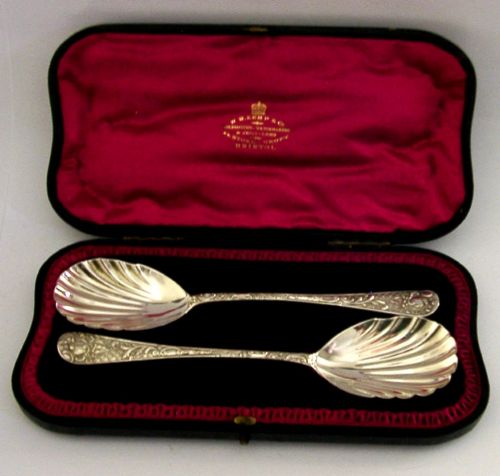
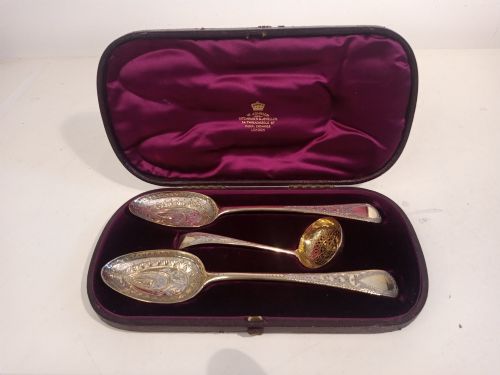
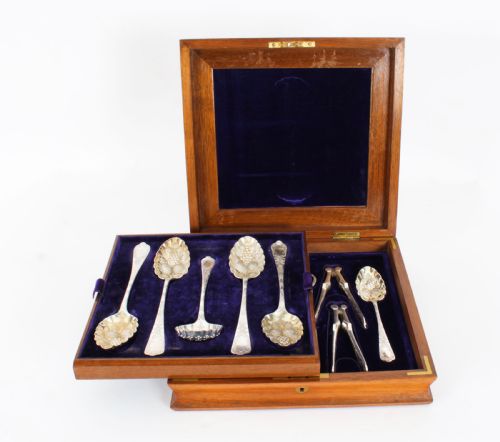
These serving spoons appear in pairs or sets, frequently nestled inside velvet or satin lined boxes alongside matching sifter spoons or fruit knives.
The pieces on this page span the Victorian period, the Edwardian era, and the nineteenth century, taking the form of large serving spoons and fruit sets.
Makers adapted earlier Georgian blanks or created purpose-built Victorian naturalistic leaf and shell designs specifically for dessert service.
Materials and construction methods
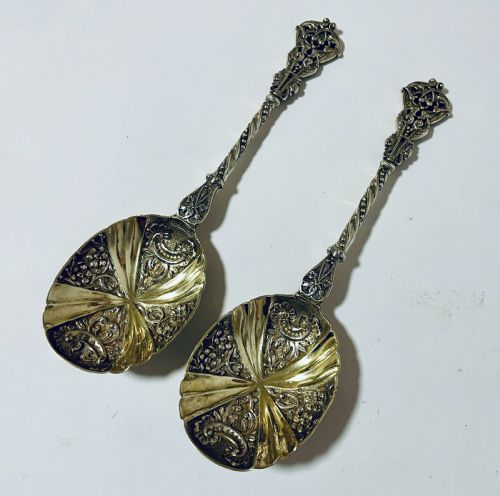
Silversmiths utilised sterling silver and silver plate, often applying a silver gilt wash to the bowl interiors for a contrasting finish.
Handles received detailed hand engraving, while bowls were chased with fruit and foliage motifs, sometimes paired with silk and satin presentation cases.
Some nineteenth-century diners required specialised grape scissors and nutcrackers alongside their berry spoons to tackle dessert.
Judging the quality of the spoons
The depth and crispness of the chased fruit work in the bowl separate standard production from superior examples.
Substantial weight in the hand and the presence of an intact original fitted case distinguish the finest service sets.
Sebastian Crespell·Hukin & Heath·Thomas Hart Stone·Chawner & Co
The Victorian Silver Berry Spoons Glossary
- Berry spoon
- A large serving spoon with chased fruit and foliage decoration applied to the bowl. These pieces were frequently produced during the Victorian era by adapting earlier spoons or manufacturing new naturalistic designs.
- Silver-gilt
- Sterling silver that has been coated with a thin layer of gold. This technique provides a warm, two-tone appearance inside the bowls of serving cutlery.
- Sifter spoon
- A perforated spoon designed for dusting sugar over fruit and desserts. They often accompany berry spoons within fitted presentation boxes.
- Serving cutlery
- Large flatware pieces intended for portioning food at the table rather than individual dining. These items include fruit sets, nutcrackers, and grape scissors.
- Naturalistic style
- Design ornamentation that mimics organic forms such as leaves and shells. Victorian silversmiths utilised this aesthetic to create decorative serving ware.
Victorian Silver Berry Spoons: Frequently Asked Questions
What were berry spoons used for?
These large serving spoons were utilised at the dining table for serving fresh fruit and berries during dessert courses. They allowed hosts to portion soft fruits neatly.
Many examples were housed in fitted presentation boxes alongside matching sifter spoons for powdered sugar.
Are these spoons made of solid silver?
The pieces available include both sterling silver and silver plate items, alongside silver gilt variants. Hallmarks on the stems generally indicate solid silver construction.
Plated and gilt options provide alternative finishes found frequently across nineteenth-century serving sets.
How do I date a Victorian berry spoon?
Dating relies upon examining the maker marks, town hallmarks, and date letters stamped directly into the silver. Design styles such as naturalistic leaf motifs also provide chronological clues.
Boxed sets often retain retailer labels inside the velvet lining to assist with identification.
Can I use them for everyday dining?
These decorative serving pieces function well for modern dessert service, particularly when handling fruit or pastries. Their substantial size suits occasional entertaining.
Careful hand washing preserves the chased bowl details and any delicate silver gilt surfaces.