
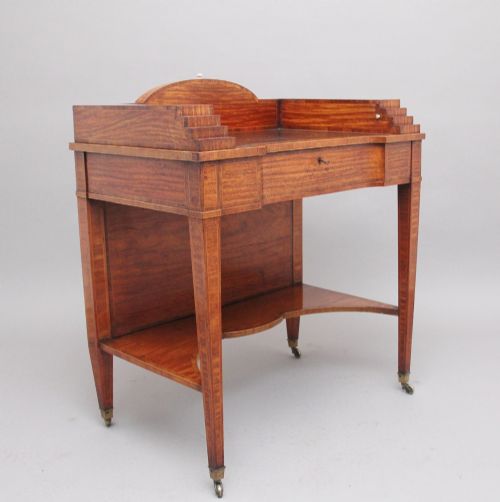


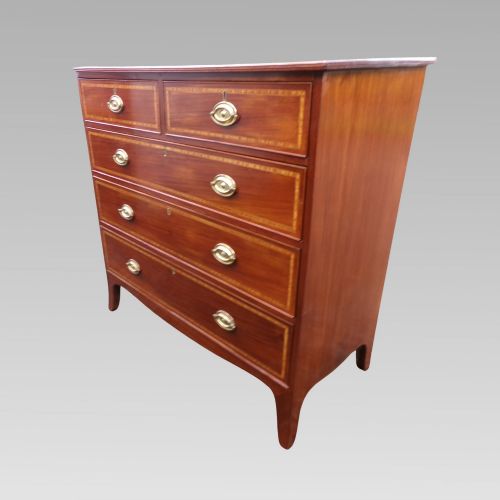
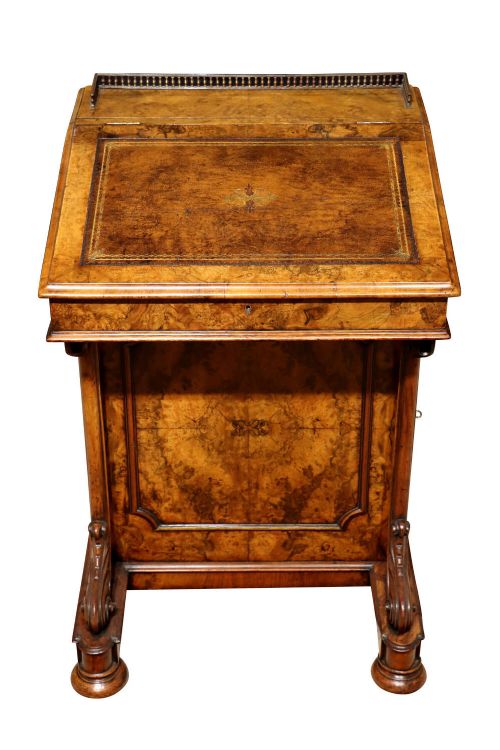


Victorian Satinwood Bureau
A victorian satinwood bureau brings warmth and refined light to a room through its pale timber and practical writing slope.
Victorian Satinwood Bureau
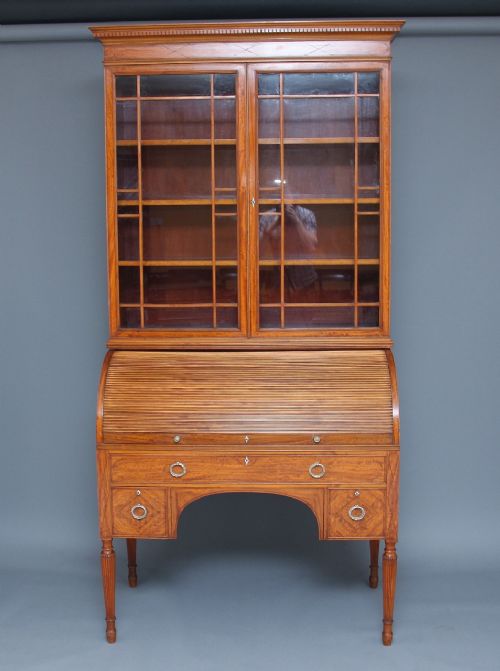
When you search for a victorian satinwood bureau, you encounter writing furniture built during the nineteenth century from pale, figured tropical timbers. These pieces range from compact ladies writing tables to cylinder bookcases and fall-front writing desks.
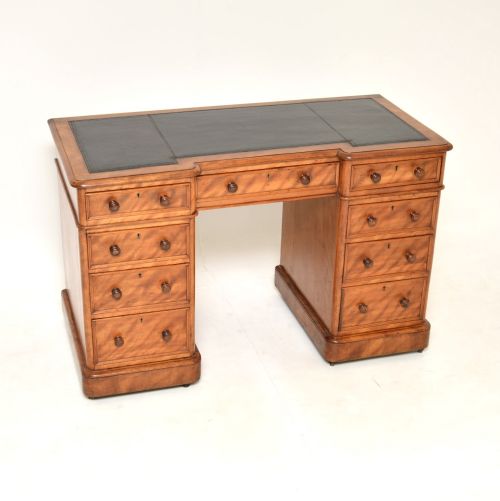
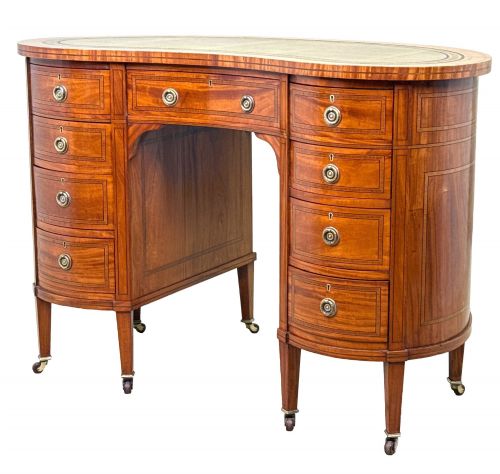
The versions most commonly met on this page date from the Victorian and Edwardian eras, often showing Sheraton Revival influence through classical inlay and marquetry. Workshops of this period also produced Carlton House desks, knee-hole desks, and bureau bookcases.
The form combines a sloping writing flap or cylinder front with fitted interior compartments, drawers, and pigeonholes. Makers utilised the blond grain of satinwood either as the primary wood or as contrasting crossbanding alongside mahogany and walnut.
How they were made
Cabinet makers constructed these desks using solid and veneered satinwood over secondary framing timbers, often incorporating mahogany, walnut, or rosewood for contrast. Marquetry inlay, parquetry, and painted decoration embellished the principal surfaces, while brass handles and ormolu mounts finished the drawers and doors.
Interiors frequently feature fitted pigeonholes, small drawers, and leather writing surfaces inset into the fall-front flap or desktop. Skilled joiners employed crossbanding and contrasting stringing lines to frame the panels and accentuate the natural shimmer of the wood.
Listings feature items spanning the Georgian period through the Victorian and Edwardian eras, executed in satinwood, mahogany, walnut, and rosewood.
What varies in quality
Quality in these desks rests upon the selection of the satinwood veneer, the crispness of the marquetry inlay, and the complexity of the interior fittings. Pieces with finely figured timber, intricate ormolu mounts, and signed cabinet maker attribution command greater appreciation.
Construction methods also distinguish standard commercial production from exhibition standard work. Subtly curved cylinder fronts, hand-painted details, and fully fitted internal compartments indicate superior craftsmanship from prominent nineteenth-century workshops.
HARRIS LEBUS of TOTTENHAM·Edwards & Roberts·Donald Ross·Morison of Edinburgh·Henry Samuel
The Victorian Satinwood Bureau Glossary
- Satinwood
- A dense tropical timber prized for its pale, lustrous golden colour and reflective grain. It serves as the primary veneer on high-status nineteenth-century case furniture.
- Cylinder desk
- A writing desk featuring a quarter-circle rotating wooden cylinder that conceals the writing surface and internal pigeonholes when closed.
- Marquetry
- The art of forming decorative patterns using thin veneers of various woods applied to a supportive carcass. It frequently depicts floral or neoclassical motifs on Victorian writing furniture.
- Crossbanding
- A narrow strip of veneer laid around the border of a panel so that its grain runs at right angles to the central wood. This technique frames the surface and highlights the main timber.
- Carlton House desk
- A horseshoe-shaped writing desk with a tiered superstructure of small drawers and compartments curving around the back of the writer. It represents one of the most sophisticated forms of Georgian and Victorian writing furniture.
Victorian Satinwood Bureau: Frequently Asked Questions
What is a satinwood bureau?
A satinwood bureau is a desk featuring a sloping fall-front or cylinder lid that opens to reveal internal compartments, constructed using pale exotic timber.
These pieces were produced primarily during the nineteenth and early twentieth centuries, combining practical writing space with decorative marquetry and inlay.
How do I care for satinwood furniture?
Keep satinwood furniture away from direct sunlight and heat sources to prevent the pale timber from darkening or the veneer from lifting.
Dust gently with a dry cloth and apply a quality furniture wax sparingly to maintain the natural lustre of the polished surface.
What is Sheraton Revival style?
Sheraton Revival furniture draws inspiration from late eighteenth-century neoclassical designs, featuring symmetrical proportions, tapered legs, and delicate inlay work.
Victorian cabinet makers revived this aesthetic using satinwood, painted details, and classical motifs like urns, swags, and bellflowers.
Where were these desks used?
These desks were kept in private drawing rooms, libraries, and ladies boudoirs as refined places for correspondence and private accounts.
Their finished backs often allowed them to stand freely in the centre of a room rather than against a wall.