


Victorian Rosewood Jewellery Box
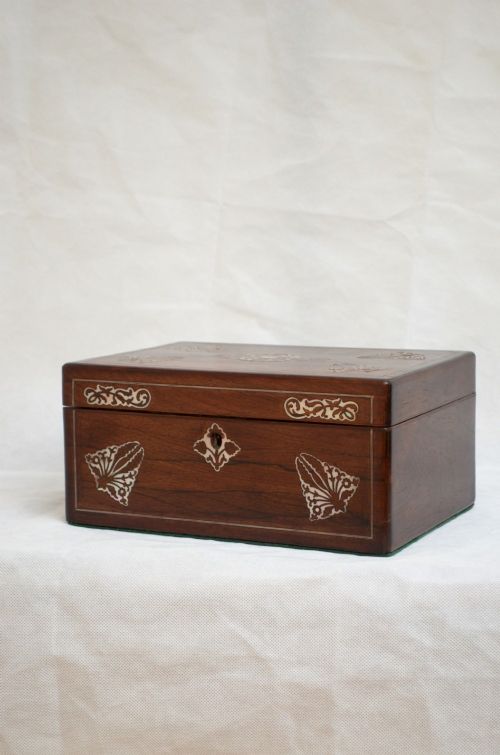
A victorian rosewood jewellery box brings rich grain and precise marquetry to the dressing table, serving as a handsome home for precious trinkets.
Victorian Rosewood Jewellery Box
A victorian rosewood jewellery box encompasses portable caskets, vanity cases, and fitted chests designed for personal valuables. The pieces found here date principally from the nineteenth century, spanning decades from the eighteen-fifties through to the eighteen-eighties.
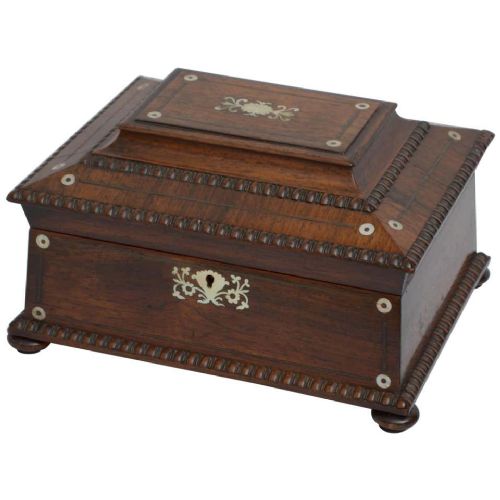
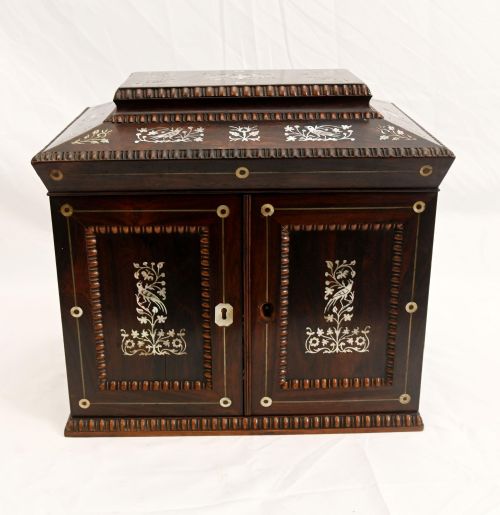
Most examples take the form of hinged rectangular boxes or sarcophagus shapes with sloping lids, frequently containing removable internal trays. Alongside standard jewellery storage, related variants appear configured as work boxes, writing slopes, and small display cabinets.
Materials and Technique
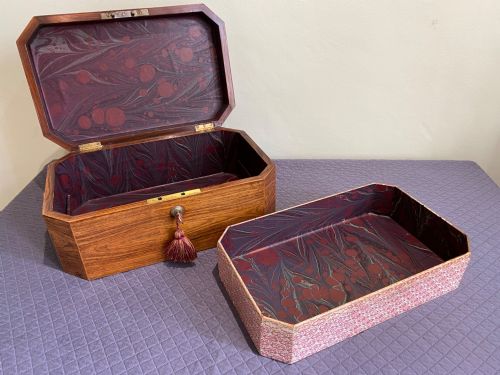
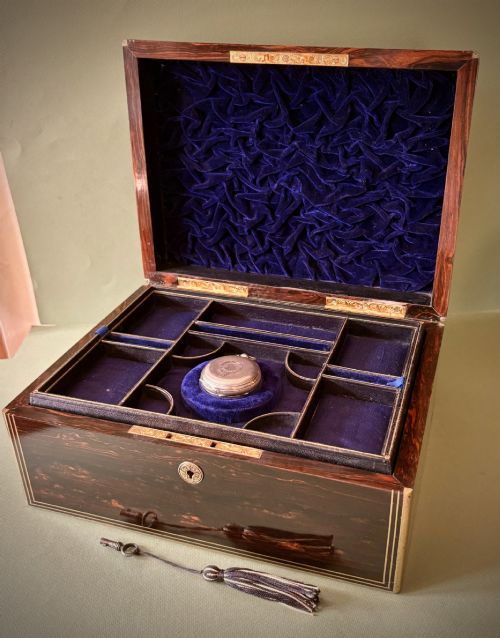
Construction relies upon dense, dark rosewood timber as a foundation, often shaped into sarcophagus profiles or straight-sided carcasses. Makers embellished these surfaces using contrasting materials, embedding mother-of-pearl, boxwood stringing, and brass banding into the wood.
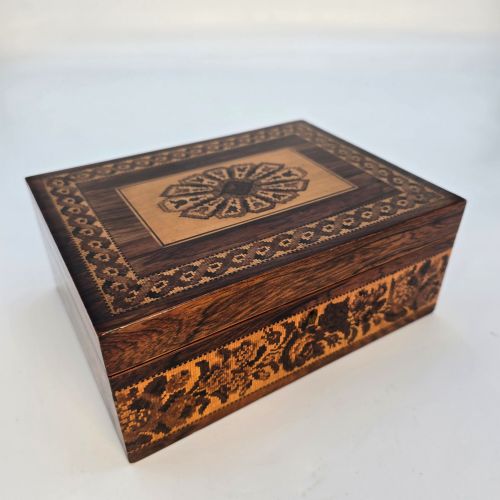
Specialised workshops also produced Tunbridge Ware pieces utilising mosaic marquetry to create intricate pictorial designs from tiny wooden tesserae. Interiors commonly received linings of velvet or silk alongside fitted compartments for rings and accessories.
Listings feature rosewood alongside brass, mother-of-pearl, and boxwood across the Victorian and Edwardian periods.
Judging Quality
Distinction across the range rests on the precision of the external embellishment and the complexity of the interior architecture. Finely executed mother-of-pearl inlay, crisp brass stringing, and elaborate Tunbridge Ware mosaics separate standard boxes from superior examples.
The degree of original internal fitting also dictates standing, with complete lift-out trays, secret drawers, and intact silk or velvet linings commanding higher regard. Structural integrity in the rosewood carcase and sound alignment of the hinged lid complete the assessment.
Edmund Nye
The Victorian Rosewood Jewellery Box Glossary
- Rosewood
- A heavy, dark timber valued for its distinct grain patterns and deep colour. It serves as the primary structural and visual medium for these boxes.
- Tunbridge Ware
- A form of decorative woodwork originating from Kent utilising tiny blocks of various coloured woods to build up mosaic pictures. These intricate patterns frequently decorate the lids of smaller trinket boxes.
- Sarcophagus
- A box profile featuring a stepped or sloping lid rising to a flat top, mimicking ancient stone tombs. This popular Regency and Victorian shape maximises internal depth.
- Marquetry
- The art of applying pieces of veneer to a structure to form decorative patterns and pictures. Craftsmen deployed this technique using boxwood and mother-of-pearl on rosewood surfaces.
- Stringing
- Thin lines of contrasting wood or metal inlaid flush into the surface of the timber. It outlines panels and geometric borders on the lid and sides.
Victorian Rosewood Jewellery Box: Frequently Asked Questions
What went inside a victorian rosewood jewellery box?
These boxes housed rings, brooches, necklaces, and delicate personal accessories belonging to Victorian ladies. Many included specialised compartments or lift-out trays to keep smaller items separated from larger pieces.
Some variants doubled as writing slopes or sewing cases, incorporating spaces for spools, needles, and stationery alongside trinkets.
How do I date a rosewood jewellery box?
Dating relies upon stylistic markers, construction methods, and materials used in the decoration. Pieces from the earlier part of the nineteenth century often display bold sarcophagus shapes and heavy brass mounts.
Later Victorian examples from the eighteen-seventies and eighties frequently incorporate elaborate mother-of-pearl inlay or Tunbridge Ware mosaics. Hardware such as hinges and lock mechanisms also offer clues to the manufacturing decade.
What is Tunbridge Ware?
Tunbridge Ware is a specialised type of wooden mosaic decoration made from thousands of tiny tinted wood squares. Craftsmen arranged these microscopic pieces to form detailed geometric or pictorial scenes, usually featuring flora or architectural views.
Boxes adorned with this technique represent a high point of English decorative woodwork from the nineteenth century.
How should I care for rosewood and mother-of-pearl?
Keep the wood away from direct sunlight and sudden temperature shifts to prevent the rosewood from drying or splitting. Gentle dusting with a dry cloth maintains the finish without harming delicate inlaid sections.
Interior velvet and silk linings benefit from careful vacuuming with a soft brush attachment to remove accumulated dust.