
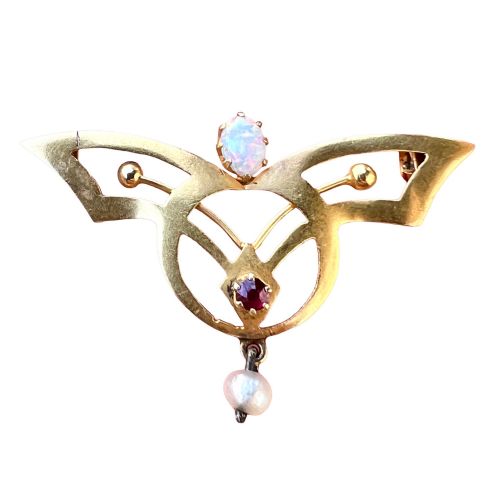


Victorian Opal Pendant
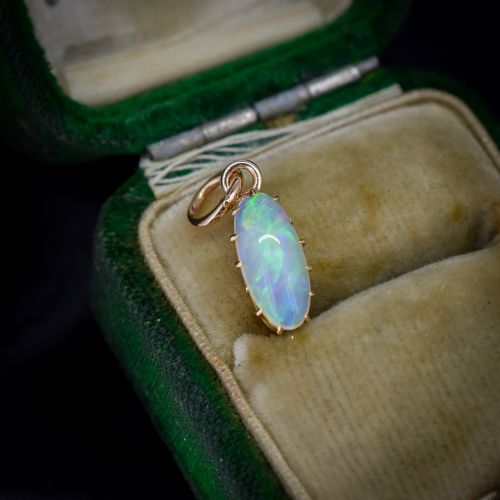
A victorian opal pendant brings together fiery cabochons and period metalwork, offering the collector a distinct piece of nineteenth-century jewellery.
Victorian Opal Pendant
A victorian opal pendant encompasses items designed to suspend from the neck, alongside dual-purpose brooch pendants and convertible pieces. These jewels draw the eye through iridescent play-of-colour, often enhanced by surrounding gemstones.
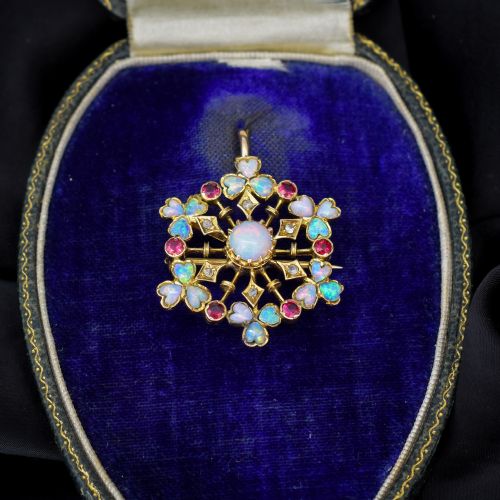
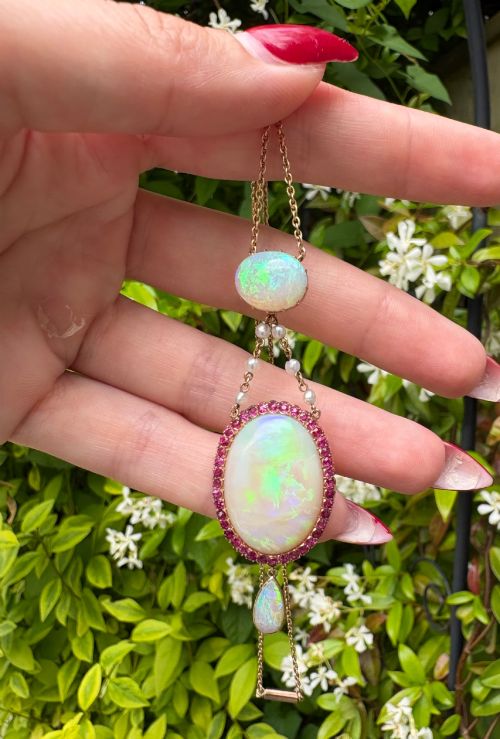
The selections span the nineteenth century into the early twentieth century, incorporating Victorian, Arts and Crafts, and Art Nouveau styles. Buyers frequently encounter configurations featuring seed pearls, rubies, and diamonds set alongside the central opal.
Versatility marks these objects, as many items function as both pendants and brooches. The forms range from floral clusters and clover motifs to lavaliere drops and lover's knots.
Materials and Technique
Goldsmiths utilised yellow gold in varying purities, alongside silver settings designed to mount diamonds and highlight their brilliance. Metalwork ranges from standard 9ct and 15ct gold to 18ct gold.
Cabochon cut opals form the focal point of these jewels, paired with rubies, old cut diamonds, and natural seed pearls. Setting techniques securely hold stones within intricate floral, clover, and geometric frames characteristic of the period.
Lucky three-leaf clovers and delicate butterflies emerge from the Victorian archive, proving past owners pinned their hopes on winged insects.
Factors of Quality
Quality rests significantly on the optical performance and stability of the opal itself, specifically the intensity of its play-of-colour across the stone. Secondary gemstones like diamonds and rubies contribute to the overall refinement of the piece.
The integrity of the metalwork and the complexity of the design distinguish finer examples. Convertible mechanisms that allow a brooch to function as a pendant require precise engineering to survive intact.
The Victorian Opal Pendant Glossary
- Cabochon
- A gem polished with a smooth rounded surface rather than faceted. This cut displays the shifting colours of opals most effectively.
- Lavaliere
- A drop necklace featuring a central pendant suspended from a chain. This style gained popularity during the late nineteenth and early twentieth centuries.
- Seed pearl
- A very small natural or saltwater pearl, often drilled and threaded. These tiny pearls accent the borders of floral and cluster designs.
- Old cut diamond
- A vintage diamond facet style characterised by a small table and high crown. These stones exhibit broad flash patterns distinct from modern cuts.
- Play-of-colour
- The optical phenomenon where spectral colours shift across the stone as the angle of light changes. It remains the primary measure of an opal's visual appeal.
Victorian Opal Pendant: Frequently Asked Questions
How do I wear a convertible pendant?
Many nineteenth-century jewels feature a hinged pin and a hidden loop on the reverse. This construction allows the wearer to pin the item to clothing or suspend it from a chain.
Securing the safety catch properly ensures the piece remains stable when worn as a brooch. When using the loop for a chain, tuck the pin safely behind the frame.
Are these pieces solid gold?
The listings show metal purities including nine-carat, fifteen-carat, and eighteen-carat yellow gold. Some hybrid mounts also incorporate silver on the face to brighten white stones like diamonds.
Testing marks or professional assessments confirm the metal standard used by the period jeweller. Hallmarks and metal tests help verify the composition of each mount.
What styles are common in these pendants?
Designs span strict Victorian work through to Arts and Crafts and Art Nouveau aesthetics. Motifs draw heavily from nature, including clover leaves, butterflies, flowers, and lover's knots.
As the nineteenth century turned into the twentieth, styling shifted towards flowing organic lines. Earlier pieces often favour symmetrical cluster arrangements.
How do I care for antique opals?
Opals contain natural water content and require gentle handling to avoid damage. Keep them away from harsh chemicals, ultrasonic cleaners, and extreme temperature changes.
Store the jewellery separately in a soft pouch to prevent scratches from harder gemstones. Regular wear allows the stones to absorb ambient moisture from the air.