


Edwardian Opal Necklace
An edwardian opal necklace brings together shimmering stones and delicate metals from the turn of the twentieth century for a graceful display.
Edwardian Opal Necklace
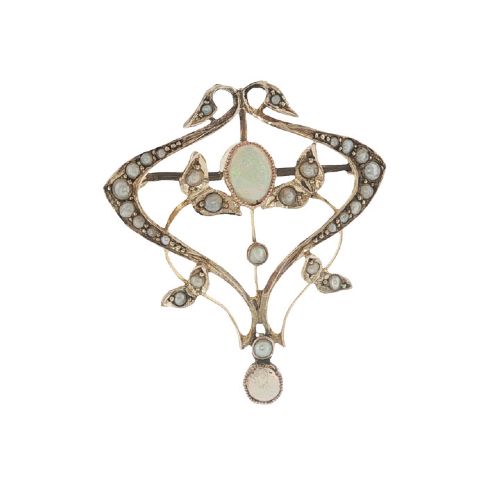
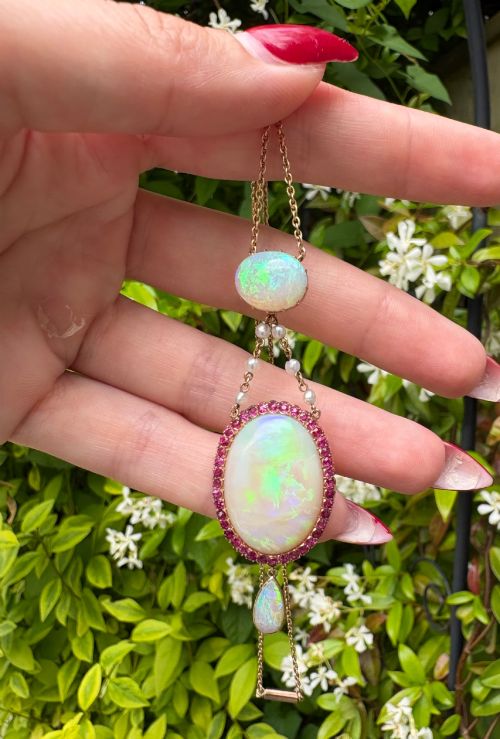
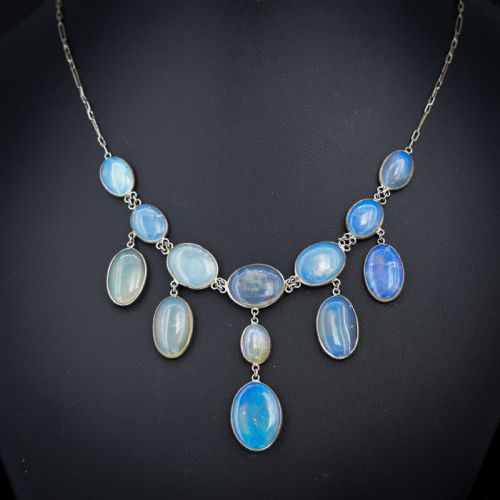
The selection ranges from delicate fringe and festoon arrangements to striking drop pendants and convertible brooch-pendant combinations. Surviving examples connect directly to the stylistic shifts moving from late Victorian sensibilities through Art Nouveau and Arts and Crafts aesthetics into early Art Deco.
Makers of the period utilised varied gold purities alongside silver and platinum, often pairing opals with seed pearls or turquoise. The forms reflect both machine precision and hand-wrought artisan traditions characteristic of early twentieth century workshops.
Materials and Construction
Goldsmiths and silversmiths constructed these necklaces using 9ct gold, 15ct gold, 18ct white gold, silver, and platinum to house the stones securely. Metalwork frequently involved delicate wirework, pierced frames, and prong or bezel settings designed to highlight the play of colour within each opal.
Opals appear alongside accent diamonds, natural saltwater pearls, seed pearls, and rubies, sometimes taking the form of doublets or solid stones. Chain lengths commonly span sixteen inches, often accompanied by original pearl chains or rock crystal beads.
Listings feature periods spanning from the late nineteenth century through the Edwardian era into the 1920s and 1930s.
Distinctions in Quality
Quality rests upon the optical play and brilliance of the opal itself, alongside the purity and weight of the precious metals employed. Master metalsmithing and documented workshop provenance elevate specific pieces above standard commercial production.
The integration of complementary gemstones such as diamonds and natural pearls, combined with intact original chains and secure settings, determines the standing of individual examples within the wider market.
The Gaskins·WH Haseler for Liberty and Co
The Edwardian Opal Necklace Glossary
- Festoon
- A necklace style featuring a curved chain swag suspended across the neckline, often dripping with pendants or drops. This design was particularly popular during the Edwardian period.
- Fringe necklace
- A necklace featuring vertical drops hanging at regular intervals from a central collar or chain. These drops frequently incorporate opals and pearls.
- Opal doublet
- A composite gemstone made by adhering a thin slice of natural opal to a dark backing material to enhance its colour play. It offers the visual depth of a solid opal.
- Blister pearl
- An organic pearl formed attached to the inner shell of an oyster rather than within the mantle tissue. It results in a domed shape often utilised in Arts and Crafts jewellery.
- Seed pearl
- A very small natural or saltwater pearl, typically drilled and threaded onto fine silk or wire. They are characteristic accents in late Victorian and Edwardian cluster work.
Edwardian Opal Necklace: Frequently Asked Questions
How do I care for an antique opal necklace?
Opals contain water within their structure and benefit from gentle handling away from harsh chemicals, sudden temperature changes, and ultrasonic cleaners. Store them in a soft fabric pouch rather than direct contact with harder gemstones.
Regularly check the claw or bezel settings to ensure the stones remain secure within their gold or silver mounts. Wear the necklace with care to preserve both the delicate metal chains and the integrity of the gems.
Are these necklaces made of solid gold?
Many examples utilise solid 9ct, 15ct, or 18ct yellow or white gold, while others employ sterling silver or platinum settings. The metal purity reflects the manufacturing standards common during the late nineteenth and early twentieth centuries.
Examining hallmarks or testing the metal confirms the exact composition of each piece. Makers often matched the precious metal weight to the prominence of the central opal.
What is the difference between an Edwardian pendant and a brooch pendant?
A standard pendant suspends solely from a chain around the neck, designed specifically for vertical display. A brooch pendant includes an integrated pin finding on the reverse, allowing the wearer to use the piece as either a brooch or a necklace.
This versatility was common in Victorian and Edwardian jewellery, offering multiple ways to display the central gemstones. The conversion mechanisms are typically discreetly integrated into the rear frame.