
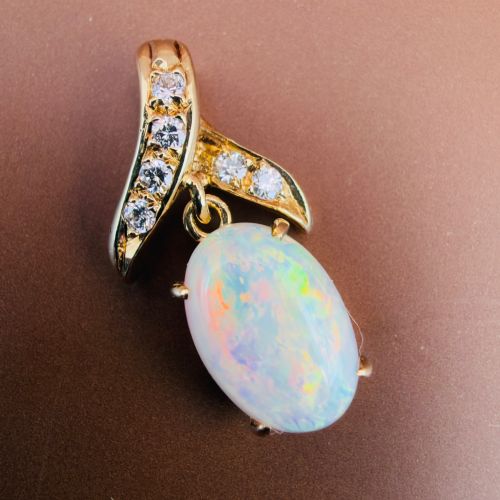


Opal Diamond Necklace
An opal diamond necklace brings together the play of colour in the stone and the hard brilliance of cut stones, spanning Victorian, Edwardian, and Art Deco periods.
Opal Diamond Necklace
An opal diamond necklace pairs colourful cabochons with bright stones, appearing in forms from simple pendants to elaborate clusters and convertible brooch pendants. These pieces span Victorian, Edwardian, Art Deco, and mid-century periods, showing how jewellers set precious gems in gold, silver, and platinum over decades.
The most common pieces on this page are pendants and necklaces featuring central cabochons surrounded by small diamonds, often set in yellow gold or white metal. Stones range from white and fire opals to dark black opals, mounted on fine metal chains or integrated into rigid settings.
How they were made
Maker's workshops built these pieces using yellow gold, white gold, platinum, and silver, often combining metals to support different stones. Silver and platinum provided a bright white surface for mounting diamonds around central gems, while gold formed the warm structure of chains and heavy cluster mounts.
The central opals are shaped as cabochons to display their internal play of colour, accompanied by faceted diamonds set in claws or bezels. Goldsmiths constructed substantial pieces like heavy cluster pendants and convertible brooch mounts using soldered settings designed to hold multiple stones securely.
Some Victorian pieces double as brooches, letting you pin your opals straight to a lapel when necklaces feel too pedestrian.
What varies in quality
Quality depends heavily on the optical performance of the central stone and the weight and type of the surrounding precious metal. A strong, vibrant play of colour across the opal surface distinguishes superior examples from stones with flat or muted tones.
The mounting work also marks the division between standard and finer pieces, seen in the proportion of the diamonds and the strength of the gold, silver, or platinum settings. Heavier gold weights and integrated platinum work show greater investment by the original maker.
The Opal Diamond Necklace Glossary
- Cabochon
- A gemstone cut with a smooth, rounded, convex top and a flat or curved base rather than faceted surfaces. This traditional style allows opals to display their internal play of colour effectively.
- Cluster
- An arrangement of smaller gemstones grouped tightly around a larger central stone. This layout maximises the visual impact of both diamonds and opals in a single pendant.
- Fire opal
- A transparent to translucent opal possessing bright yellow, orange, or red body colour. These stones bring warm tones to mid-century and vintage designs.
- Black opal
- A dark-bodied variety of opal that displays intense flashes of spectral colours against a deep grey or black background. This type often commands attention in Victorian and Edwardian pieces.
- Platinum
- A dense, ductile, and malleable white precious metal used in jewellery for its strength and resistance to tarnish. It holds delicate diamond settings securely in Art Deco designs.
Opal Diamond Necklace: Frequently Asked Questions
How do I care for an opal diamond necklace?
Opals contain water and require gentle handling, so avoid harsh chemicals, ultrasonic cleaners, and sudden temperature changes when wearing or storing your necklace.
Store the piece away from hard gems that might scratch the surface, and wipe it gently with a soft, damp cloth after wearing.
What periods do these necklaces come from?
The pieces span the Victorian, Edwardian, and Art Deco eras, extending through the mid-century and vintage periods into the later twentieth century.
Each period brings distinct mounting styles, from heavy gold Victorian clusters to geometric platinum Art Deco work.
Are all the opals natural?
The historical pieces listed across these records feature natural stones, including solid white opals, fire opals, and dark black opals set alongside genuine diamonds.
Craftsmen mounted these natural gems in gold, silver, and platinum according to the prevailing fashions of each decade.
Can these pendants be worn as brooches?
Certain Victorian and early twentieth-century examples were built as convertible pieces, featuring integrated pin mechanisms alongside pendant loops.
This dual function allowed the wearer to pin the cluster to clothing or suspend it from a chain.