


Gold Opal Charm
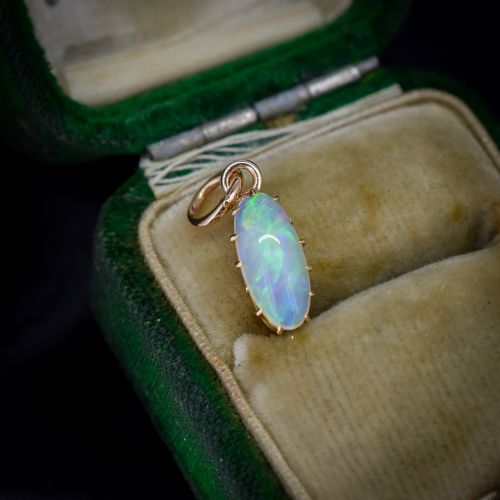
A gold opal charm displays vibrant play-of-colour suspended from a precious metal mount, bringing centuries of lapidary skill to a simple pendant.
Gold Opal Charm
When you search for a gold opal charm, you are looking at small pendant pieces designed to sit on a chain, encompassing everything from delicate solitaires to substantial cluster necklaces. The pieces listed here span a considerable chronological range, taking in late Victorian examples alongside Edwardian, Art Deco, mid-century, and later twentieth-century creations.
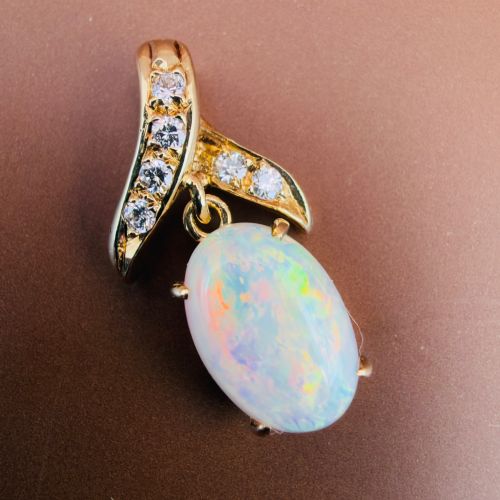
You are most likely to meet mid-century pendants set in nine-carat yellow gold, often featuring oval cut stones or simple solitaire arrangements. Alongside these, earlier Victorian and Edwardian iterations appear less frequently, generally incorporating older stones paired with diamonds in fourteen or fifteen-carat gold and silver settings.
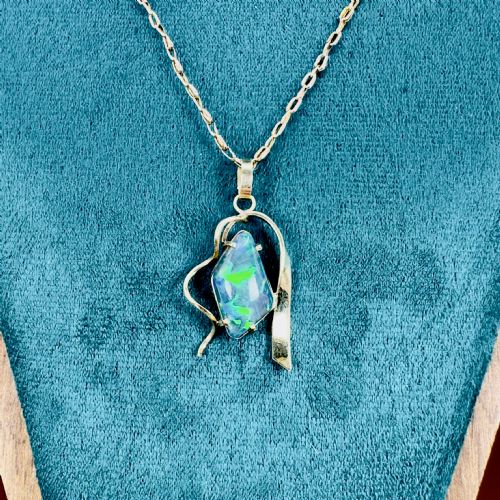
The primary form is the pendant necklace, though titles also designate simple pendants and necklaces designed to display the gemstone at the chest. Each piece relies on the optical phenomenon of the stone itself to draw the eye, whether shaped as a heart, an unusual silhouette, or a classic cluster.
How they were made
The manufacture of these pieces centres on the combination of precious metals with natural or doublet gemstones cut into cabochons. Goldsmiths utilised nine-carat and fourteen-carat yellow gold, sometimes mounting stones in silver over gold during the late Victorian period.
Setting techniques visible in the inventory include cluster arrangements where diamonds encircle a central opal, alongside solitaire mounts and fancy filigreed work. Lapidaries shaped the opals into smooth cabochons rather than facets to best display the internal play-of-colour within the stone.
The inventory spans several decades from the late Victorian period through the nineteen-fifties and sixties, utilising nine, fourteen, and fifteen-carat gold.
What varies in quality
Quality in a gold opal charm depends upon the optical vibrancy and weight of the gemstone itself, with larger stones reaching past five carats in notable black opal doublets and clusters. The presence and quality of surrounding diamonds also elevate a piece, shifting it from a simple solitaire to a substantial cluster pendant.
The intricacy of the metalwork forms another distinction, ranging from plain bezels to heavy fourteen-carat mounts and fancy filigreed settings that require greater skill from the goldsmith. The structural integrity of the stone, particularly in doublet formations, marks a clear difference across the selection.
The Gold Opal Charm Glossary
- Cabochon
- A gemstone shaped and polished with a smooth, rounded surface rather than faceted edges. This style highlights the internal colour play of an opal.
- Doublet
- A composite gemstone made of two layers, typically combining a thin slice of natural opal with a darker backing to enhance the apparent body colour and stability.
- Filigree
- Delicate ornamental work made from fine gold or silver wire twisted into openwork patterns. It appears frequently in fancy mounts from the mid-century period.
- Cluster
- An arrangement of smaller gemstones surrounding a larger central stone, designed to maximise brilliance and visual impact. Diamonds frequently serve as the border stones.
- Play-of-colour
- The optical phenomenon where flashes of spectral colours shift and change as the opal moves under the light. It remains the defining characteristic of the gemstone.
Gold Opal Charm: Frequently Asked Questions
What is a gold opal charm?
A gold opal charm is a pendant featuring an opal gemstone set in gold, designed to be worn on a necklace chain.
The selection includes various forms such as simple solitaires, heart shapes, and diamond clusters dating from the Victorian era to the mid-twentieth century.
How do I care for my opal pendant?
Opals contain water within their structure and require gentle handling to avoid damage from sudden temperature changes or harsh chemicals.
Store the piece separately from harder gemstones to prevent scratching the soft surface of the cabochon.
What is the difference between a solid opal and a doublet?
A solid opal consists entirely of natural opal material cut from the rough stone.
A doublet combines a genuine opal slice glued to a dark backing material to strengthen the stone and deepen the perceived colour.
How can I tell the period of a gold opal charm?
Period identification relies on a combination of metal purity marks, stone cuts, and stylistic clues like Edwardian filigree or Victorian silver-on-gold settings.
Mid-century pieces often feature heavier nine-carat yellow gold mounts with straightforward oval or cabochon solitaire settings.