
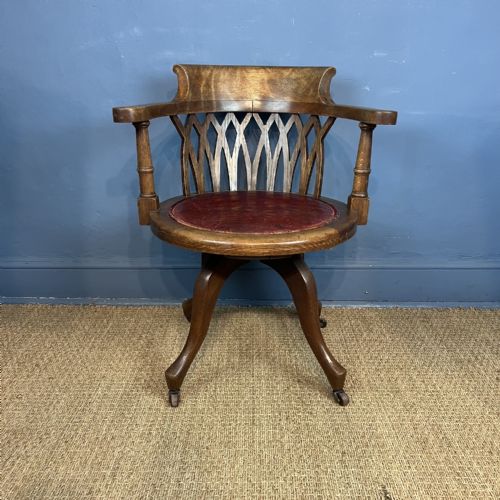
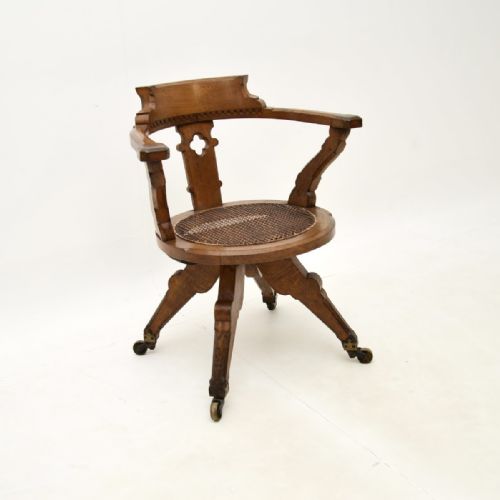


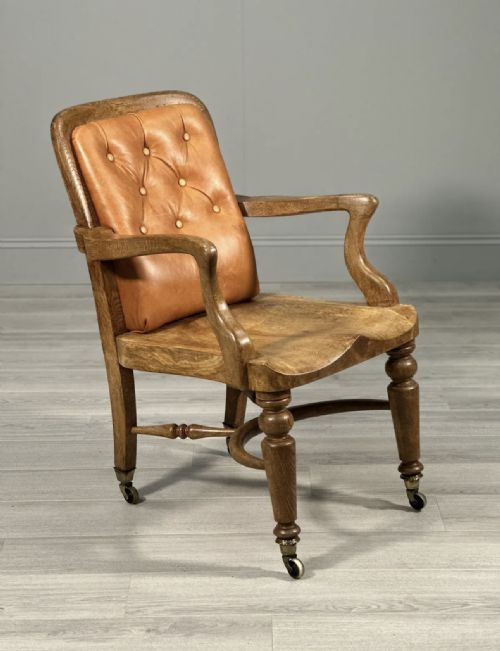
Victorian Oak Swivel Chair
A victorian oak swivel chair brings sturdy timber and practical rotation to a study, built to turn smoothly through long hours at a desk.
Victorian Oak Swivel Chair
A victorian oak swivel chair functions primarily as a desk chair, library armchair or captain's chair designed for heavy daily use.
Most examples found here date from the late nineteenth century, spanning standard office seating to more elaborate library armchairs.
Makers produced these revolving seats in various regional interpretations, including maritime variants meant for use on ships and specific Gothic revival designs.
Materials and construction
Carpenters shaped solid oak into robust frames, often adding deep carvings or turned spindles depending on the prevailing style.
Mechanism engineering relied upon cast iron and brass to provide the revolving action and height adjustment.
Seats and backs frequently integrated leather, cane or fabric upholstery fixed with brass tacks.
Listings demonstrate a strong presence of oak alongside brass and cast iron, spanning standard office seating to carved ship chairs.
Judging the build
Quality rests in the stability of the revolving mechanism and the integrity of the solid timber frame.
Superior pieces display crisp carving, thoughtful joinery and high-grade leather or brass fittings that have endured decades of turning.
S&H Jewell·P & O·Edward William Godwin·Hale & Kilburn
The Victorian Oak Swivel Chair Glossary
- Revolving
- Turning round on an axis or pivot. This action allows the sitter to rotate freely without moving the base.
- Captain's chair
- A sturdy wooden armchair with a low back and steam-bent arms. These seats offer robust support for prolonged writing or reading.
- Gothic Revival
- An architectural and decorative style drawing on medieval forms. Such pieces exhibit pointed arches, heavy carving and quatrefoil motifs.
- Cast iron
- A hard, brittle alloy of iron and carbon poured into moulds. This material forms the heavy underpinnings and mechanical swivel parts.
- Aesthetic Movement
- A late nineteenth-century design focus on artistic value over moral narrative. Pieces in this style show simpler lines and refined proportions.
Victorian Oak Swivel Chair: Frequently Asked Questions
How do I adjust the height?
Many of these chairs utilise a threaded spindle mechanism beneath the seat. Turning the seat clockwise or anti-clockwise raises or lowers the wooden platform.
Heavier cast iron and brass assemblies beneath the frame hold the adjustment firmly once set.
Were these used in offices?
Banks, law courts and merchant offices utilised these revolving seats extensively during the nineteenth century. The swivel action allowed clerks to reach different ledgers without standing.
Domestic libraries and ship cabins also housed these robust armchairs.
How do I distinguish Gothic Revival examples?
Gothic Revival pieces display pointed arches, heavy relief carving and architectural mouldings drawn from medieval stonework. The oak timber is often darker and more substantial. 柏 Plain office variants prioritize simple spindles and smooth curves over ornamentation.
Are the swivel mechanisms robust?
The cast iron and brass underpinnings engineered during this period were built for heavy daily labour. Most mechanisms survive in working order.
Regular gentle lubrication keeps the central screw and iron plates turning smoothly.