




Leather Swivel Arm Chair
A leather swivel arm chair offers practical rotation and sturdy seating, bringing period character directly to a workspace.
Leather Swivel Arm Chair
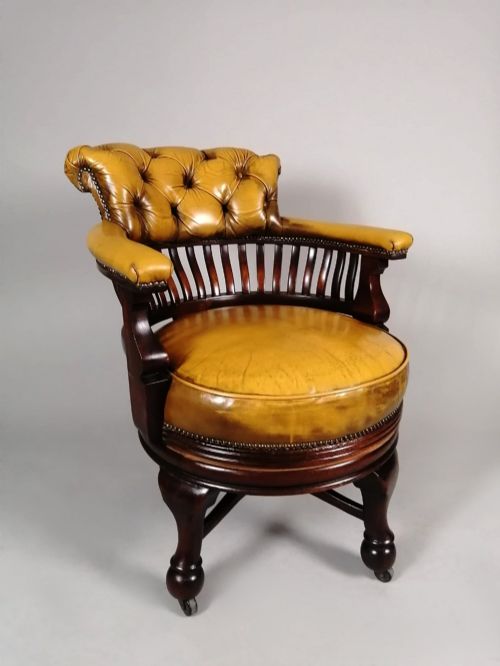
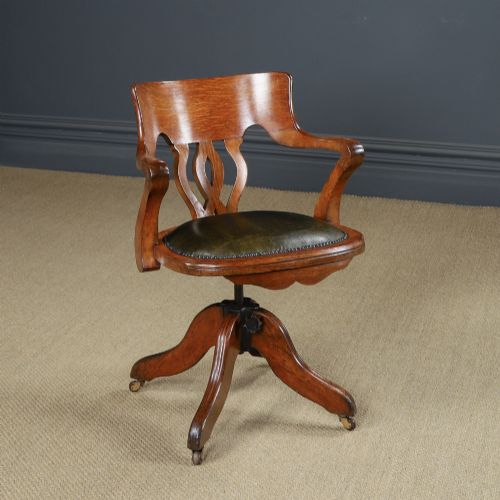
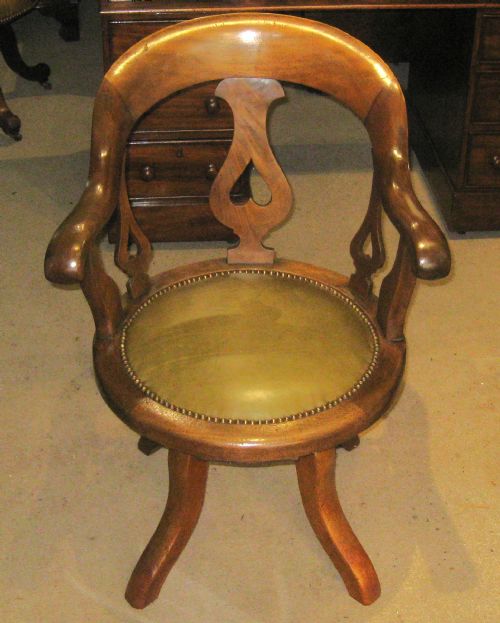
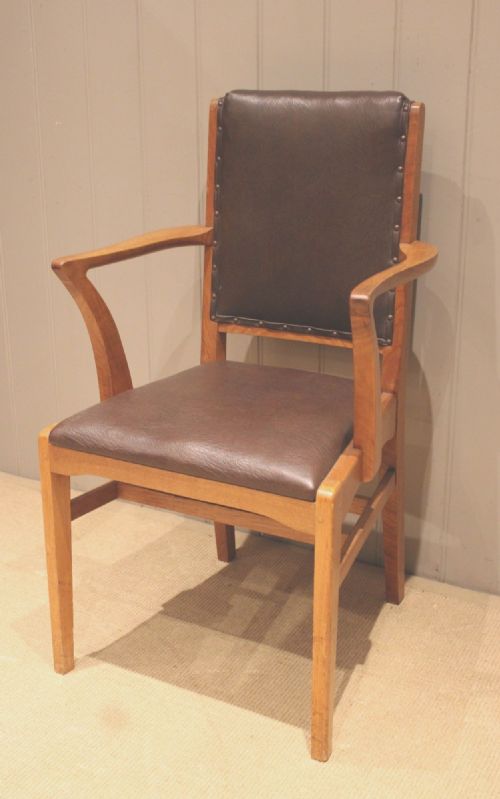
A leather swivel arm chair is typically found as a desk chair, revolving office chair, or captain's chair designed for working at a library table or partner's desk. The examples seen here predominantly date from the Victorian, Edwardian, and early twentieth-century periods, spanning from the late nineteenth century through to the 1920s.
Most pieces combine a timber frame with a rotating mechanism and a upholstered leather seat or backrest. Desk chairs and revolving office armchairs form the bulk of the selection, reflecting their original purpose in professional offices and domestic studies.
How They Were Made
Frames rely on solid hardwoods such as oak, mahogany, and teak, shaped through standard cabinet-making techniques and sometimes enhanced with bentwood or heavy carving. Metal components, including iron, cast iron, and brass, form the adjustable swivel mechanisms that allow the chairs to rotate and tilt.
Upholstery consists of durable leather stretched over padding, often secured with brass studs along the borders. Woods are finished to highlight their natural grain, while structural joints are engineered to withstand the continuous motion of a revolving seat.
One remarkably enthusiastic maker produced a heavily carved fully rotating oak ship's chair for life on the rolling waves.
What Varies in Quality
The refinement of the timber frame and the complexity of the carving distinguish standard utilitarian seating from finer office chairs. Mahogany and heavily carved oak examples often show a higher level of craftsmanship in the turnings and joinery than plain utility models.
The sophistication of the swivel and tilting mechanism dictates the mechanical quality of the piece. Robust iron and brass assemblies that maintain a smooth rotation and secure height adjustment represent better construction than simpler, stiffer pivots.
S&H Jewell·WM Heywood Chair Co·Maple & Co
The Leather Swivel Arm Chair Glossary
- Revolving
- A seat construction that allows the upper portion of the chair to rotate fully on a central spindle. This movement relies on an undercarriage fitted with metal bearings or iron pivots.
- Captain's Chair
- A sturdy armchair traditionally used in offices or ships, featuring a rounded wooden back rail supported by spindles. In later iterations, this form was adapted to include a swivel base and a leather-upholstered seat.
- Bentwood
- Wood that has been softened by steam and bent into curved structural forms. This technique created the rounded framework seen on specific Victorian swivel chairs.
- Anglo-Indian Colonial
- A distinctive style of furniture manufactured in India during the British rule, frequently utilising native timbers such as teak. These pieces often incorporate deep carvings and specialised forms like planter's chairs.
- Gothic Revival
- An architectural and decorative style drawing on medieval motifs, visible in the pointed arches and heavy ornamentation applied to certain Victorian chairs.
Leather Swivel Arm Chair: Frequently Asked Questions
What periods do these chairs date from?
The pieces span from the late nineteenth century through to the 1920s, covering the Victorian, Edwardian, and George V eras.
Most examples originate between 1880 and 1920, reflecting the height of traditional office and library seating design.
How do you adjust the height on them?
Adjustment mechanisms typically involve a central threaded iron or steel spindle beneath the seat. Turning the chair allows the upper section to rise or lower on the screw.
Some later twentieth-century variants incorporate tilting actions alongside the standard swivel rotation for added flexibility.
Were they used only in offices?
While primarily designed as desk chairs for offices, studies, and libraries, they were also utilised in domestic spaces. Captain's chairs and revolving armchairs served readers and professionals alike.
Certain forms, such as planter's chairs, indicate specialised usage in colonial settings.
What timbers were commonly used?
Oak and mahogany appear most frequently across the selection, providing the structural strength required for a revolving office chair. Teak and beech are also present in specific regional or period pieces.
Metal components like brass and cast iron were integrated into the undercarriages to support the weight and movement.